

Editor's PiCK
"Insufficient Preparation for Virtual Asset Taxation" vs "Coins Should Be Taxed as a Money Game"... Ongoing Conflict Over Virtual Asset Taxation [Issue]
공유하기
- The ongoing controversy over virtual asset taxation raises concerns about potential harm to investors.
- The Justice Party emphasized the principle of "where there is income, there is tax" and urged for virtual asset taxation.
- The ruling party maintains a stance of deferral, citing insufficient preparation for virtual asset taxation.
- The article was summarized using an artificial intelligence-based language model.
- Due to the nature of the technology, key content in the text may be excluded or different from the facts.
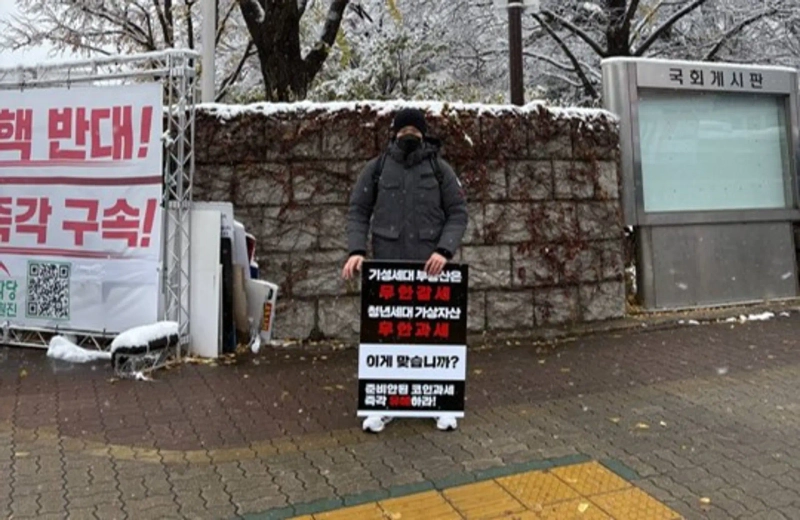
Virtual asset influencer Bulgaemi Crypto is holding a one-person protest in front of the National Assembly Building on the 27th. Photo provided by Bulgaemi Crypto
The debate over virtual asset (cryptocurrency) taxation is heating up.
On the 27th, there was a one-person protest against virtual asset taxation at the main gate of the National Assembly Building. Introducing himself under the pseudonym Bulgaemi Crypto (hereafter referred to as Bulgaemi), he said, "I thought that with the news of the planned abolition of the Financial Investment Income Tax (FIT), the coin tax would naturally be postponed as well, but the situation is unfolding differently than expected." He continued, "I studied a lot about virtual asset taxation for the protest and came to the conclusion that it is a law that should not be implemented, so I took to the streets."
Conversely, at 10 a.m. on the same day, a press conference urging virtual asset taxation was held at the same location. The Justice Party held a press conference at the main gate of the National Assembly Building, stating, "Since the emergence of new assets called virtual assets several years ago, we have been working to create a plan where there is income, there is tax," and criticized, "However, the political sphere keeps postponing it."
Lee Baek-yun, the leader of the Labor Party, who jointly held the press conference, also argued, "If the deduction limit is raised to 50 million won, most investors will be excluded from taxation," and "Insufficient preparation is not a justification for tax deferral." He continued, "Virtual asset investment is a typical unearned income, and coin investment is purely a money game," and argued, "Isn't it wrong to tax earned income without exception but not tax virtual assets?"

Photo provided by the Justice Party
Respect for the Opinion "Where There is Income, There is Tax," but Insufficient Preparation...
It seems that only virtual asset investors are being harmed by the political strife surrounding virtual asset taxation. Bulgaemi said, "The topic of virtual asset taxation has become a political issue with the opposition and ruling parties clashing," and "Virtual asset investors only wish for reasonable virtual asset taxation, not such political strife."
He also agreed with the principle of "where there is income, there is tax," but appealed, "Every tax obligation should have clear tax items, guidelines, and infrastructure specified in the law as a prerequisite. Don't just demand taxes without preparation."
Bulgaemi pointed out the current issues with the virtual asset taxation plan as ▲ the absence of loss carryforward deductions, ▲ equity issues with the FIT, ▲ the risk of increased health insurance premiums due to classification as other income, and ▲ the burden of proof of taxation on investors. He warned, "Virtual asset investors are not unconditionally opposing the Democratic Party. However, if the problematic virtual asset taxation is forcibly implemented, they will surely hold them accountable in the upcoming election."
When Will the Decision on the Deferral of Virtual Asset Taxation Be Made?

National Assembly Building / Photo by Son Min, Bloomingbit Reporter
However, despite the protests and press conferences, discussions on virtual asset taxation continue to be postponed. This is because the opposition and ruling parties are unable to narrow their differences on virtual asset taxation.
The opposition party insists on raising the deduction limit from 2.5 million won to 50 million won and implementing virtual asset taxation from the originally scheduled date of January 1. Jin Sung-joon, the policy chairman of the Democratic Party, said, "Taxation on virtual assets, which are unrelated to the real economy, is different from the Financial Investment Income Tax (FIT). It must be implemented for legal stability and predictability," and "Coins are unrelated to the real economy. The party's position is to significantly raise the deduction limit to 50 million won to reduce the tax burden."
On the other hand, the government and the ruling party argue that virtual asset taxation should be viewed the same as the FIT. Han Dong-hoon, the leader of the People Power Party, explained, "The younger generation now has fewer opportunities for asset formation and social mobility. We need to quickly decide on virtual asset taxation and recognize virtual asset investment as a new tool for asset formation," and "Fundamentally, we are not ready to implement fair taxation on virtual assets. We intend to actively pursue the deferral of virtual asset taxation."
Meanwhile, the Planning and Finance Committee's general meeting scheduled for today was once again disrupted, further delaying discussions on virtual asset taxation. If November 30 passes, the issue will be automatically referred to the plenary session, and the Planning and Finance Committee will no longer be able to discuss the virtual asset taxation issue.