

Lee Jae-myung to hold summit with Trump on the 25th…business leaders and economic delegation to accompany him
공유하기
- The two presidents will consult on measures to strengthen economic cooperation and an economic security partnership, including manufacturing sectors such as semiconductors, batteries, and shipbuilding, based on the tariff agreement reached at the end of last month.
- An economic delegation, including business leaders, is also expected to accompany this visit to the United States.
- President Trump said after the Korea-U.S. tariff agreement that an additional investment amount would be announced when President Lee visits the White House.
- The article was summarized using an artificial intelligence-based language model.
- Due to the nature of the technology, key content in the text may be excluded or different from the facts.
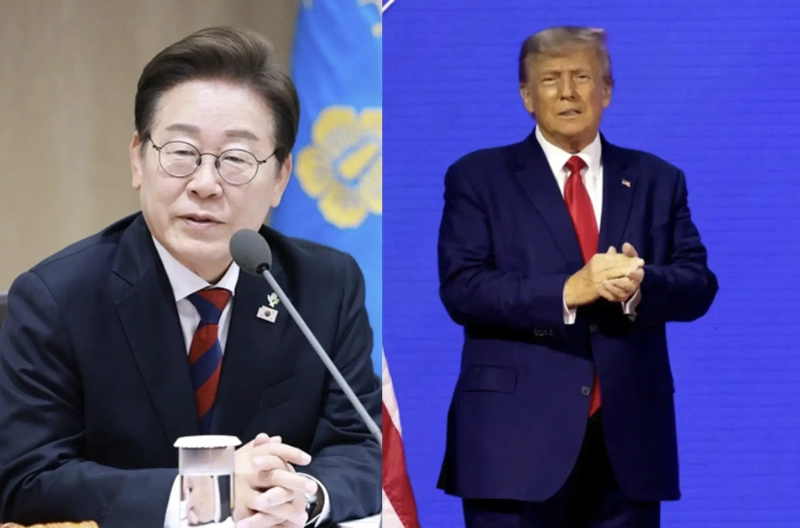
President Lee Jae-myung will hold a South Korea–U.S. summit with U.S. President Donald Trump in Washington, D.C. on the 25th. The meeting will take place 82 days after President Lee took office.
Kang Yoo-jung, a spokesperson for the Blue House, said at a briefing on the 12th, "President Lee will visit the United States from the 24th to the 26th at the invitation of President Trump." Kang said, "The two leaders plan to discuss ways to develop the Korea-U.S. alliance into a 'future-oriented comprehensive strategic alliance' in response to changing international security and economic environments," and added, "While strengthening a robust Korea-U.S. combined defense posture, they will also discuss measures to build peace on the Korean Peninsula and cooperate on denuclearization."
The two presidents are also scheduled to consult on measures to strengthen economic cooperation and an economic security partnership, including manufacturing sectors such as semiconductors, batteries, and shipbuilding, based on the tariff agreement reached at the end of last month. This visit to the United States is characterized as a 'working visit.' Unlike a state visit or official visit, the presidential office explained that this visit is focused on in-depth consultations between the leaders on agenda items of mutual interest without a welcoming ceremony. The presidential office said it will announce details of the summit and working lunch with President Trump at the White House and other schedules as they are finalized.
An economic delegation including business leaders is also expected to accompany the president on this trip. It is likely to include the heads of the four major conglomerates — Lee Jae-yong, chairman of Samsung Electronics; Chey Tae-won, chairman of SK Group (and chairman of the Korea Chamber of Commerce and Industry); Chung Eui-sun, chairman of Hyundai Motor Group; and Koo Kwang-mo, chairman of LG Group — as well as Kim Dong-kwan, vice chairman of Hanwha Group; Jung Ki-sun, chief vice chairman of HD Hyundai Group; and Ryu Jin, chairman of the Korea Economic Association. These business leaders, who are active in the United States, also engaged in behind-the-scenes communication with U.S. political and business circles to secure the tariff agreement.
President Lee is highly likely to visit the Hanwha Philadelphia shipyard acquired by Hanwha Group. Kang said, "(A visit to the shipyard) is predicted to be quite possible." The Hanwha Philadelphia shipyard is regarded as the frontline base of the MASGA (Make American Shipbuilding Great Again) project, which played a decisive role in the tariff negotiations. On the 30th of last month, just before President Trump was to sign the tariff agreement, dozens of high-ranking U.S. government officials visited the shipyard, including John Pellen, U.S. Secretary of the Navy, and Russell Boat, director of the White House Office of Management and Budget.
After the tariff agreement was reached at the end of last month, President Trump posted on social media, "When President Lee visits the White House within two weeks for a bilateral meeting, an additional investment amount will be announced." However, given the volume of outstanding issues between the two leaders, the meeting date was agreed to be the 25th. Some analysts say that President Trump's mention of "within two weeks" is political rhetoric he commonly uses and should not be given too much weight. The New York Times reported that "two weeks is President Trump's favorite unit of time." Kang said, "It is hard to see President Trump's 'within two weeks' as a precise deadline; it can be viewed as a date that was set during practical coordination."
The Blue House, the Foreign Ministry, and the Ministry of Trade, Industry and Energy are reportedly selecting the agenda items to be put on the Korea-U.S. summit table and preparing response plans for various scenarios. On the negotiation table, modernization of the Korea-U.S. alliance, including adjustments to the role of U.S. Forces Korea, is expected to be a primary topic. Elbridge Colby, Deputy Assistant Secretary of Defense for Policy, and J.B. Branson, commander of U.S. Forces Korea, have repeatedly suggested the possibility of reducing U.S. forces in Korea. Given President Trump's tendency for off-the-cuff remarks, he may demand immediate additional openings for agricultural and livestock products such as beef and rice during the meeting.
According to Kyodo News and other outlets, President Lee may stop in Japan before visiting the United States to hold a South Korea-Japan summit with Prime Minister Shigeru Ishiba. Kang said, "We are examining various possibilities with a shared view that, for example, resuming shuttle diplomacy and other mutual understandings could create opportunities for a leaders' meeting."
Kim Hyung-kyu reporter khk@hankyung.com




![2025-12-24 [Javis] 'PICK News Image5 Reporter Taek'](https://media.bloomingbit.io/static/news/brief_en.webp?w=250)