222
Summary
- Starting this year, CARF, the Crypto-Asset Reporting Framework, will strengthen information collection and customer due diligence and data-collection procedures, tightening oversight of crypto-asset service providers.
- From next year, the automatic exchange of information between jurisdictions will expand, bringing overseas exchanges, transaction information of South Korean residents, and the South Korean tax authorities’ line of sight further into focus, potentially increasing risks for overseas-linked investors.
- In particular, it noted that preparations are needed from a risk-management perspective as high-net-worth investors, the obligation to report when balances at overseas crypto-asset service provider accounts exceed KRW 500 million, and organizing documentation on asset sources and transfer routes become more important.
Forecast Trend Report by Period


International standardization of crypto-asset transaction information enters the data-collection phase this year
Overseas assets also come into tax authorities’ line of sight…automatic exchange of information begins next year
Limited impact for most domestic investors…high-net-worth and overseas-linked investors need to prepare
The key is organizing supporting documents…you must be able to explain fund flows
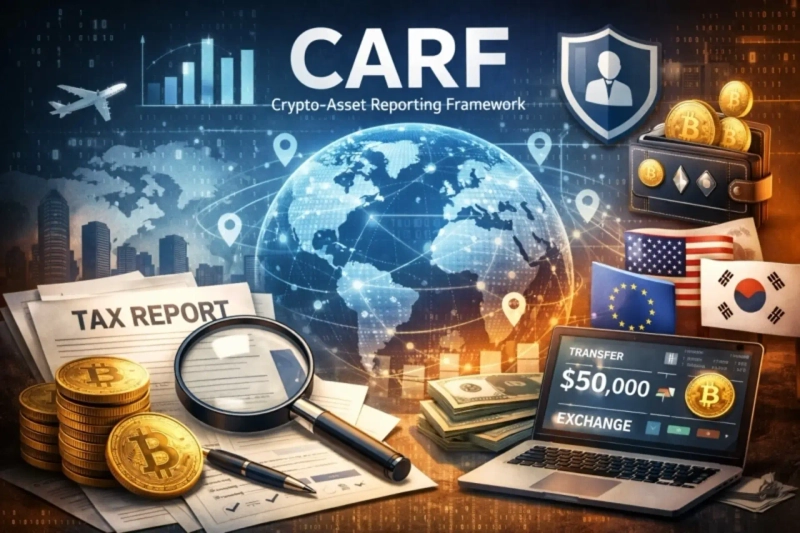
A major wave—“global standardization of tax information”—is reaching South Korea’s crypto-asset market as well. With the Crypto-Asset Reporting Framework (CARF) set to apply from the new year, customer due diligence and data-collection procedures at crypto-asset service providers such as exchanges are expected to become more rigorous.
According to the Organisation for Economic Co-operation and Development (OECD) and tax authorities on the 2nd (local time), major economies including South Korea will begin full-scale information collection for CARF implementation starting this year. CARF is an international standard under which jurisdictions standardize user information collected by businesses and automatically exchange, each year, transaction details of residents of partner jurisdictions. The South Korean government has been preparing to introduce the system since signing the Multilateral Competent Authority Agreement (MCAA) in 2023.
CARF is less a regime that immediately introduces new taxation than an “information infrastructure” designed to enable tax authorities to identify crypto-asset transactions and holdings with greater precision. Still, as the scope of information collection and exchange broadens, investors are increasingly seen as having clearer preparation requirements than before.
Crypto assets, like CRS…what exactly is CARF?
CARF is often called the “crypto version of CRS (Common Reporting Standard).” While CRS—centered on bank accounts—has enabled the automatic cross-border exchange of financial account information, CARF extends that scope to the crypto-asset domain. Given the nature of crypto assets traded over decentralized networks—an area difficult to capture within existing financial regulatory frameworks—the aim is to manage it in a standardized manner.
The reporting entities are “crypto-asset service providers” that broker transactions or execute asset transfers. They must report users’ identity information and certain types of crypto-asset transaction data to their competent tax authorities each year. They must report users’ identity information, along with certain types of crypto-asset transaction information, each year to their competent tax authorities.
Reportable transactions include exchanges with fiat currency, exchanges between crypto assets, and transfers of crypto assets. Notably, payment transactions for goods and services exceeding $50,000 are also reportable, bringing into scope not only investment trading but also the use of crypto assets as a means of payment.
The scope of reportable assets is also broad. Under OECD documentation, crypto assets encompass digital representations of value based on distributed ledger technology, and depending on structure and use, non-fungible tokens (NFTs) may also fall within the reporting perimeter. In other words, it is not limited to “coin investing.”
Data collection starts this year; automatic exchange begins next year
CARF implementation will be phased in. From January 1 this year, crypto-asset businesses in each jurisdiction will begin collecting user information and transaction data, and from January 1 next year, automatic exchange of information between jurisdictions will be ramped up in earnest. In other words, 2026 is the preparation phase in which information is accumulated, and 2027 is when that information begins moving across borders.
However, not all jurisdictions will participate at the same pace. While CARF-implementing jurisdictions numbered more than 70 countries and regions as of the end of last year, the actual start of information exchange may vary depending on the status of domestic legal and regulatory preparations. In some jurisdictions, the launch of exchanges could be delayed.
Jae-hyuk Lee, a partner at PwC Samil, explained, “For example, in the case of jurisdictions that joined CARF later, such as the United Arab Emirates (UAE), information sharing related to Binance users could begin only from 2028, meaning some exceptional delays may occur.”
Even so, over the long term, transaction histories of South Korean residents using overseas exchanges are also increasingly likely to come into the South Korean tax authorities’ line of sight. Through the concepts of a “reporting jurisdiction” and “reportable residents,” CARF is structured so that even foreign platforms can transmit transaction information on South Korean residents to South Korea.
Most Korean investors may feel little change…overseas-linked investors need to prepare
A significant portion of domestic investors have no overseas tax obligations and therefore may not be included as direct reporting targets. In such cases, the most tangible change is likely to remain at the level of stronger identity-verification procedures. Still, exchanges must verify and manage information such as tax residence and taxpayer identification number (TIN) through self-certification, and users must comply.
Partner Lee said, “South Korea has already been operating a data-collection system for tax purposes, so changes at the domestic system level are limited,” adding, “CARF essentially adds a standard to expand the existing system internationally and link it with overseas tax authorities.”
As such, investors who use only domestic exchanges may only need to comply with enhanced identity-verification procedures, but the situation differs for those who use overseas exchanges or have a history of residing abroad or multiple tax obligations. In particular, if past transaction records are not organized, they may be more likely to face requests for explanations after information exchange begins.
Prepare documentation on asset sources and transfer routes
In a CARF environment, the most important task for investors is “explainability.” As tax authorities gain access to overseas transaction histories, the key is whether one can logically explain how assets were acquired and the routes by which they moved.
Investors should first organize transaction records and asset transfer routes into a single flow. Aligning, in chronological order, inter-exchange transfers, personal wallet deposits and withdrawals, and the funding sources of KRW deposit accounts will make it easier to respond to future requests for clarification. They should also review the possibility that tax residence could change due to overseas stays, immigration, employment, study abroad, and similar circumstances.
High-net-worth investors should also reconfirm their obligation to report overseas financial accounts. This is because if the balance of an account with an overseas crypto-asset service provider exceeds KRW 500 million even for a single day during the year, it becomes reportable. After CARF implementation, the likelihood that holdings on overseas exchanges will be shared automatically increases, meaning reporting risk could become a reality.
Lee said, “The biggest change after CARF implementation is not taxation itself, but the way tax authorities access information,” adding, “Since assets held on overseas exchanges and even historical transaction records could be automatically linked, it will be effectively essential to organize documents so you can explain sources of funds and transfer routes at any time.” He continued, “The larger the asset size and the higher the share of overseas exchange usage, the more advance organization is not a choice but preparation from a risk-management perspective.”
Young-min Lee, Bloomingbit reporter 20min@bloomingbit.io, Soo-hyun Lee, Bloomingbit reporter shlee@bloomingbit.io

영문프로필_tek기자
tek_win_chrome@bloomingbit.ioENG_hi! YS