"Bitcoin has already entered a bear market…the bottom is $56,000"
Summary
- Julio Moreno said Bitcoin has already entered a bear market as its price fell below the one-year moving average.
- Moreno said the bottom in this downcycle is $56,000–$60,000, implying a roughly 55% decline from the peak.
- Moreno said structural demand—such as from spot ETFs and institutional capital—has improved the market’s resilience and soundness compared with past cycles.
Forecast Trend Report by Period


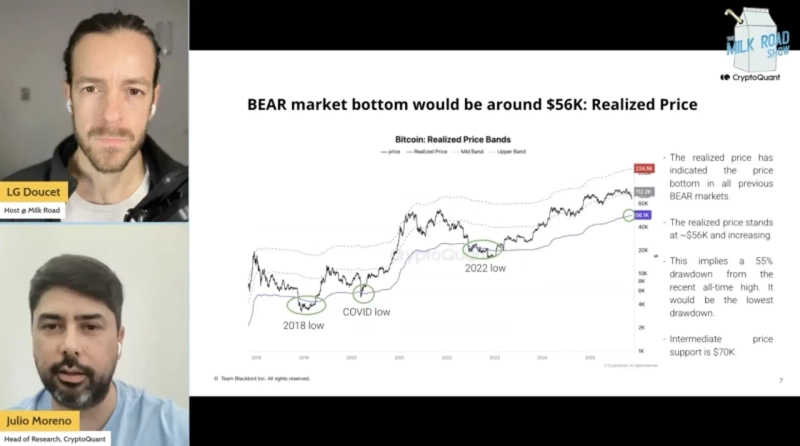
An analysis has been raised that Bitcoin already entered a bearish market about two months ago.
On the 1st (local time), Julio Moreno, head of research at CryptoQuant, appeared on the YouTube channel 'Milk Road' and said, "Bitcoin’s price has fallen below its one-year moving average (the 12-month average price)," adding that "this is a technical indicator that confirms entry into a bear market."
He further explained that "our proprietary 'bull market score' indicator, which aggregates network activity, investor profitability and liquidity, already turned bearish in early November last year and has yet to recover."
In fact, Bitcoin hit a record high of $126,199 on Oct. 1 last year, but later gave back its gains and ended the year below its price at the start of the year ($93,576). As of today, Bitcoin is trading around $88,700.
Moreno put the trough of this bear market in the $56,000 to $60,000 range. The estimate is based on the 'realized price' (the average cost basis of all Bitcoin holders). "Looking at past cases, in bear markets the price tends to fall to around the realized price," he said, adding that "this would be roughly a 55% drop from the peak, indicating relatively solid downside resilience compared with past downcycles that saw 70–80% collapses."
Still, the market’s structural soundness is seen as improved versus the past. That is because there are no major systemic risks such as the 2022 Terra-Luna debacle or FTX’s collapse, and institutional capital channeled through spot exchange-traded funds (ETFs) is supporting the market.
"In previous bear markets, demand contracted sharply, but now there is structural demand from institutions and ETFs that buy on a regular basis," Moreno added. "They are absorbing supply and reducing market volatility."

Bloomingbit Newsroom
news@bloomingbit.ioFor news reports, news@bloomingbit.io