Price Fluctuations
[For QA testing] Even a tariff ruling didn’t move the needle… ‘fear of uncertainty’ spreading across the crypto market
Summary
- It reported that even after a U.S. court ruling finding reciprocal tariffs unlawful, prices of bitcoin, ethereum and XRP have continued to fall, leaving the crypto market unable to recover.
- It said that President Trump’s warning of additional tariffs, rising tariff uncertainty and escalating geopolitical tensions are thinning crypto-market liquidity and strengthening risk-off sentiment.
- It reported that concerns over a lame duck period for the Trump administration and a potential drop in approval ratings are acting as political variables that could weaken momentum for crypto-policy initiatives and weigh on prices.
Forecast Trend Report by Period


The crypto-asset (cryptocurrency) market, which had plunged on the back of the U.S. reciprocal tariff measures, has failed to show a clear rebound even after a court ruling finding those tariffs unlawful. Analysts say the uncertainty created by the decision—and concerns over its political fallout—are instead weighing on the market.
As of 5 p.m. KST on the 25th, CoinMarketCap data show bitcoin (BTC), the bellwether crypto, trading at $65,208, down 4.85% from a week earlier. At the same time, ethereum (ETH) and XRP (XRP), leading altcoins, were also down 6.41% and 8.32% week-on-week, respectively.
In other words, market weakness is persisting even though the reciprocal tariffs were voided by an unlawful ruling.
On the 20th (local time), the U.S. Supreme Court ruled that the reciprocal tariff measures imposed by President Donald Trump’s administration since April last year, based on the International Emergency Economic Powers Act (IEEPA), were not lawful. The court’s rationale was that imposing large-scale tariffs without explicit congressional approval exceeds presidential authority.
The Trump administration has imposed steep tariffs on China, Canada and Mexico, among others, stoking risk-off sentiment across global financial markets. A notable example was on Oct. 10, when Trump declared on Truth Social that he would "impose an additional 100% reciprocal tariff on China," triggering mass liquidations of futures positions in the crypto market.
Yang Hyun-kyung, an analyst at iM Securities, said, "The Supreme Court ruling was something the market had anticipated to some extent," adding, "As a result, the invalidation of the tariffs was partly priced in even before the decision."
Tariff uncertainty widens... risk-off sentiment strengthens for risky assets
One reason the market has not taken the ruling as an unambiguous positive is the possibility of additional tariffs.
In fact, immediately after the Supreme Court decision, Trump signed a proclamation invoking Section 122 of the Trade Act to impose an additional 10% tariff on all exports to the United States worldwide. He then said on the 21st that he would raise the rate to as high as 15%.
In addition, the Trump administration is reportedly exploring further tariff mechanisms using Section 301 of the Trade Act and Section 232 of the Trade Expansion Act, among others. In a state-of-the-nation address held that day, Trump said, "The tariff threat is a measure to save the United States," adding, "A fully approved alternative is under review. Congressional action will not be necessary."
Some argue that the ruling has actually become a negative for the crypto market by amplifying uncertainty.
Ryan Lee, chief analyst at Bitget, said, "Risk-off sentiment is spreading through the market due to factors including tariff uncertainty and geopolitical tensions," adding, "This is thinning liquidity in the crypto market."
CoinDesk, a crypto-focused outlet, also said, "The crypto market is now tightly linked to macroeconomic news," adding, "Until tariff policy becomes clearer, it is likely to move in line with shifts in risk-asset sentiment."
Concerns over ‘lame duck’ risks for the Trump administration add to headwinds
The political fallout from tariffs is another variable. If President Trump’s political clout weakens—having positioned himself as "pro-crypto" since his days as a presidential candidate—it could affect momentum for crypto-related policy initiatives and, by extension, the market.
Yang said, "Given that President Trump has, to some extent, driven crypto policy, a drop in approval ratings could raise fears of an early lame-duck period (a loss of political leverage), which could weigh on prices."
In particular, with high inflation in the U.S. recently putting downward pressure on Trump’s approval ratings, some forecasts say a Republican loss to Democrats in the November midterm elections could accelerate lame-duck dynamics for the Trump administration.
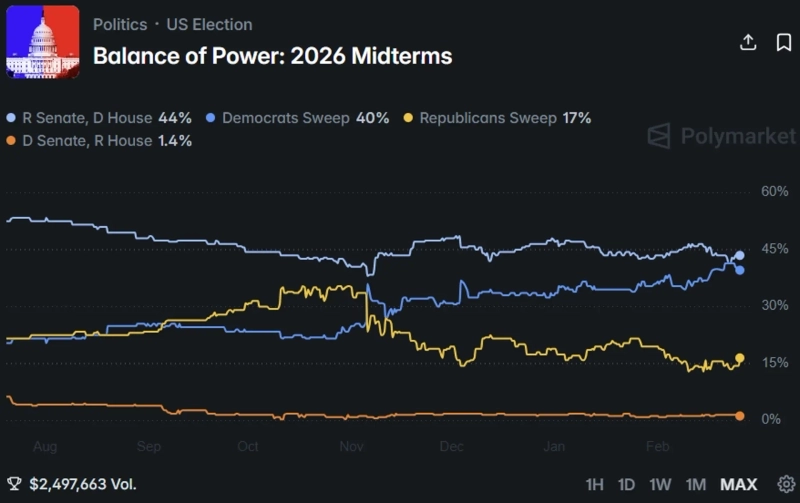
As of that day, decentralized prediction market Polymarket shows overseas bettors placing the probability that Democrats will take control of both the House and the Senate in the November U.S. midterm elections at 40%. By contrast, the probability that Republicans will control both chambers stands at a relatively low 17%.
The Wall Street Journal (WSJ) said, "This ruling will have broad spillover effects," adding, "It could deal a significant blow to President Trump, who has shored up his political standing through aggressive use of tariffs." In a recent Washington Post poll, 64% of respondents said they "do not support President Trump’s tariff policy."

Bloomingbit Newsroom
@newsFor news reports, news@bloomingbit.io