China’s View of US Shifts as Trump Returns to Beijing After Nine Years
Summary
- China put robots, drones and other forms of technological competitiveness at the center of President Trump’s visit, reflecting a mood that no longer sees the US only as a country to catch up with.
- In China, references to America’s decline are spreading, and some argue Trump’s tariff offensive accelerated China’s strategic self-reliance, signaling a shift in perceptions of the balance of power between the two countries.
- In Chinese diplomatic circles, some see President Trump’s transactional approach and the reduced pressure on China caused by the Iran war as an opportunity, while also saying US instability could weigh on China’s highly export-dependent economy.
Forecast Trend Report by Period


Trump Returns to Beijing for First Time in Nine Years
China Puts Tech Gains Ahead of the Forbidden City
New York Times Says China’s View of the US Has Changed
Interest in Studying in the US Also Loses Ground
China Watches Trump’s Deal-Making Diplomacy Closely
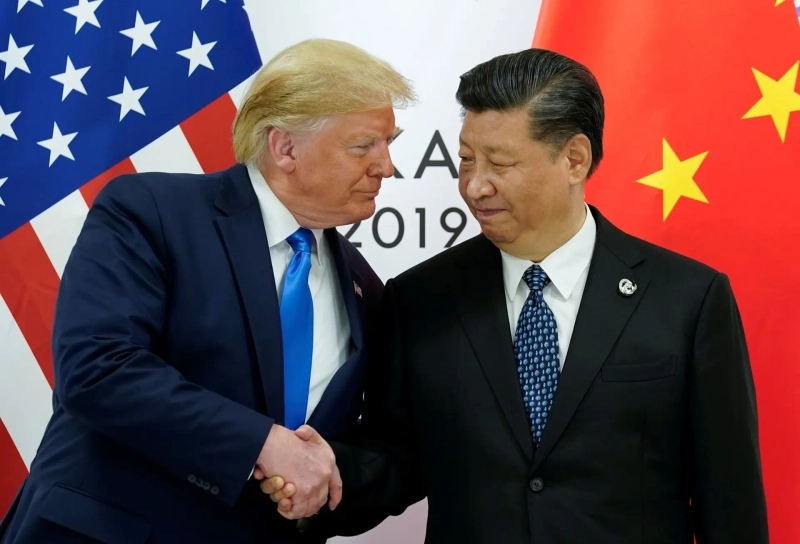
President Donald Trump’s return to Beijing for the first time in nine years has highlighted a broader shift in how China views the US, according to a New York Times analysis. When Trump first visited China in 2017, Beijing showcased the Forbidden City to underline its long history and status. This time, it is emphasizing technological advances such as robots and drones.
From the Forbidden City to Robots and Drones
The New York Times reported on May 12 that Trump’s latest visit to China offered a window into changing sentiment inside the country. When Trump first visited Beijing in December 2017, Chinese President Xi Jinping invited him to the Forbidden City for a private tour that lasted four hours.
At the time, China focused on presenting its long history and civilization. This visit carries a different message. Rather than foregrounding the legacy of an ancient empire, China is putting more emphasis on technological competitiveness represented by robots and drones.
The newspaper said China no longer sees Trump’s America only as a power it needs to catch up with. Trump’s unpredictable moves have also reduced some of the awe many Chinese once felt toward the US.
That change is also visible in Chinese domestic discourse. Mentions of “America’s decline” in mainstream Chinese political rhetoric have nearly doubled over the past year, the report said. A think tank affiliated with Renmin University in Beijing published a report earlier this year titled “Thank Trump.”
Some Chinese scholars say Trump’s tariff push and pressure on US allies have weakened American power while accelerating China’s drive for strategic self-reliance. Some have called Trump “an accelerator of the decline of American politics.”
Changing Attitudes Toward the US
Chinese perceptions of American-style democracy and US society have also shifted, the New York Times reported. An education consultant in northern China told the newspaper that 80% of students wanted to study in the US a decade ago, but the share has now fallen to 45%.
For students preparing to study abroad and their parents, the US is no longer the automatic first choice. Concerns have grown over turmoil in American society, including gun violence and political conflict.
Diplomatically, China is also viewing the Trump administration differently from former President Joe Biden’s administration. In Chinese foreign policy circles, some see Trump’s transactional approach as a potential opportunity compared with the Biden administration’s more systematic pressure campaign against China.
Wu Xinbo, a professor at Fudan University in Shanghai, said the Iran war has drawn US attention to the Middle East and reduced pressure on China. There is also speculation that Trump, ahead of the November midterm elections, may seek visible results such as agricultural purchase agreements and could be willing to compromise with China.
Still, China is not unconditionally welcoming US instability, the newspaper said. A decline in US influence could create openings for China, but unpredictable moves by Washington could also weigh on China’s export-dependent economy.
The New York Times said China is, for now, likely to avoid direct confrontation with the US and instead watch the Trump administration’s next steps.
Hong Min-seong, Hankyung.com reporter mshong@hankyung.com

Korea Economic Daily
hankyung@bloomingbit.ioThe Korea Economic Daily Global is a digital media where latest news on Korean companies, industries, and financial markets.