ZKsync Says Institutional Finance Needs Privacy, Interoperability Beyond Public and Private Chains
Summary
- Marco Cora said institutional finance needs infrastructure that delivers both privacy and interoperability for on-chain expansion.
- ZKsync said its zero-knowledge-proof-based Previdium structure enables both privacy and regulatory compliance while allowing interaction with networks such as Ethereum.
- He said infrastructure for tokenized deposits, stablecoins and real-time settlement is expanding, citing the US Cari project, the Middle East's ADI Chain, and Xsolla's on-chain settlement use case.
Forecast Trend Report by Period


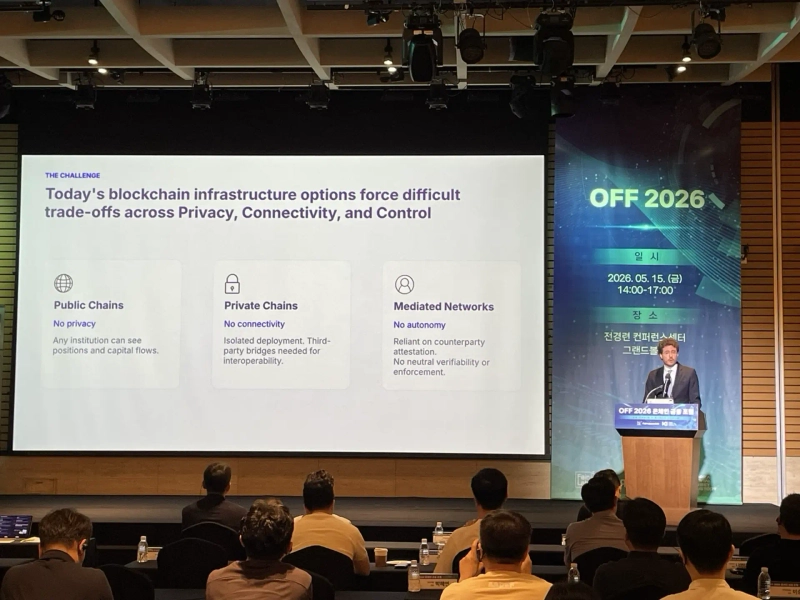
"Public chains have a transparency problem, while private chains face fragmentation. For institutional finance to expand on-chain, it needs new infrastructure that delivers both privacy and interoperability."
Marco Cora, head of the ZKsync Foundation, made the remarks on May 15 at OFF 2026, the On-chain Finance Forum 2026, held at FKI Tower in Seoul's Yeouido district.
Cora said demand for on-chain financial infrastructure is rising rapidly as markets for stablecoins and tokenized assets grow. Major financial institutions such as JPMorgan and PayPal are issuing their own digital currencies, while companies are expanding adoption of programmable money. That points to clear demand for digital assets that can move quickly, cheaply and globally.
He said current infrastructure still has limits for institutional adoption. On public blockchains, companies' transaction data can be exposed because of the networks' transparent design. Their permissionless structure also makes them harder to fit into regulatory frameworks.
Private chains, by contrast, can provide full control and security, but their limited connectivity between networks constrains scalability. Many Hyperledger-based private chains were built, yet actual operating use cases remained limited. Network fragmentation is a critical flaw for financial infrastructure, Cora said.
As an alternative, ZKsync presented a structure called Previdium. It uses zero-knowledge proofs, or ZKPs, to preserve privacy while establishing trust across networks.
"The data itself is not exposed externally. Only proof that the rules were followed is shared," Cora said. "That makes it possible to achieve privacy and regulatory compliance at the same time."
Under the structure, each institution can operate its own system independently while still interacting with others by recording proofs on a neutral layer such as Ethereum. The key is that data integrity can be secured without a separate intermediary.
Cora also introduced real-world use cases. In the US, the Cari project is building tokenized deposit infrastructure for interbank use, with initial participating banks holding about $700 billion in total assets. If the project expands to 50 to 60 banks, that figure could exceed $7 trillion.
In the Middle East, Abu Dhabi-based ADI Chain is building infrastructure for a dirham stablecoin and expanding into global payments and asset management. Xsolla is also pursuing an on-chain settlement structure aimed at cutting payment processing times from several days to seconds.
"Legacy financial systems are marked by settlement delays and high costs," Cora said. "On-chain infrastructure can shift that to a real-time settlement model, reducing costs and improving efficiency at the same time."
He added that the issue is not simply adopting blockchain, but designing infrastructure that meets institutions' requirements for privacy, regulation and interoperability. Such a structure will become the standard for the future financial system, he said.
