PiCK
Institutional Era Opens for Digital Assets as Market Center Shifts: EastPoint:Seoul 2026
Summary
- EastPoint:Seoul 2026 said it will spotlight the trend toward institutionalization under the banner of The Institutional Unlock as one of its key themes.
- It said digital assets are being incorporated into mainstream finance following U.S. approval of spot Bitcoin ETFs and debate over the CLARITY Act, while South Korea has expanded discussions on won-denominated stablecoins and security token offerings (STOs).
- It said the digital-asset market's center of gravity is shifting from exchanges to banks, securities firms, asset managers and payment networks, with future competition hinging on the ability to connect institutional capital with global financial networks.
Forecast Trend Report by Period


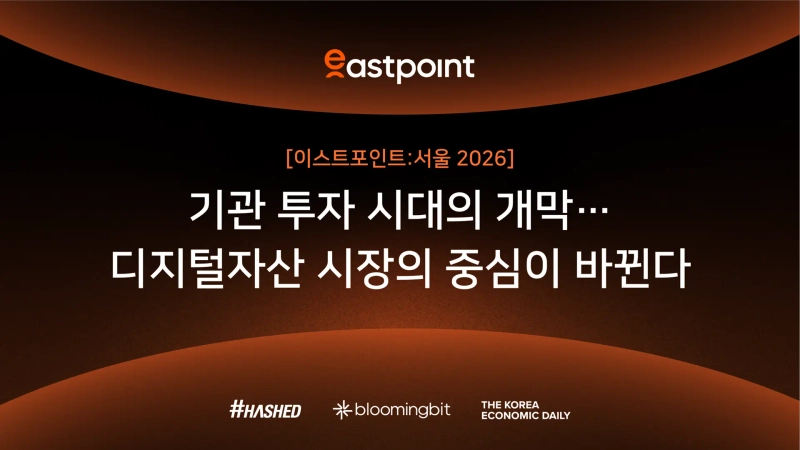
[Editor's note] The digital-asset industry is no longer confined to a market centered on exchanges and tokens. Institutional capital, stablecoins, tokenized capital markets and artificial intelligence infrastructure are becoming increasingly interconnected, reshaping the industry's structure. EastPoint:Seoul 2026 aims to serve as a new type of global platform linking finance, policy, big tech, AI and the blockchain industry amid that shift.
The digital-asset market is undergoing a structural shift. EastPoint:Seoul 2026 has chosen "The Institutional Unlock" as one of its key themes this year. The event will focus on the emergence of South Korea's institutional capital market and the broader global trend of institutional adoption. A market that grew around retail investors and exchanges is now seeing full-scale entry by banks, securities firms, asset managers, insurers and global investment institutions. The industry views that as more than simple market expansion. It marks the start of institutionalization.
The shift began in the U.S. After the Securities and Exchange Commission approved spot Bitcoin exchange-traded funds in 2024, global asset managers including BlackRock, Fidelity and Franklin Templeton entered the market. Digital assets began to be incorporated as a new institutional asset class. Bitcoin, once seen as a volatile speculative market, is now entering the portfolios of pension funds and asset managers.
Institutions are entering the market for reasons that go beyond betting on a rise in Bitcoin prices. Applying blockchain to traditional financial products can significantly reduce the processes involved in trading, clearing and settlement. It can also lower intermediary costs. More recently, institutions have been accelerating the on-chain migration of traditional financial assets including private credit, government bonds, real estate and commodities.
The regulatory environment is also changing quickly. In the U.S., discussions have continued around the CLARITY Act, legislation intended to provide clearer market structure for digital assets. The bill is designed to define regulatory jurisdiction and standards for determining whether a digital asset qualifies as a security. In the industry's view, that shows the U.S. is moving quickly to build the institutional framework needed to attract institutional capital.
South Korea has also joined the shift. In the financial sector, discussions on won-denominated stablecoins and the institutionalization of digital assets are expanding rapidly. The securities industry is preparing to take an early lead in security token offerings and tokenized assets. Banks are also reviewing opportunities in digital-asset custody and payment infrastructure. Financial institutions that approached the sector cautiously just a few years ago have now moved to asking how they should enter it.
EastPoint:Seoul 2025, held last year, symbolized that trend. The event was co-hosted by Hashed, Bloomingbit and the Korea Economic Daily. Major banks including KB Kookmin Bank, Shinhan Bank, Hana Bank and Woori Bank took part, along with domestic financial institutions such as NH Investment & Securities, Shinhan Securities, Hana Securities and Meritz Securities. Global names including Mastercard, PayPal Ventures, Temasek, SMBC Nikko Securities and Anchorage Digital also participated, highlighting strong interest in the South Korean market.
Companies are also moving faster. Fintech firms including Kakao Pay, Naver Pay and Toss have joined the race to build next-generation digital payment infrastructure. Retail and logistics companies are also watching stablecoin-based global settlement systems. Shopify, the global e-commerce platform, is expanding USDC payments, while the logistics industry continues blockchain experiments aimed at improving supply-chain management and trade-finance efficiency.
EastPoint:Seoul 2026 goes a step further. "The Institutional Unlock," one of this year's key themes, goes beyond the stage where financial institutions simply invest in virtual assets. It will focus in earnest on the process of integrating digital assets into the mainstream financial system. As the boundary between traditional finance and the digital-asset industry begins to break down, institutional capital is emerging as a key force reshaping market structure.
Ultimately, the digital-asset industry's decisive battleground may be institutional financial infrastructure. In other words, the market's center of gravity is shifting from exchanges to banks, securities firms, asset managers and payment networks. Some in the market argue that the next phase of competition will depend not on which company can issue more tokens, but on who can connect institutional capital with global financial networks.
Against that backdrop, EastPoint:Seoul 2026 will serve as a platform linking financial institutions, policy bodies, big tech and global Web3 companies. The digital-asset industry is no longer just a crypto market. It is expanding into a contest over global capital markets and financial infrastructure. "The Institutional Unlock" is expected to emerge as a key phrase marking the start of that shift.
EastPoint:Seoul 2026 will be held on Sept. 28 at the Westin Josun Seoul Parnas. Unlike traditional blockchain conferences, EastPoint will operate on a dual-track structure combining a main stage with private roundtables.
