Fear Over Samsung Electronics, SK Hynix Selloff May Be a Chance to Add Exposure
Summary
- Experts said that despite the Kospi index plunge, this is not a broad market downturn, and that fundamentals centered on AI and semiconductors remain intact.
- Research chiefs said a volatile market could persist for some time due to rising US interest rates, concerns over returns on AI investment, and foreign investors' net selling.
- Experts said they see the 7,000 level on the Kospi as support and advised staggered buying focused on high-quality stocks, adding that increasing exposure to market leaders could be an opportunity.
Forecast Trend Report by Period


Brokerage research chiefs
Offer an emergency read on the Kospi slump
"Not a full-blown bear market, but the Kospi could fall toward 7,000"
Rising US rates and AI investment worries seen as main triggers
Volatility expected to persist for now
Semiconductor fundamentals remain intact
Staggered buying favored over panic selling

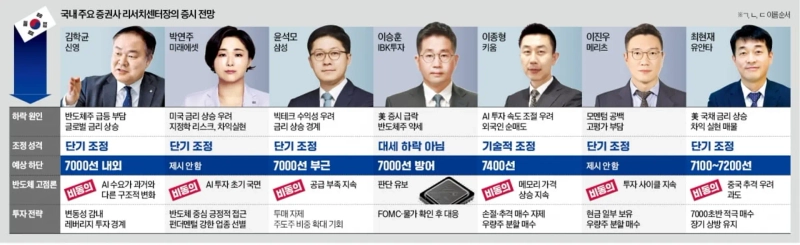
Brokerage research heads in Seoul largely do not view the Kospi's sharp drop on June 8 as the start of a sustained bear market. They argue that earnings fundamentals tied to artificial intelligence and semiconductors remain solid. In an emergency survey of eight research chiefs at major securities firms conducted by the Korea Economic Daily that day, respondents broadly agreed the market is not entering a structural downtrend. They added that volatility could persist for some time as uncertainty lingers over the Federal Open Market Committee, inflation data and questions about returns on AI investment.
◇ Rising US rates and AI spending worries hit sentiment
Research chiefs cited higher US interest rates and concerns over AI-related investment as the immediate causes of the recent correction. Park Yeon-joo, head of research at Mirae Asset Securities, said stronger-than-expected US jobs data had revived concern about further rate increases and prompted broader profit-taking after the recent rally. Kim Hak-gyun, head of research at Shinyoung Securities, attributed the decline to valuation pressure after a sharp short-term run-up in semiconductor shares and worries about rising global borrowing costs.
A shift in sentiment around AI investment also shook the market. Concerns have spread that expanding AI spending could hurt profitability after the possibility emerged that US big tech companies such as Alphabet and Meta may raise large amounts of capital. Broadcom's conservative guidance also cooled investor sentiment. Lee Jong-hyung, head of research at Kiwoom Securities, said Broadcom posted stronger-than-expected revenue but did not lift guidance for AI semiconductors. That fueled concern that big tech companies may slow the pace of AI investment. A 20-session foreign selling streak added to the market's losses, he said.
◇ "The AI cycle isn't over"
Experts stopped short of reading the selloff as the start of a broader bear market. Their central argument is that the AI investment cycle and the semiconductor industry outlook remain intact. Kim said sharp pullbacks can happen even in a bull market and there is still no sign the semiconductor upcycle is structurally weakening.
Lee Jin-woo, head of research at Meritz Securities, said neither the AI investment cycle nor the earnings outlook has broken down. That makes it difficult to interpret the current correction as a trend decline.
Lee Seung-hoon, head of research at IBK Investment & Securities, said last week's sharp drop in US stocks was the immediate trigger, but the move also reflected an overlap of short-term negatives including rates, inflation and a potential SpaceX listing. He expects many of those headwinds to ease during June.
Research chiefs said the chance of a full-fledged bear market remains low, though they cautioned that volatility could intensify in the near term. Choi Hyun-jae, head of research at Yuanta Securities Korea, said investors need to see the dot plot and the Fed's growth and inflation projections before the market's direction becomes clearer. Lee Jong-hyung said the volatile phase is unlikely to end within a day or two. The market may remain sensitive until the outline of second-quarter earnings comes into view.
Many of the analysts pointed to around 7,000 on the Kospi as a likely support level. Yoon said that, based on the maximum drawdowns seen during the US-China tariff war and the conflict in the Middle East, the index could find a short-term bottom near 7,000.
◇ "Avoid indiscriminate chase buying"
On investment strategy, many advised against panic-driven selling. Rather than rush to buy dips, they recommended keeping some cash on hand and building positions in stages. Yoon said the correction could offer an opportunity for investors who had not sufficiently raised exposure to market leaders. Lee Jong-hyung said investors should avoid both fear-driven stop-loss selling and indiscriminate chase buying. Long-term investors should stick to a staggered buying strategy focused on high-quality stocks.
Jeon Ye-jin, Jo A-ra and Oh Hyun-a

Korea Economic Daily
hankyung@bloomingbit.ioThe Korea Economic Daily Global is a digital media where latest news on Korean companies, industries, and financial markets.