Won Briefly Tops 1,550 Per Dollar, Matching Global Financial Crisis Levels
Summary
- The won-dollar rate broke above 1,550 won, reaching its highest level since the global financial crisis, and authorities said they would respond forcefully.
- Brokerages said net foreign selling of stocks, a strong dollar, and uncertainty over the Middle East conflict were the main drivers behind the exchange-rate surge.
- They said upcoming events including the ECB, BOJ, FOMC and MSCI review, along with whether foreign outflows ease, will be the key variables for exchange-rate stability.
Forecast Trend Report by Period


Won-dollar rate breaks above 1,550
Highest since the global financial crisis
FX authorities step up verbal intervention
"Middle East risks must ease, and foreign outflows need to slow"
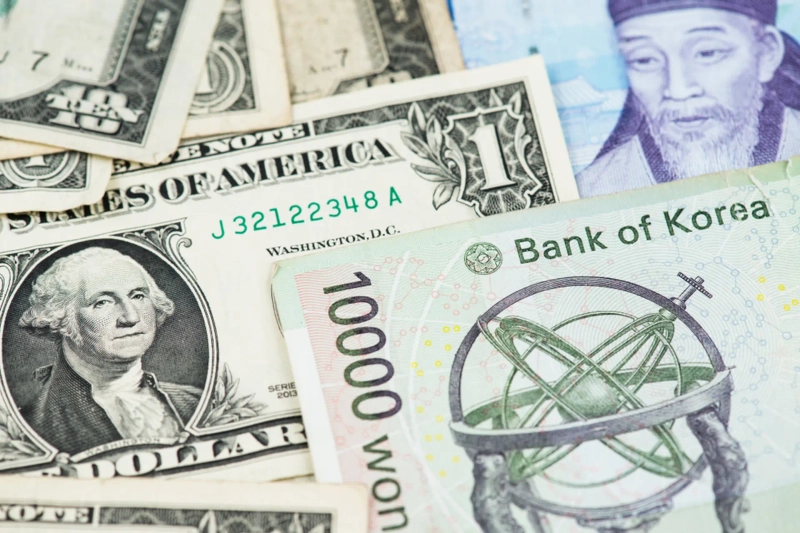
South Korea’s won briefly weakened past 1,550 per dollar, reaching levels last seen during the global financial crisis. With authorities signaling a strong willingness to respond, attention has turned to where the won-dollar exchange rate heads next. Analysts say the currency is unlikely to stabilize unless external risks such as the Middle East conflict ease. They also point to a moderation in foreign selling of South Korean stocks as another key condition.
According to the Seoul foreign-exchange market on June 9, the won-dollar rate opened at 1,555.2 won, up 16.1 won from the previous session’s daytime close. On an opening-price basis, that was the highest level since March 6, 2009. The won later trimmed its losses and reversed lower, ending the session at 1,535.0 won, down 4.1 won from the previous session’s daytime close.
The pullback appeared to reflect verbal intervention by the authorities. The Bank of Korea and the Ministry of Economy and Finance said recent foreign-exchange moves were driven not only by supply and demand factors, but also by some speculative trading, including offshore non-deliverable forwards, that had amplified volatility. They said they would not tolerate excessive volatility or one-way market moves out of line with fundamentals and would respond forcefully.
Brokerage analysts cited foreign investors’ retreat from South Korean equities as the main driver of the won’s weakness. Kwon A-min, an analyst at NH Investment & Securities, said the current rise in the exchange rate was disconnected from improving macro conditions and the current-account backdrop, and instead reflected market flows. Persistent foreign net selling in the stock market, along with related custodial dollar buying, appeared to be behind the move, he added.
A stronger dollar was also cited as a key factor. Lee Jin-kyung, an analyst at Shinhan Securities, said safe-haven demand had strengthened amid uncertainty over the Middle East conflict, keeping the US currency firm against major peers. Surging oil prices and solid US economic data have also fueled expectations that the Federal Reserve could return to rate hikes, supporting broad dollar strength.
Analysts say external risks need to ease before the won-dollar rate can stabilize. Moon Da-woon, an analyst at Korea Investment & Securities, said the market had little choice but to wait for negative factors to be resolved one by one. The biggest turning point for a decline in the exchange rate would come only when the US-Iran war, which he described as the starting point of many current problems, ends and the dollar loses strength. Until then, he said, the upper bound is effectively open.
Several events that could push the won-dollar rate higher still lie ahead. Kwon said the European Central Bank policy meeting, the Bank of Japan policy meeting, the Federal Open Market Committee meeting and MSCI’s review, which is closely tied to stock flows, are all scheduled for June. Given that lineup, near-term stabilization in the won-dollar rate and a quick easing in foreign selling would be difficult to expect, he said.
A moderation in foreign outflows from South Korean stocks is also a condition for exchange-rate stability. Lee said foreign investors could return to buying if portfolio adjustments to Korea within global allocations were nearing completion and expectations for an improvement in the global semiconductor cycle remained intact. Even so, uncertainty is likely to persist for the time being because the structural nature of the underweighting makes the timing of any return difficult to predict.
Still, most analysts say it would be inappropriate to interpret the won’s current weakness as a sign of a financial crisis. Moon said that during the global financial crisis, countries became vulnerable when foreign capital flowed out. Now, by contrast, domestic residents are voluntarily sending money abroad and building up external assets. That process has structurally increased demand for dollars and helps explain the steep rise in the won-dollar rate over the past three years.
Lee Su, Hankyung.com reporter, 2su@hankyung.com

Korea Economic Daily
hankyung@bloomingbit.ioThe Korea Economic Daily Global is a digital media where latest news on Korean companies, industries, and financial markets.