Samsung Electronics Becomes Largest Shareholder in Element Biosciences
Forecast Trend Report by Period


Pushes Ahead With Digital Health Business
Invests Additional $175 Million in Element
Becomes Top Shareholder With Stake in the 20% Range
Secures Core Precision Medicine Technology
Moves to Strengthen Health Services on Wearables
Samsung Electronics has become the largest shareholder in Element Biosciences, a U.S. maker of gene-sequencing equipment. The move underscores Samsung’s push to strengthen health-management services tied to Galaxy smartphones and wearable devices.
Samsung said on June 10 that it invested $175 million in Element’s Series E funding round. The company joined Element’s Series D round in July 2024 and has now increased its stake for the first time in two years. The latest investment made Samsung Element’s largest shareholder for the first time. Its stake is understood to be in the 20% range.
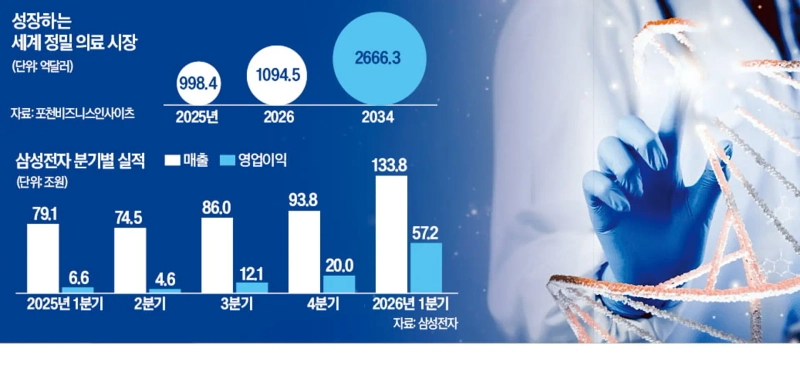
The additional investment is aimed at securing core technologies related to precision medicine, according to industry officials. In the healthcare sector, technologies that combine artificial intelligence and biotechnology have recently drawn growing attention. Solutions that analyze genetic, lifestyle and clinical data with greater precision are advancing rapidly. Market research firm Fortune Business Insights estimates the precision medicine market, valued at $99.84 billion last year, will grow at an annual average rate of 11.76% to reach $266.63 billion by 2034.
Samsung is understood to view DNA sequencing and multiomics as especially promising areas within precision medicine. DNA sequencing is the technology used to read the base sequence of DNA, often described as the blueprint of life. Multiomics analyzes how DNA identified through sequencing functions in the body. Both technologies are useful for closely examining individual genetic variations and traits, helping assess disease risk and support prevention, diagnosis and monitoring.
Until now, the industry has largely conducted DNA sequencing and multiomics analysis separately before combining the results. That approach has drawbacks, including higher costs, longer processing times and lower accuracy. Element has attracted attention for developing technology that overcomes those limitations. Its platform can analyze DNA, RNA, proteins and even cellular changes over time simultaneously on a single device.
Samsung said the expanded investment will help deepen its strategic partnership with Element and generate synergies. The company’s technology could eventually be incorporated into Samsung’s flagship IT devices, including Galaxy smartphones and wearables.
Samsung earlier acquired Sonio, a French startup developing AI software for ultrasound diagnostics, through Samsung Medison in 2024. Last year, it also acquired Xealth, a U.S. digital health platform, accelerating development of its health platform business. By adding genetic analysis capabilities through the Element investment, Samsung stands to further advance personalized healthcare services across the Galaxy lineup.
Roh Tae-moon, president and head of Samsung Electronics’ Device eXperience division, said combining Samsung’s expertise in AI, medical devices and digital health with Element’s innovative genomics analysis technology would create synergies for the future of personalized medicine.
Kang Hae-ryeong, Hankyung reporter hr.kang@hankyung.com

Korea Economic Daily
hankyung@bloomingbit.ioThe Korea Economic Daily Global is a digital media where latest news on Korean companies, industries, and financial markets.