South Korea Urged to Focus Stablecoin, RWA Rules on Market Use, Not Issuance
Summary
- The focus of formalizing won-denominated stablecoins, RWA, and STO should shift from issuance debates to designing real-world use structures such as payments and distribution.
- Politicians said the timing of the Digital Asset Basic Act and the rollout of won-denominated stablecoins should be treated as part of South Korea’s long-term capital-market competitiveness and its future financial infrastructure.
- Overseas experts said policymakers should consider the use of public blockchain networks, permissionless infrastructure trading for tokenized securities, and broader use cases for stablecoins in payments, cross-border remittances and RWA.
Forecast Trend Report by Period


Hashed Lounge hosts policy symposium on South Korea’s bid to become a digital G2
Lawmakers call for faster talks on the Digital Asset Basic Act as stablecoins gain traction as financial infrastructure
Experts say South Korea must design how markets will function in the era of AI agents and RWA
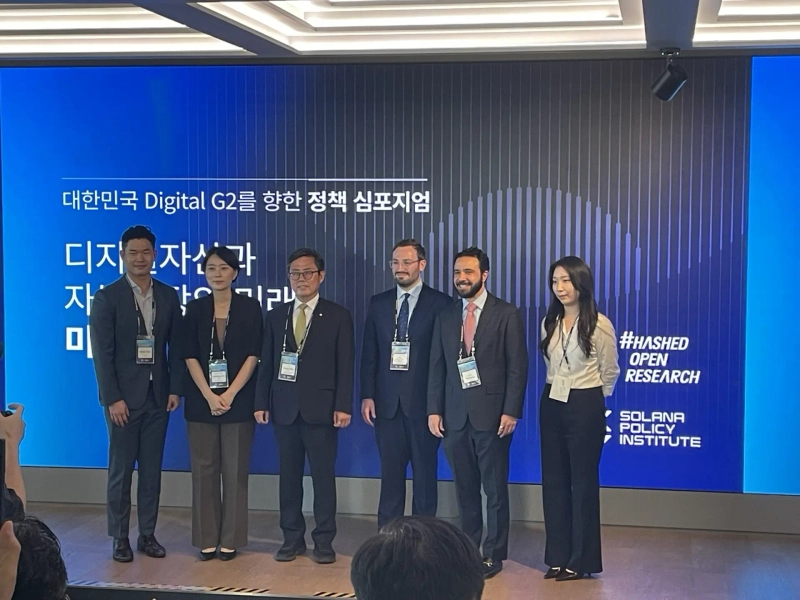
South Korea’s effort to formalize won-denominated stablecoins, real-world asset tokenization and security token offerings should shift from debates over issuers and legal form to how those assets will be used in practice, speakers at a policy symposium said. Global blockchain experts also called for policymakers to design payment and distribution systems, a 24-hour capital market and frameworks for using public blockchains.
A policy symposium titled “Toward a Korean Digital G2: The Future of Digital Assets and Capital Markets — Choices for the U.S. and South Korea” was held on June 23 at Hashed Lounge in Seoul’s Gangnam district. Lawmakers, policy and legal experts, and domestic and overseas digital-asset industry participants attended to discuss the Digital Asset Basic Act and frameworks for stablecoins, RWA and STO.
“Digital assets should be viewed through the lens of national competitiveness”
Politicians said overhauling digital-asset rules is tied to the medium- and long-term competitiveness of South Korea’s capital markets.
Min Byung-duk, a lawmaker from the Democratic Party, said in opening remarks that the world is building a new financial and capital-market order around digital assets and blockchain technology while South Korea’s institutions have not kept pace with the market. He added that the National Assembly would speed up discussions on the Digital Asset Basic Act in the second half.
Ahn Do-geol, also of the Democratic Party, described stablecoins in a keynote speech as a core part of future financial infrastructure. Stablecoins are moving beyond a simple investment product and reshaping financial infrastructure, he said. Because money is the foundation and engine of all financial and real-economy transactions, South Korea needs to pay attention to stablecoins.
He also said work to consolidate draft bills led by the Democratic Party’s digital-asset task force is in its final stages. On stablecoins, discussions are centered on a structure in which they are pegged one-to-one to the won and backed by highly liquid reserve assets equal to the amount issued.
Esther Kim, a researcher at Hashed Open Research, said digital assets should be linked to industrial strategy in the age of artificial intelligence. On-chain digital assets can keep AI, content and consumer markets moving around the clock across borders, she said, adding that stablecoins, RWA and STO could help South Korea attract talent and capital in the AI era.
In South Korea’s framework talks, market structure matters more than issuance
Panelists said South Korea’s institutional debate should not remain limited to who can issue digital assets and what legal form they should take.
Lee Yeo-jin, a senior secretary at the National Assembly’s Political Affairs Committee, said the next three years will be a critical window for South Korean finance to join the digital transition. If a won stablecoin does not emerge until 2029, the country may already have missed an important opportunity.
Lee said the won stablecoin debate needs to expand to actual payment networks, distribution structures and user touchpoints. On RWA and STO, she added that South Korea cannot keep postponing RWA discussions while waiting for a perfect system. The country should open areas where it can move now and use a regulatory sandbox or follow-up legislation to close gaps, she said.
Overseas experts also said policymakers should consider frameworks that make use of public blockchains. Miller Whitehouse-Levine, chief executive of the Solana Policy Institute, said that if South Korea uses private blockchains, the result would not be fundamentally different from existing exchange systems. Concerns over the confidentiality of transaction data can be addressed through technical tools such as confidential token extensions, he added.
Chris Montagnano, chief legal officer at Orca, said tokenized securities can trade on permissionless blockchain infrastructure if issuers handle investor qualification checks and disclosure obligations. Protocols such as Orca are not the party making regulatory judgments, but instead serve as infrastructure supporting transactions between verified wallets.
On stablecoins, speakers also said the U.S. GENIUS Act could strengthen incentives for dollar stablecoin issuers to move to the U.S. Whitehouse-Levine said major dollar stablecoin issuers would have little choice but to establish a U.S. domicile. Montagnano described stablecoins as the bright spot of on-chain markets and pointed to payments, cross-border remittances and RWA as key use cases.
The discussion also touched on U.S. digital-asset market-structure legislation. Whitehouse-Levine said the CLARITY Act, a U.S. crypto market-structure bill, could reach an inflection point on Aug. 7. Even if it passes, details on disclosure, secondary trading and spot-market regulation would still need to go through about 40 separate rulemaking processes, and completing the full framework could take about a decade, he said.
