Memory-Led Price Shock Begins as Apple Raises Prices by Up to 29% After Samsung
Forecast Trend Report by Period


Apple Surprise Price Increase Fuels Fears of a Third Inflation Wave
‘Chipflation’ Becomes Reality
Rising semiconductor prices are starting to push up consumer-goods costs, especially for electronics, turning “chipflation” — inflation driven by chip costs — into a reality. Apple’s decision to raise prices on its latest devices highlights the pressure, with electricity and labor costs also rising.
Apple said on June 25 that it would raise prices for major products. The MacBook Pro will sell for $1,999, up 17.7%, while the MacBook Air will cost $1,299, an 18.2% increase. Lower-priced iPads are seeing even steeper increases. The iPad Air will rise 25.0%, the iPad Pro 20.0%, and the entry-level iPad 28.7%.
Apple attributed the increases to a sharp jump in component costs. The company said demand for memory chips and storage devices had surged abnormally as AI data centers expanded rapidly, sending parts prices sharply higher. It added that it had never seen component prices rise so fast or by so much.
Demand for semiconductors from AI data centers is climbing sharply. FactSet estimates capital spending this year by five hyperscalers — Alphabet, Amazon, Meta, Microsoft and Oracle — will reach $741 billion. Most of that will go into AI infrastructure such as data centers, up 75% from a year earlier.
That is driving up not only memory-chip prices but also the cost of cables, cooling equipment and related labor. TrendForce said DRAM prices jumped 172% last year and rose another more than 90% in the first quarter alone.
The Wall Street Journal said a semiconductor-driven “third inflation wave” may be approaching, after the pandemic-era supply-chain shock and the energy-price spike triggered by the Russia-Ukraine war. In Asian trading on June 26, shares of memory-chip makers including Samsung Electronics, SK Hynix and Japan’s Kioxia tumbled on concern that higher product prices could weaken demand.
Race to Build AI Infrastructure Lights the Fuse as DRAM Prices Double in Three Months
Power Bills and Technician Pay Add Pressure as ‘Chipflation’ Is Set to Last at Least Two Years
Apple’s product pricing is widely viewed as an important gauge of global inflation trends. The company is regarded as one of the best at absorbing cost shocks through long-term supply contracts, massive advance orders and design optimization. That is why Apple’s price increases suggest inflation pressures are broadening in earnest. Apple Chief Executive Officer Tim Cook recently said he had never experienced chip-driven inflation like this in more than 40 years in the electronics industry, calling it a once-in-a-century flood.
Inflation Driven by AI
Apple held out longer than many rivals. Samsung Electronics raised smartphone prices by as much as 20% earlier this year after keeping them unchanged through last year. Nintendo, Sony and Microsoft have also raised game-console prices. PC makers including Dell, HP and Lenovo have been notifying customers since last year of price increases of 15% to 20%.
This inflation cycle is unusual because it began not with consumption but with investment. It stems from a capital-spending race among big tech companies trying to build AI infrastructure ahead of competitors. Stijn Van Nieuwerburgh, a professor at Columbia Business School, said AI data centers require sophisticated computing equipment, cooling systems, electrical and fiber-optic cables, and backup generators to prevent power outages. Spending on AI infrastructure could reach $8 trillion by 2032, he said.
That differs from the inflation that emerged just after the Covid-19 outbreak, which began with supply-chain paralysis caused by port closures, shipping bottlenecks and factory shutdowns. The price shock that followed the Russia-Ukraine war came from spikes in energy and raw-material costs, including crude oil, natural gas, grain and fertilizer.
Impact Reaches Consumer Prices
The impact of higher memory prices is now hitting finished consumer goods. High-bandwidth memory, or HBM, is essential for AI accelerators. When memory makers prioritize production for HBM and other high-value products for data centers, supplies of commodity DRAM and NAND flash used in smartphones, cars and home appliances shrink.
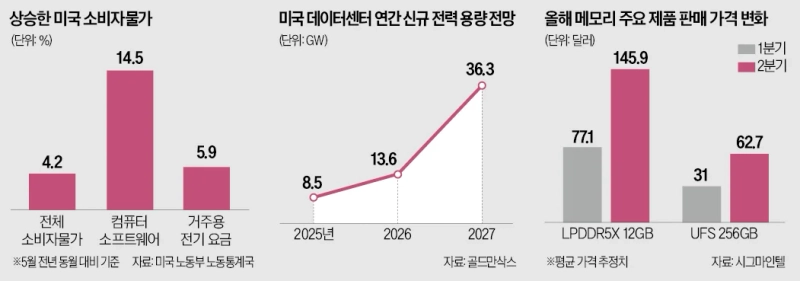
Chip prices have surged. TrendForce estimates DRAM prices rose by as much as 98% in the first quarter and will climb another 58% to 63% in the second quarter. Prices for smartphone DRAM and NAND flash have also jumped more than 80% over the past three months. Sigmaintel estimates the price of LPDDR5X 12GB for smartphones rose to $145.9 in the second quarter from $77.1 in the first quarter. Over the same period, the price of smartphone storage, or UFS 256GB, climbed to $62.7 from $31, more than doubling.
The effect is beginning to show up clearly in US consumer prices. Consumer prices for computer software and peripherals in May rose 14.5% from a year earlier, according to US Labor Department data. On a wholesale basis, electronic-component prices climbed 27% over the same period.
Labor costs are also rising. The average hourly wage for electrical and wiring installation technicians in the US, boosted by demand for data-center construction, rose 6.5% in April from a year earlier. That was nearly double the 3.6% increase in overall private-sector wages. Residential electricity rates rose 5.9% as data-center demand pushed up power costs.
‘Chipflation’ Is Only Beginning
In a survey by the National Association for Business Economics, 81% of respondents said AI infrastructure buildout would push prices higher over the next two years. Goldman Sachs projects consumer electricity bills will rise about 6% this year and next as more data centers come online.
Some analysts argue chipflation is only beginning. Federal Reserve Governor Lisa Cook said in a speech at Stanford University last month that the AI investment boom was creating new price pressures. Announced data-center plans already exceed $1.5 trillion, she said, but only part of that has materialized so far. If investment totaling as much as $8 trillion is rolled out over the coming years, demand for resources and price pressures will intensify further.
Kim Ju-wan, Kim Chae-yeon and Lee Hye-in, Korea Economic Daily reporters, kjwan@hankyung.com

Korea Economic Daily
hankyung@bloomingbit.ioThe Korea Economic Daily Global is a digital media where latest news on Korean companies, industries, and financial markets.