PiCK
Bitcoin Tests $60,000 Support as Fear Deepens Ahead of July Rebound Bid
Forecast Trend Report by Period



Bitcoin climbed back above $60,000 after Federal Reserve Chair Kevin Warsh said inflation risks had eased, but caution is building ahead of the U.S. June jobs report. In the near term, the key question is whether Bitcoin can defend the psychological $60,000 support level and show a turn in momentum.
As of 5:50 p.m. in Korea on July 2, Bitcoin was trading at $60,528 on Binance's USDT market, up 2.93% from a day earlier. On Upbit, it traded at 91.63 million won. The kimchi premium, which tracks the gap between prices on Korean and overseas exchanges, was minus 2.21%.
Warsh Says Inflation Risks Have Eased, but Prices Remain High Ahead of Jobs Report
Warsh said at the European Central Bank's central banking forum in Sintra, Portugal, on July 1 that inflation expectations had declined over the past four weeks and inflation risks had also eased. The remarks were interpreted as reflecting more stable oil prices after the ceasefire between the U.S. and Iran. He added that prices remain too high, underscoring the need for price stability.
He struck a cautious tone on monetary policy. Asked about the possibility of a rate increase, Warsh did not give a direct answer and reaffirmed the Fed's stance that it would reduce forward guidance on the rate path. He also said the Fed needs to gradually shrink its enlarged balance sheet.
Attention later turned to the U.S. June employment report, released at 9:30 p.m. Korea time on July 2. The U.S. Labor Department said nonfarm payrolls increased by 57,000 in June and the unemployment rate was 4.2%.
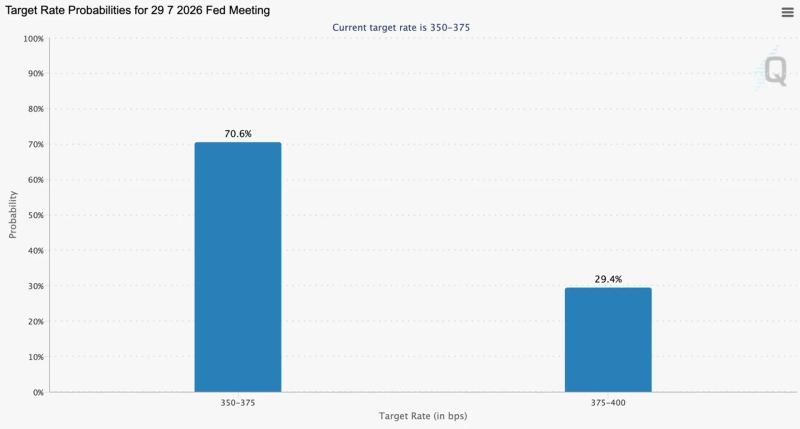
According to CME's FedWatch Tool, the federal funds futures market is pricing in a 70.6% probability that rates will remain unchanged at the July FOMC meeting and a 29.4% probability of an increase. The odds that the benchmark rate will be raised by at least 25 basis points by the end of December were about 70%.
Bitcoin ETF Outflows, Potential Strategy Sales Weigh on Sentiment as July Rebound Hopes Linger
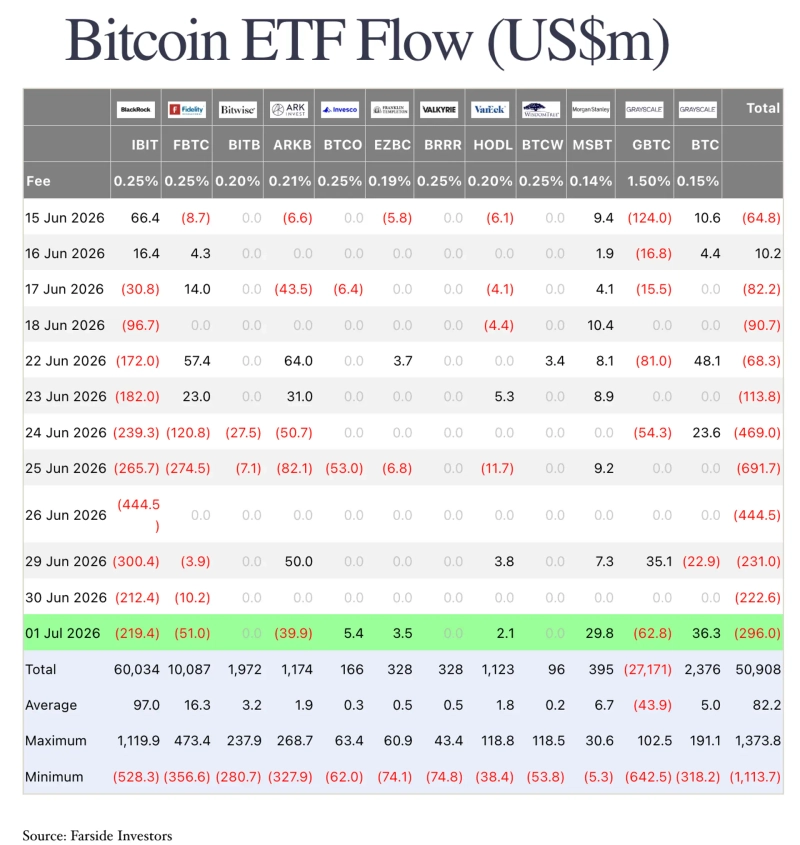
Against that backdrop, U.S.-listed spot Bitcoin exchange-traded funds posted net outflows of $1.7873 billion last week and have continued to see money leave since then. Sentiment was also hit by news that Strategy could sell up to $1.25 billion of Bitcoin to fund dividends and other needs. The initial response highlighted expectations for stronger financial stability through larger dollar reserves. Attention later shifted back to the possibility of Bitcoin sales, further dampening investor sentiment.
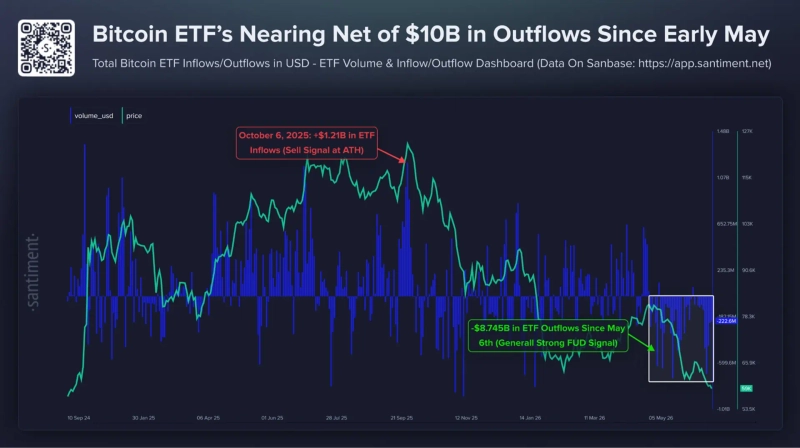
On-chain analytics firm Santiment said spot Bitcoin ETFs have recorded total net outflows of $8.475 billion since May 6. The longer that outflow streak lasts, the more it reflects mounting investor frustration, fear and retail capitulation rather than a new reason to sell, the firm said.
Santiment added that deeper outflows could pressure prices in the short term. At the same time, it said the trend may signal Bitcoin is approaching a major bottom because many investors inclined to sell may already have exited.
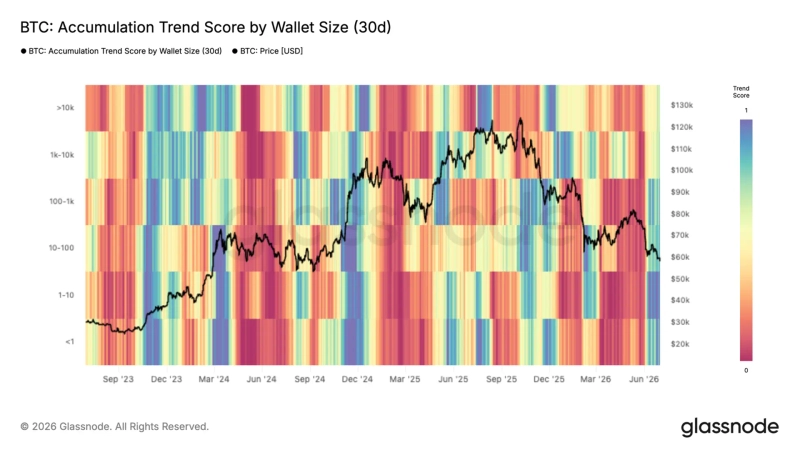
Some analysts also view the sharp deterioration in sentiment as a possible sign that Bitcoin is nearing a floor. In a weekly research report, Glassnode said long-term holders and patient buyers have started absorbing supply beneath the surface. Spot order books on Binance and Coinbase are also tilting toward buyers, it said.
Glassnode said on-chain data suggest Bitcoin is shifting from a distribution phase to an accumulation phase, though confirmation is still needed. It added that leveraged long positions are rising quickly in derivatives markets, which could intensify liquidation pressure if support levels break.
Seasonal patterns also suggest July could mark a turning point for a rebound. Digital-asset analytics firm Swissblock said that even in the 2018 and 2022 bear markets, selling pressure and investor fatigue persisted through May and June before relief rallies emerged in July. If a similar pattern repeats this year, July could mark the start of another relief rally.
Can Bitcoin Hold $60,000? Focus Is on 2 to 3 Weeks of Stability, Not a Quick Bounce
With $60,000 emerging as the key support level, analysts say investors should focus less on chasing a rebound and more on whether prices stabilize and momentum recovers over the next two to three weeks.
Julien Pineda, an analyst at Forex.com, said Bitcoin has risen more than 2.6% and is trying to reclaim $60,000, but demand is not yet strong enough to reverse the weakness of recent weeks. He said $62,170 marks a short-term neutral zone and $64,600 is a key resistance level. Bitcoin needs to retake those levels for buying momentum to strengthen again. A drop below the recent low of $57,790 would reinforce selling pressure and deepen the downtrend, he added.
Bitcoin is recovering only slowly even after falling more than 20% last month, the report said. Alex Kuptsikevich, chief analyst at FxPro, said Bitcoin fell as low as $57,800 intraday on July 1 before regaining $59,000 and then $60,000, but the rebound attempt remains limited. He added that July is seasonally viewed as a relatively favorable month for Bitcoin, though the current move is still difficult to treat as a trend reversal.
Some analysts also say Bitcoin's move into a long-term oversold zone means stabilization needs to be confirmed first. Katie Stockton, founder of Fairlead Strategies, said Bitcoin remains in a long-term oversold condition. The $60,000 area is also a psychological support level, and failure to hold it could trigger a deeper retracement, she said.
Stockton said she remains bullish on Bitcoin over the long term. For now, however, support is under heavy pressure, and investors should wait for two to three weeks of price stability and a shift in momentum rather than immediately increasing exposure.
Kang Min-seung, Bloomingbit reporter minriver@bloomingbit.io
