From $3,600 to $3.6 Million: Investor in His 40s Sells Stocks, Rebuilds Portfolio Around Bonds, ETFs
Summary
- The investor reallocated 5 billion won ($3.6 million) built through stocks and cryptocurrencies into a portfolio centered on financial assets excluding real estate, creating a diversified investment structure.
- He sought tax efficiency, stable interest income and monthly cash flow through low-coupon bonds, principal-preservation-focused ELBs, time deposits and dollar assets.
- The portfolio’s target annual return is 5.7%-10%, and it aims to raise both after-tax returns and asset growth potential by combining tax-efficient products with growth-oriented ETFs.
Forecast Trend Report by Period


Gangnam Wealth Investment Note
An Aggressive Investor’s New Dilemma
How to Manage $3.6 Million With Taxes in Mind
Low-Coupon Bonds and ELBs for Stable Returns
Diversification Through ETFs and Dollar Assets
A man in his 40s working at an information-technology company built substantial wealth over several years through investments in stocks and cryptocurrencies. He started with 5 million won, or about $3,600, and grew his financial assets to 5 billion won, or roughly $3.6 million, by making aggressive bets on technology shares, growth stocks and crypto. But as his assets grew, his priorities changed. Rather than chasing returns while absorbing sharp volatility, he needed a structure that could generate stable, sustainable income.
His objective was straightforward: reallocate the 5 billion won accumulated through stock and crypto investments into a diversified portfolio centered on financial assets, excluding real estate. He had experience with aggressive investing, but now wanted to reduce his tax burden, secure stable interest income and monthly cash flow, and still participate in stock-market gains.
Taxes Undermine an All-Deposit Strategy
The main issue was taxes. If he placed the entire 5 billion won in time deposits at an annual rate of 3%, he would generate about 150 million won, or about $108,000, in interest income each year. That financial income would be combined with his salary, potentially increasing his overall income-tax burden. As financial income rises, so does the applicable tax rate, making it difficult to manage the money based solely on pre-tax returns. The result was a need for a portfolio that considered both yield and tax efficiency.
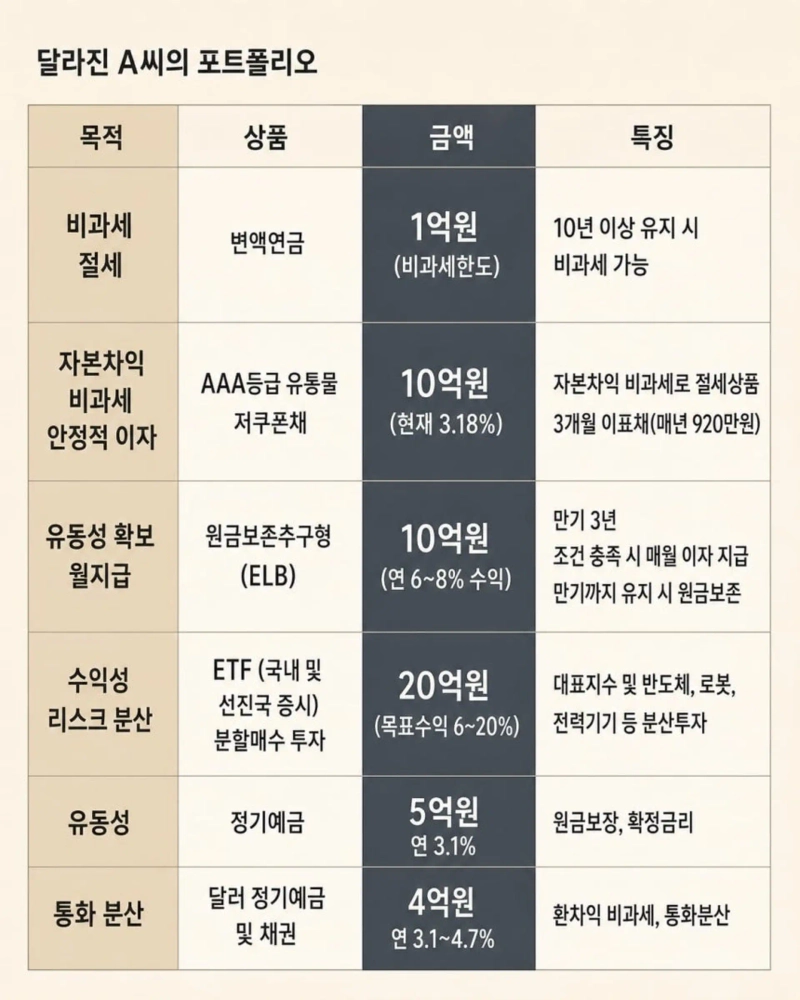
He first allocated 100 million won, about $72,000, to a variable annuity for tax planning. The product can qualify for tax-exempt treatment if it is held for more than 10 years. He chose a floating-rate product to prepare for the possibility of higher benchmark interest rates, aiming to combine long-term stability with tax benefits.
For steady interest income, he put 1 billion won, or about $720,000, into AAA-rated low-coupon bonds trading in the secondary market. Because low-coupon bonds carry a smaller share of returns as taxable interest income, investors can instead seek capital gains from rising bond prices. Unlike ordinary bonds, they face a lighter tax burden on capital gains, making them useful for wealthy investors looking to improve tax efficiency. The expected yield is about 3.18%, and the bonds pay interest every three months, generating roughly 9.2 million won, or about $6,600, in annual coupon income.
He also allocated 1 billion won, or about $720,000, to principal-preservation-focused equity-linked bonds, or ELBs, to create monthly cash flow. The three-year product is tied to the Kospi 200 and Samsung Electronics. If certain conditions are met, it pays interest monthly, and if held to maturity it is structured to preserve principal. The expected annual return is 6% to 8%, balancing stability and cash flow.
Spreading Risk With Korean and Global ETFs
The core of the portfolio for returns and risk diversification is exchange-traded funds in domestic and overseas markets. He allocated 2 billion won, or about $1.44 million, to benchmark-index and growth-sector ETFs through staggered purchases. The holdings include ETFs tied to semiconductors, power equipment, AI infrastructure, robotics, aerospace, the Kospi 200, the S&P 500 and the Nasdaq 100. Rather than concentrating on a single stock or asset class, the strategy spreads money across assets with similar growth drivers to reduce volatility.
The ETF allocation reflects expectations for continued growth in global technology shares and the artificial-intelligence industry. Investment by US software companies is continuing, and interest in aerospace and technology stocks more broadly has grown after SpaceX’s listing. He concluded that concentration in semiconductors and rallies in market leaders may continue for some time, and chose to diversify across related industries.
As a liquidity allocation, he added 500 million won, or about $360,000, in time deposits. The move locked in a fixed annual rate of about 3.1% while preserving principal and short-term liquidity. It also leaves funds available for additional investment if market volatility increases.
He also added dollar-denominated assets to diversify currency exposure. He allocated 400 million won, or about $288,000, to dollar time deposits and dollar bonds. The expected annual return is 3.1% to 4.7%. Dollar assets can offer tax-free foreign-exchange gains and help defend the portfolio when the won weakens.
Seeking Both Returns and Growth
The portfolio’s target annual return was set at 5.7% to 10%. Bond products alone would deliver expected returns of only about 4% to 5%, but combining tax-efficient products, monthly payout instruments and growth ETFs can lift both after-tax returns and long-term asset growth.
Market conditions also supported that allocation. Although the war between the US and Iran has ended, major economies have begun raising benchmark interest rates as inflation remains elevated. A rate-hiking cycle can increase market volatility in the short term, but equity assets can still perform when corporate earnings improve. For that reason, the mix of aggressive short-term bond exposure and growth ETFs was viewed as appropriate.
The investor’s portfolio has shifted away from the aggressive approach of the past and toward a structure that emphasizes tax efficiency, cash flow, growth potential and currency diversification. He has already built substantial wealth through stock and crypto investments, but stable asset management has now become more important than short-term price swings.
Lee So-young, a Gold PB division head at Hana Bank’s Gold Club Bundang PB Center, said what matters in a period of heightened uncertainty is not the speed of chasing returns but the balance needed to respond to change. Investors should manage assets by monitoring interest rates, inflation, the sustainability of corporate earnings and the direction of liquidity shaped by shifts in global policy, rather than focusing on short-term moves in share prices, she added.
Cho Mi-hyun, Hankyung reporter (mwise@hankyung.com)

Korea Economic Daily
hankyung@bloomingbit.ioThe Korea Economic Daily Global is a digital media where latest news on Korean companies, industries, and financial markets.