Samsung Electronics, SK Hynix Account for 83.1% of Korea Trading With Leverage Included
Summary
- Trading on South Korea’s stock market has become concentrated in Samsung Electronics and SK Hynix, with the two stocks and related leveraged and inverse products accounting for as much as 83.1% of trading value.
- The Kospi has also been moving largely in line with volatility in the two semiconductor heavyweights, with the index falling by a similar magnitude when both stocks decline.
- As the combined share of securities lending balances tied to Samsung Electronics and SK Hynix rose from 32.1% to 38.9%, brokerages and policymakers voiced concern over concentration in large semiconductor stocks and volatility amplified by single-stock leveraged products.
Forecast Trend Report by Period


Kospi Whipsaws With Samsung Electronics and SK Hynix Volatility
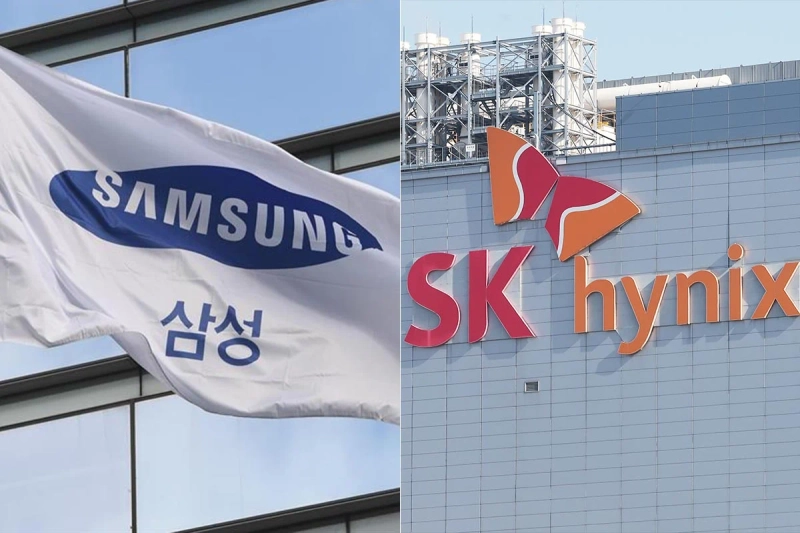
Trading on South Korea’s stock market is increasingly concentrated in Samsung Electronics and SK Hynix. Including single-stock leveraged and inverse products, the two names accounted for more than 80% of trading value.
Korea Exchange data showed Samsung Electronics posted 9.5563 trillion won in trading value on July 8, while SK Hynix reached 15.256 trillion won. Together, the two stocks accounted for 51% of the 48.609 trillion won traded across the domestic stock market, including the Kospi and Kosdaq. That was 21 percentage points higher than the 30% recorded on May 26, the day before single-stock leveraged and inverse products were listed.
As of July 8, trading value in 16 single-stock leveraged and inverse products totaled 15.6045 trillion won. Adding that to turnover in Samsung Electronics and SK Hynix shares lifts the trading share tied to the two stocks and related leverage products to 83.1%. Kospi and Kosdaq turnover figures do not include ETF trading, limiting a direct comparison. Still, the market impact of the two semiconductor heavyweights has clearly grown since the launch of single-stock leveraged products.
The Kospi’s moves have also been heavily driven by the two stocks. On July 7 and July 8, when Samsung Electronics and SK Hynix both fell, the Kospi dropped by a similar magnitude. On July 7, Samsung Electronics slid 6.92% and SK Hynix fell 6.06%, while the Kospi closed down 4.91% at 7,656.31. On July 8, Samsung Electronics lost 6.25% and SK Hynix declined 5.68%, pulling the Kospi down 5.35% to 7,246.79.
The two companies also took up a bigger share of securities lending balances, a gauge widely seen as a leading indicator for short selling. On May 26, Samsung Electronics and SK Hynix had securities lending balances of 23.6666 trillion won and 23.9763 trillion won, accounting for 15.9% and 16.2% of the total, respectively. By July 8, those balances stood at 23.524 trillion won for Samsung Electronics and 29.0041 trillion won for SK Hynix, lifting their shares to 17.4% and 21.5%. Their combined share rose to 38.9% from 32.1%.
Brokerages and policymakers have continued to voice concern over concentration in large semiconductor stocks and the volatility amplified by single-stock leveraged products. The Bank of Korea recently said concentration could worsen further if investment in single-stock leveraged products expands while Samsung Electronics and SK Hynix already account for more than half of stock market capitalization and trading. The Financial Supervisory Service said it will continue monitoring the market impact and, if necessary, inspect whether asset managers are engaging in excessive marketing.
Oh Se-song, Hankyung.com reporter sesung@hankyung.com

Korea Economic Daily
hankyung@bloomingbit.ioThe Korea Economic Daily Global is a digital media where latest news on Korean companies, industries, and financial markets.