Samsung, SK Hynix on Alert as China’s CXMT Targets Top Tier With $8 Billion IPO
Summary
- China’s CXMT plans to raise about 57.9 billion yuan through a STAR Market listing and use the proceeds for its G5 process, HBM3 development and production-capacity expansion.
- CXMT is targeting a 20% share of DRAM bit shipments and a 15% share by revenue by 2035, while increasing the share of higher-value products such as LPDDR5 and DDR5 and HBM.
- US export controls, HBM mass production and yields, and winning overseas customers were cited as key growth variables, while a potential rerating of the company remains a major focus for memory-industry investors.
Forecast Trend Report by Period


China’s CXMT to Raise 57.9 Billion Yuan on STAR Market
Proceeds Earmarked for G5 Process, HBM3 Development and Capacity Expansion
Targets 20% DRAM Bit Share by 2035
ChangXin Memory Technologies Inc. (CXMT), China’s largest DRAM maker, is using a blockbuster initial public offering to push into the top tier of the global memory market. The company plans to focus spending on next-generation process technology and high-bandwidth memory, or HBM, while tripling production capacity in a bid to move past the 15% market-share threshold the industry regards as the minimum for long-term survival.
CXMT will take orders from retail and institutional investors on July 16 and is scheduled to list on Shanghai’s STAR Market on July 27. The offering price was set at 8.66 yuan a share, valuing the deal at about 57.9 billion yuan, or roughly $8 billion, before any overallotment option is exercised. The company’s market capitalization after listing is expected to reach about 579.2 billion yuan, or about $80.6 billion. The share sale comes 10 years after construction began on its fab.
Proceeds will go toward the company’s next-generation G5 process, development of 12-layer HBM3 and new production facilities. CXMT plans to increase monthly wafer capacity to 420,000 by 2027 from about 320,000 now. It also plans new fabs in Shanghai and Beijing and a large production cluster in Hefei.
The company has set a longer-term goal of doubling capacity by 2030 and tripling it by 2035. It also plans to shift its mix away from commodity DRAM and toward higher-value products. LPDDR5 and DDR5 are set to account for about 75% of total output. Global manufacturers have already begun sourcing the company’s DRAM for PCs and servers.
Aiming to Join the Memory Big Three
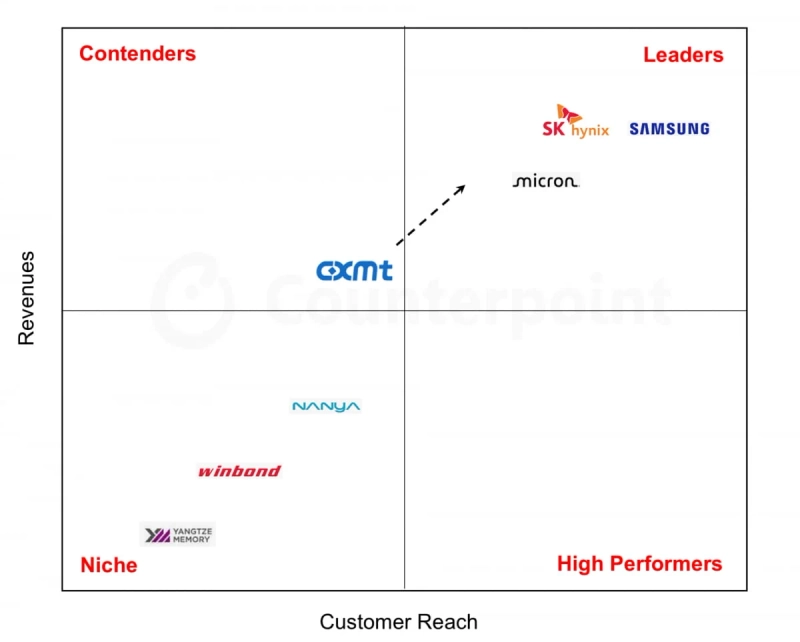
Counterpoint Research estimates CXMT currently accounts for 9% of global DRAM bit shipments. That could rise to 11% on a bit basis and 9% by revenue in 2028. Even so, breaking into the industry’s leading group now dominated by Samsung Electronics Co., SK Hynix Inc. and Micron Technology Inc. will require at least a 15% to 17% share, according to the researcher.
Hwang Min-seong, a research director at Counterpoint Research, said Taiwanese DRAM makers in 2008 saw their market share fall below 15%, leaving them unable to secure funding for next-generation fab investment. Their share eventually dropped to about 3%, reducing them to niche players. For CXMT, 15% is the threshold it must cross, he added, and the company’s current investments are part of a race to reach that mark first.
Counterpoint flagged CXMT’s ability to reach a 20% share of DRAM bit shipments and a 15% revenue share by 2035 as a key long-term indicator. If the company expands capacity as planned, it could narrow the gap with established leaders.
Another focus is whether investors will reassess the company’s valuation. Hwang said the question is whether a higher share price will trigger a rerating, or whether the DRAM cycle is already at its peak and that has already been reflected in the lofty market values of global leaders. The gap remains wide. The key issue is how quickly CXMT can close it after this major fundraising.
HBM Mass Production and Overseas Customers Are Key Variables
The first major test after the listing will be the HBM business. CXMT is developing 12-layer HBM3, but its large-scale manufacturing capability and yields have yet to be proven.
Counterpoint estimates CXMT could generate about $2 billion in HBM revenue by 2028, supported by increased production of Huawei Technologies Co.’s Ascend AI chips. Chinese companies including Cambricon and Biren are also evaluating CXMT products.
Winning customers outside China remains another task. CXMT entered the PC supply chain in mid-2025, and whether that leads to large supply agreements will help determine the pace of its market-share gains. Supplying Apple Inc. was cited as a variable requiring political approval.
Neil Shah, a vice president at Counterpoint Research, said CXMT’s growth conditions are improving as it expands market share, lobbies Apple, broadens global exports and approaches entry into the HBM market. Still, the prospect of tighter US restrictions and an HBM business that has yet to prove itself in large-scale production complicate comparisons with rivals’ valuations.
US restrictions on semiconductor equipment exports will also shape CXMT’s growth path. Tougher controls could make it harder to secure advanced tools and win overseas customers. With access to advanced lithography equipment limited, the company is accelerating development of new memory structures including vertical channel transistors, or VCT, and wafer-on-wafer bonding.
Shah said, paradoxically, restrictions on CXMT could create an opportunity for the company to move ahead of incumbent leaders. Existing players may be slower to adopt such innovations because they are trying to protect returns on their installed equipment base. He added that export controls could become a catalyst that helps CXMT close the gap and catch competitors off guard.
Hong Min-seong, Hankyung.com reporter mshong@hankyung.com

Korea Economic Daily
hankyung@bloomingbit.ioThe Korea Economic Daily Global is a digital media where latest news on Korean companies, industries, and financial markets.