BOK Hawkish Shift Fuels Bets on 3.25%-3.50% Terminal Rate, Adding to Mortgage Burden Fears
Summary
- Brokerages have raised forecasts for the Bank of Korea’s rate-hike stance, putting the benchmark rate’s terminal rate at 3.25%-3.50%.
- The Bank of Korea’s formal shift to a tightening stance is expected to push commercial banks’ mortgage rates to 4.77%-7.49%, increasing households’ interest burden.
- According to Bank of Korea estimates, a 0.25-percentage-point increase in mortgage rates would raise the annual interest burden by about 1.8 trillion won, increasing the load on individual borrowers.
Forecast Trend Report by Period


Brokerages are lifting their forecasts for South Korea’s benchmark interest rate after the Bank of Korea formally signaled it will keep tightening policy. They now expect the next rate increase in August and see the terminal rate in this cycle reaching 3.25% to 3.50%. As mortgage rates at commercial banks climb quickly, households stand to face a heavier interest burden.
As of July 17, Korea Investment & Securities and Hana Securities both said after the Monetary Policy Board meeting a day earlier that they expect the next rate hike in August. Korea Investment & Securities kept its year-end benchmark rate forecast at 3.0% but brought forward the timing of an additional increase to August from October. It put the terminal rate for this cycle at 3.25%.
The Bank of Korea’s Monetary Policy Board raised the benchmark rate by 25 basis points to 2.75% from 2.50% at its monetary policy meeting the previous day. It marked the first rate increase since January 2023, roughly three and a half years ago.
Korea Investment & Securities expects the BOK to raise rates in both July and August before assessing the impact of the moves. If stronger growth and further upside pressure on inflation are confirmed after that, the central bank could deliver one more increase in the first quarter of next year. Otherwise, it sees the benchmark rate staying at 3.0% for a considerable period.
Moon Da-woon, an analyst at Korea Investment & Securities, wrote that the BOK would probably move toward another increase after confirming improved income conditions through gross domestic product and gross domestic income data and revising its August economic outlook. Still, he said stronger growth is unlikely to translate directly into more rate hikes because gains in semiconductor prices are expected to moderate from the fourth quarter and the recovery in private-sector employment remains slow.
Hana Securities also raised the possibility of more aggressive BOK tightening. It expects three more rate increases in August, November and February next year, which would lift the terminal rate to 3.50%. That is 25 basis points higher than its previous forecast of 3.25%.
Hana Securities said the BOK began incorporating demand-side inflation pressure into its policy assessment at the May Monetary Policy Board meeting. It later raised its forecast for South Korea’s economic growth this year to 3.3% and said the central bank’s signal that it will sharply raise its own growth outlook points to stronger vigilance over demand-driven inflation.
US monetary policy was also cited as a variable that could shape the BOK’s rate path. Park Jun-woo, an analyst at Hana Securities, said expected US rate hikes this year and next mean American rates will be added to the BOK’s reaction function alongside growth, inflation and financial stability. That increases the odds that both the speed and size of benchmark rate increases will exceed earlier forecasts.
The market also focused on the monetary policy statement. In the statement released a day earlier, the Monetary Policy Board said future monetary policy needs to maintain a rate-hike stance. Earlier statements had said the board would decide whether further adjustments were needed while monitoring inflation, growth and broader economic conditions. This time, it explicitly used the phrase “rate-hike stance,” clarifying the direction of further tightening.
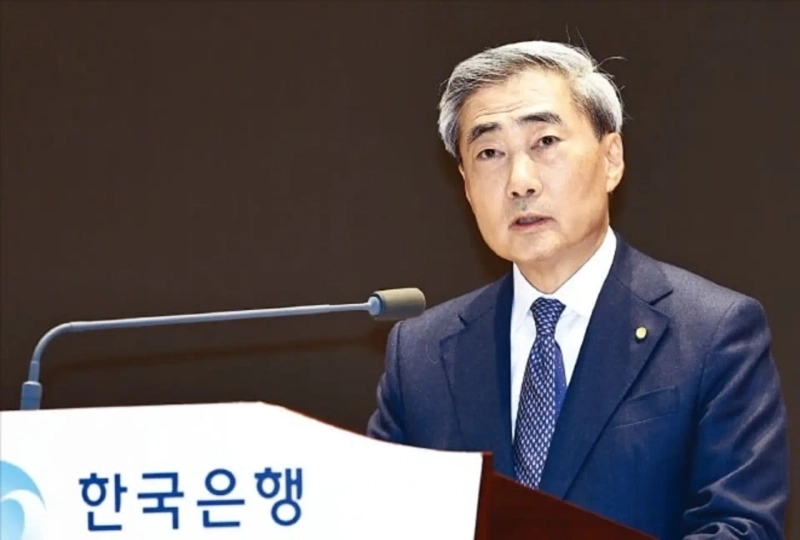
BOK Governor Shin Hyun-song also made clear that additional increases remain on the table. At a news conference, he said demand-side inflation pressure should not be overlooked and that the central bank would respond until it is confident inflation is converging stably toward target.
With the BOK formally embracing a tighter stance, mortgage rates are poised to keep rising. Five-year fixed mortgage rates at the country’s five major banks — KB Kookmin, Shinhan, Hana, Woori and NH NongHyup — have climbed by as much as 0.4 percentage point this month, reaching 4.77% to 7.49%. The yield on five-year bank bonds, the benchmark for fixed-rate loans, has also risen about 0.2 percentage point this month, pushing lending rates higher.
Borrowers’ interest burdens are also set to increase as rates rise. According to Bank of Korea estimates, a 25-basis-point increase in mortgage rates would raise annual interest payments by about 1.8 trillion won ($1.3 billion). The additional average annual interest burden per borrower is estimated at about 300,000 won ($217), and the industry expects annual interest payments on other loans, including unsecured credit loans, to rise by about 1.5 trillion won ($1.1 billion).
Kang Kyung-ju, Korea Economic Daily reporter qurasoha@hankyung.com

Korea Economic Daily
hankyung@bloomingbit.ioThe Korea Economic Daily Global is a digital media where latest news on Korean companies, industries, and financial markets.