Kim Yong-beom Says Delisting Single-Stock Leveraged ETFs Is ‘Hard to Imagine’
Summary
- Kim Yong-beom, presidential chief of policy, said it is hard to imagine delisting single-stock leveraged ETFs.
- He said the government’s new rules for single-stock leveraged ETFs — requiring 30 million won in cash on deposit and a minimum purchase of 20 shares — should help address side effects.
- Kim said further talks are needed among authorities, asset managers and brokerages to minimize tracking gaps and reduce the market impact of leveraged ETFs.
Forecast Trend Report by Period


"Side effects should be largely eased once supplementary measures take effect"
"Tracking gaps in single-stock leveraged ETFs must be minimized"
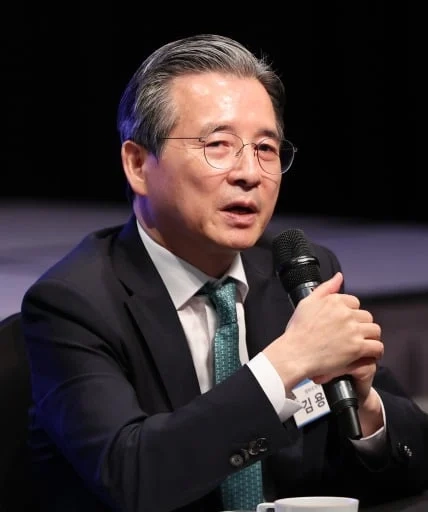
Kim Yong-beom, presidential chief of policy, said on July 19 that delisting single-stock leveraged exchange-traded funds is "hard to imagine," pushing back on calls for their removal from the market. The products, which aim to deliver at least twice the moves of individual stocks, have recently been cited as a major source of volatility as South Korea’s stock market has swung sharply.
Appearing on KBS’s “Sunday Diagnosis Live” on July 19, Kim said investors are already invested in the products and their assets have grown to more than 10 trillion won ($7.22 billion). Delisting them would itself deal a major shock to the market, he said, adding that authorities would also have to absorb the resulting wave of sell orders.
Single-stock leveraged ETFs based on Samsung Electronics and SK Hynix were launched on May 27. As the two companies’ shares gyrated, criticism mounted that the products were adding to stock-market volatility. In response, the Ministry of Economy and Finance, the Bank of Korea, the Financial Services Commission and the Financial Supervisory Service recently announced measures targeting the products.
Under the plan, investors will need to keep at least 30 million won ($21,700) in cash in their accounts to trade single-stock leveraged ETFs starting next month. From November, the minimum purchase size for a single order will be raised to 20 shares.
Kim said the measures should resolve a substantial part of the side effects. He said authorities held extensive discussions and adopted steps that reflect many of the concerns raised in the market. Once the rules take effect, many of the problems that have been flagged should be eased.
Still, Kim pointed to the gap between an ETF’s net asset value and its market price. "We need to minimize the premium or discount," he said, adding that further discussion could focus on ways to keep in check the selling pressure created by efforts to narrow that gap.
Leveraged ETFs have an effect that doubles in a falling market, Kim said. He added that authorities, asset managers and brokerages need further talks on how to minimize market shocks. He also noted that volatility in leveraged ETF products tends to rise just before the market close, and said policymakers should consider a range of ways to reduce the impact the products can have on the market at certain times.
Kim also addressed the so-called triple-strength pattern in the housing market, in which home sale prices, jeonse deposits and monthly rents are all rising. "I feel very sorry to the many people affected," he said. "Housing supply and demand and other conditions are extremely challenging, and I take the matter seriously."
He also explained remarks he made at a Kwanhun Club debate last month, when he said, "We just have to build housing." Kim said supply cannot be produced overnight and that he meant the government must mobilize every available method, including buying non-apartment homes for rental use, to find solutions with urgency. At the time, he mentioned the possibility of using former industrial cluster areas in Seoul districts such as Yeongdeungpo and Guro.
Kim said the government would mobilize every short-term supply option, including non-apartment housing, private officetels and converting land designated for commercial use in third-generation new towns into residential use.
Still, he said redevelopment and reconstruction are not a cure-all. They do not secure supply in the short term. Procedures can be shortened and floor-area ratios can be discussed, but redevelopment and reconstruction take at least three to five years. On using semi-industrial areas in Seoul for housing supply, Kim said the issue is not Seoul’s alone and that cooperation with the central government could deliver much bigger results. He added that he had arranged a separate meeting with Seoul Mayor Oh Se-hoon.
On tax revisions aimed at stabilizing the property market, Kim said the government will distinguish between owners of multiple homes and single-home owners, and will also apply different rules depending on whether a property is owner-occupied. Even for a single owner-occupied home, there has been extensive debate over whether ultra-high-priced properties should be treated differently because of the owner’s ability to pay and the burden such homes place on the housing market, he said. The direction of applying different treatment has broadly been decided, while the remaining question is the appropriate threshold and how to set the standard.
Asked about arguments that capital-gains taxes should be cut if property holding taxes rise in order to bring more homes onto the market, Kim said the government is taking that into account. He said the system could also be designed to allow owners to sell within an appropriate period and impose a heavier burden if they wait beyond that window. The framework is being designed with tax fairness in mind, he added. Lowering capital-gains taxes when holding taxes rise is one factor to consider, but it is difficult to apply that principle uniformly.
Oh Jung-min, Hankyung.com reporter blooming@hankyung.com

Korea Economic Daily
hankyung@bloomingbit.ioThe Korea Economic Daily Global is a digital media where latest news on Korean companies, industries, and financial markets.