PiCK
South Korea Lawmaker Min Says Digital Asset Framework Act Must Pass This Year, With ‘No Plan B’
Forecast Trend Report by Period


Interview with Min Byung-duk, a lawmaker from South Korea’s Democratic Party
‘Settle key disputes by September and speed the framework law’
‘No monopoly for any one sector in digital assets’
‘Crypto taxation needs fixes on fairness and other issues’
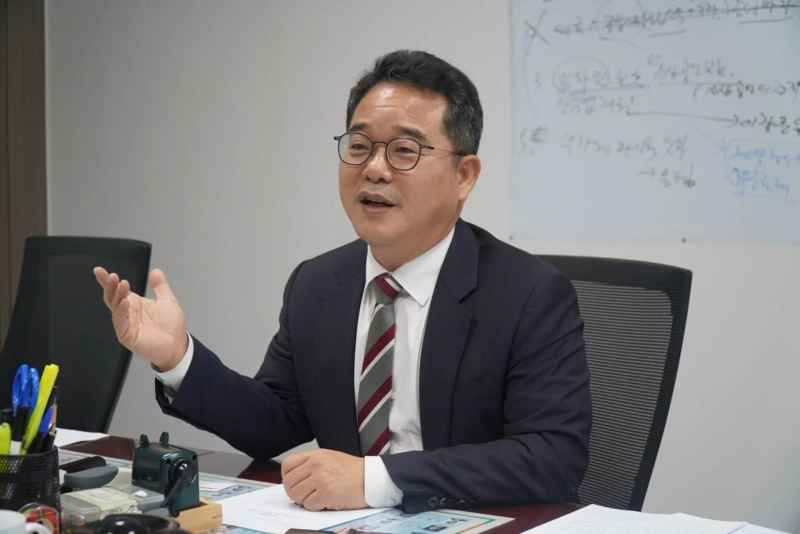
“There is no Plan B if the Digital Asset Framework Act slips past this year. I am confident the National Assembly will pass the law before year-end.”
Min Byung-duk, a member of the National Assembly’s Political Affairs Committee, told Bloomingbit in an interview on July 29 that he remains committed to passing the Digital Asset Framework Act this year. He said he is confident of year-end passage because lawmakers have already held extensive discussions in the first half of the year and the government is also aiming to enact the law this year.
He said the bill was delayed because it took time to reconcile differences over the design of detailed rules. Min first introduced the framework law in the National Assembly in June 2025, but legislative talks have stalled for more than a year.
The government’s draft of the framework law will soon be submitted to the National Assembly, he said. Once it is filed, lawmakers plan to quickly sort out areas of agreement and disagreement based on the discussions accumulated so far and the bills already proposed.
‘Differences with ruling party and regulators to be narrowed as September review gains speed’
Min said differences between the ruling party and financial authorities should be resolved by the September plenary session. Key sticking points include who should be allowed to issue won-denominated stablecoins and rules governing major shareholders’ stakes in domestic virtual-asset exchanges.
He said the broad framework of the law and its main points of dispute are already clear. Review by the Political Affairs Committee’s bill subcommittee should move much faster because the Democratic Party’s digital asset task force has already debated the issues and lawmakers have held separate consultations.
Min said he would not compromise on efforts to limit entry into the digital-asset industry to a specific sector. No industry should be given a de facto monopoly, he said.
What matters, he said, is not whether an issuer is a bank or a nonbank, but whether it has sufficient reserve assets, repayment capacity and internal controls. Protecting user assets is another principle that cannot be compromised.
There is also speculation that the Democratic Party’s digital asset task force could resume operations in September. Min said no specific timetable has been discussed, but noted that six of the task force’s nine members are now assigned to the Political Affairs Committee in the second half of the parliamentary session.
Most members of the committee already have a strong understanding of both the lawmakers’ framework bills and the government draft, he said. They have also heard extensive views from industry and experts through the task force, which should help make passage of the framework law a top priority.
‘South Korea is falling behind and needs to secure global leadership’
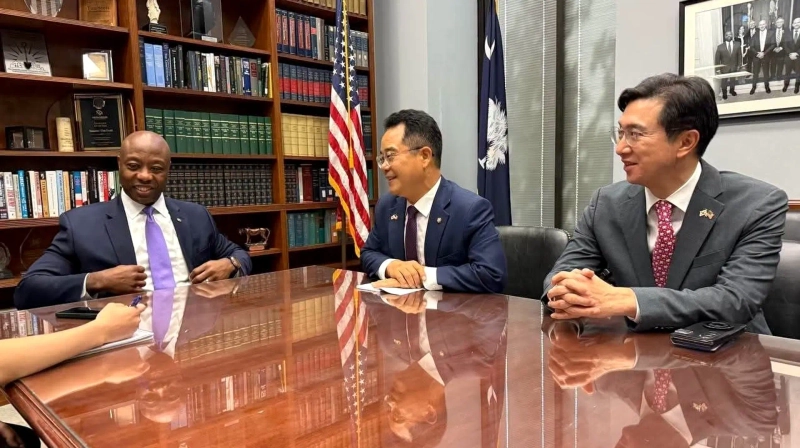
Min also referred to his recent trip to the US. Last month, he discussed digital-asset legislative trends with Congress, the White House, the Securities and Exchange Commission and Coinbase.
He said his takeaway from the US trip was that digital assets are being treated not merely as financial products, but as a national strategy. South Korea is ahead in technology and the market, he said, but behind in building the necessary system.
Domestic companies are more worried about regulatory uncertainty than business operations or technology development, he said. If South Korea builds a supporting framework, its companies can secure leadership in the global financial order.
Min also stressed the need to formalize a framework for won-denominated stablecoins, one of the law’s core pillars. Won stablecoins are not simply about creating a new means of payment, he said.
The issue, he said, is how far the use of the won can be expanded and how South Korea can protect its monetary sovereignty and industrial strategy.
Stablecoins can reduce payment fees and settlement burdens for small merchants and the self-employed, while giving the public faster and more convenient financial services, he said. Won-denominated stablecoins are both an innovation for the digital and artificial intelligence era and a technology that can directly help everyday livelihoods, he added.
‘Tax fairness and other issues need to be addressed’
On virtual-asset taxation, which is scheduled to take effect in 2027, Min cautioned against treating the issue as a binary choice between repeal and enforcement. The principle that income should be taxed cannot be denied, he said.
But taxation should begin only after a fair system that taxpayers can accept is in place, along with an accurate framework for identifying income.
He said both unconditional repeal and pressing ahead on schedule despite inadequate preparation require caution. The priority is to use the framework law to clarify issuance and distribution structures and the responsibilities of service providers, then address tax fairness and ways to secure transaction data from overseas platforms.
Min also expressed expectations for EastPoint: Seoul 2026, a global private Web3 conference scheduled for Sept. 28. He said the most striking feature of last year’s EastPoint was that theory, policy and the industry came together in one place.
Policymakers, companies and financial institutions gathered to discuss concrete ways to connect digital assets with real-world industry and regulation, he said. This year, he added, he hopes EastPoint will go beyond tracking industry trends and produce practical answers on how South Korea can lead a new financial order.
