China’s STAR Market Surges 34.8% Since Second Quarter as Wall Street Turns Overweight
Forecast Trend Report by Period


Record Foreign Net Buying in the Second Quarter
AI and Chip Self-Reliance Fuels Rally
Total Market Capitalization Doubles in a Year
MetaX Rapidly Closes Gap With Nvidia
Unitree and DeepSeek Await IPOs
UBS Says Stocks Are Undervalued
Foreign capital is pouring into China’s STAR Market, the tech board often dubbed the country’s version of Nasdaq. Chinese stocks had long been shunned by global investors because of escalating U.S.-China tensions, the property downturn and regulatory risks. That mood has begun to shift as investors reassess the competitiveness of Chinese companies such as ChangXin Memory Technologies, or CXMT, that have advanced the country’s push for technological self-reliance amid the U.S.-China rivalry.
Best Performer Among Major Indexes
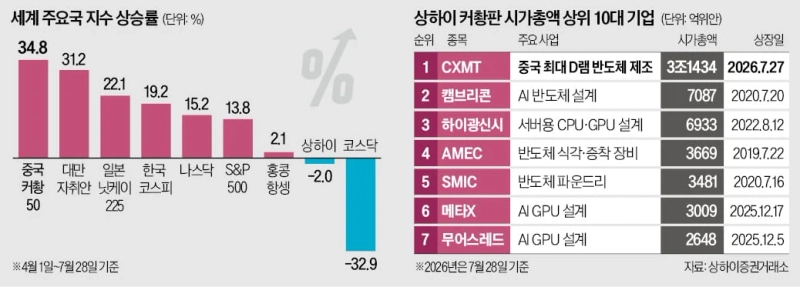
The STAR 50 Index has climbed 34.80% from the start of the second quarter through July 28, according to the Shanghai Stock Exchange. The gauge tracks 50 leading stocks listed on the STAR Market. Over the same period, it outperformed the Kospi’s 19.22% gain, the Kosdaq’s 32.93% decline and the Nasdaq’s 15.22% advance.
Foreign investors have been a key driver of the rally. Overseas funds bought a net 219.3 billion yuan of China A-shares in the second quarter, equivalent to about $30.6 billion, according to Guoxin Securities. That was the largest quarterly total on record. Analysts estimate a sizable share of those inflows went into the STAR Market.
China launched the STAR Market in July 2019 to help advanced technology companies raise capital. The board struggled for a period under U.S. semiconductor restrictions, but last year it jumped 36% as enthusiasm for DeepSeek and expectations for domestic advances in semiconductors and artificial intelligence gathered pace. Total market capitalization stood at 15.6729 trillion yuan, or about $2.19 trillion, as of July 28, roughly double from a year earlier. Over the same period, the number of listed companies rose only 3.9% to 612 from 589, but total value expanded sharply.
The market’s largest companies have also been reshuffled. CXMT, the memory-chip maker that listed on July 27, went straight to the top spot by market capitalization. Chip designer Cambricon turned profitable on a full-year basis for the first time last year, rising to No. 2 from No. 6 at the time of its 2020 listing.
MetaX and Moore Threads, two GPU design startups founded in 2020, have also climbed into the top ranks. The companies unveiled domestic chips that narrowed the performance gap with Nvidia products to about 75% to 80%, lifting them to sixth and seventh place by market value.
By contrast, software company Kingsoft Office, the board’s biggest stock three years ago, has fallen out of the top 10. Solar company Jinko Power, formerly No. 3, medical-device maker United Imaging Healthcare, formerly No. 4, and smartphone maker Transsion Holdings, formerly No. 6, have also dropped out of the rankings. Park Su-hyun, a senior analyst at KB Securities, said hardware companies stand to benefit more than software firms from spillover effects as China’s AI industry expands. The STAR Market is the most attractive among China-focused equity markets because of its high concentration of companies leading domestic AI hardware development, he added.
Major IPO Candidates Are Waiting in the Wings
Many strategists expect the STAR Market rally to continue. Support from Chinese authorities for stock-market stabilization is one factor. Another is the prospect of listings by high-profile companies including humanoid robot maker Unitree, Yangtze Memory Technologies and DeepSeek.
Baek Seung-hye, an analyst at Hana Securities, said shares of companies leading China’s localization drive on the STAR Market could extend gains if AI fabless companies such as Cambricon deliver solid results during the August earnings season. Jeon Jong-kyu, a senior analyst at Samsung Securities, said a rally in STAR Market technology shares could continue in the second half as growth at Chinese tech companies becomes more visible. He ranked the STAR Market as the most attractive, followed by Hong Kong and Shanghai.
Wall Street is also paying closer attention to Chinese technology companies that have built their own ecosystems despite U.S. containment policies. Citigroup recently raised its view on Chinese equities to overweight from strategic neutral. Eva Lee, head of Greater China equities at UBS, said leading Chinese AI companies have entered historically very low valuation ranges, creating an attractive investment opportunity.
Jo Ara and Go Song-hee, Hankyung.com reporters rrang123@hankyung.com

Korea Economic Daily
hankyung@bloomingbit.ioThe Korea Economic Daily Global is a digital media where latest news on Korean companies, industries, and financial markets.