PiCK
Retail Investors Feared Another July Rout. Strategists Say a Repeat Is Unlikely
Forecast Trend Report by Period


Will a Bond-Yield-Driven Triple Slump Return? Strategists Say There Won’t Be a July-Style Crash
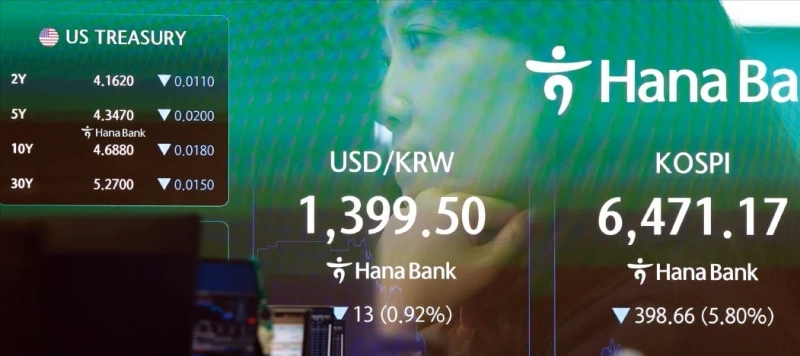
Until recently, the 30-year US Treasury yield was not a major focus for equity investors. Markets had been more attuned to whether the Federal Reserve would raise interest rates, second-quarter earnings from Big Tech and chipmakers, and ceasefire talks between the US and Iran. But after a broad global equity selloff, the 30-year Treasury yield — which climbed to its highest level in 19 years — has emerged as the epicenter of the turmoil. Yields in South Korea, Japan and Germany also surged, dragging their stock markets lower.
The Kospi closed down 5.80% at 6,471.17 on Aug. 19. The benchmark tumbled from the open, triggering a sell-side sidecar that suspended the effect of program sell orders on the main board for five minutes. It was the second such sell-side sidecar on the main bourse this month, after Aug. 6.
Semiconductor heavyweights led the drop, with Samsung Electronics falling 7.82%, SK Hynix sliding 9.75% and SK Square sinking 11.54%. Declines were widespread across the market. After touching 7,000 on Aug. 18, the Kospi fell back into the 6,400 range. The Kosdaq closed down 1.17% at 824.46.
Rising long-term US Treasury yields helped drive the selloff. Overnight, the 30-year Treasury yield climbed to 5.33%, the highest level since 2007. The move hit US chip shares, sending the Philadelphia Semiconductor Index down 4.98%. “As long-term yields in the US, Japan and Europe rose together, concerns over discount rates for growth stocks and capital spending came into focus, weighing on technology shares,” Kim Ki-back, an analyst at Shinhan Securities, said.
The won traded at 1,397.7 per dollar as of 3:30 p.m., strengthening 14.1 won from the previous session. It was the first time in about 10 months that the currency had returned to the 1,300-won range.
Kospi Crumples After Nearing 7,000. Where Does the Market Go From Here?
US Fiscal Deterioration Is the Root Cause, but Korean Stocks Are More Sensitive to the 10-Year Yield
Historically, the US 10-year Treasury yield has had the most direct impact on South Korean equities among medium- and long-term maturities. The clearest example was 2023, when the 10-year yield rose above 5% on fears that US monetary tightening would persist. At the time, South Korean stocks, bonds and the won all fell together in a so-called triple slump. The Kospi slid from the 2,600 range to the 2,200 range.
Still, the nearly 6% plunge in the Kospi on Aug. 19 was unusually linked to the 30-year Treasury yield. The 30-year typically has less influence on equities than the 10-year. This time, however, it sharpened concern over funding costs — a key variable for artificial intelligence stocks — and pulled down large-cap names including Samsung Electronics and SK Hynix.
Nvidia Also Falls as Yield Shock Spreads
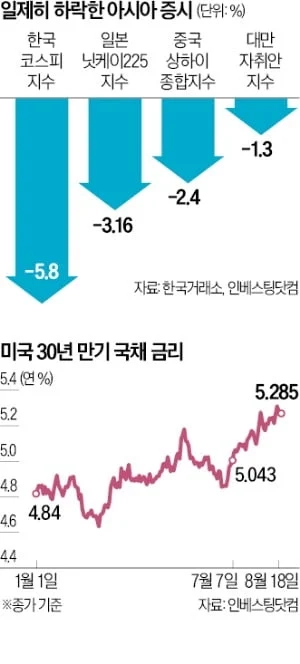
The Kospi ended Aug. 19 down 5.80% at 6,471.17. Market heavyweights including Samsung Electronics, down 7.82%, and SK Hynix, down 9.75%, led the retreat. Other large-cap stocks also fell, including SK Square, down 11.54%, Samsung Electro-Mechanics, down 3.68%, and Hyundai Motor, down 4.83%.
The main cause was a chain reaction in sovereign bond yields across major economies. Overnight, the 30-year US Treasury yield rose as high as 5.33%, touching its highest level since 2007. It later pared gains to close at 5.285%, but remained well above the 4.8% range seen at the start of the year. The jump in long-dated US yields spread to Japan, Germany and France. Nvidia fell 2.34% and Micron Technology dropped 7.02%. Just before Asian markets opened, Pennsylvania’s governor signed an executive order requiring environmental and community approval for AI data-center construction, adding to concerns that AI data-center projects could be delayed.
Analysts cite three reasons for the surge in long-term yields. The immediate trigger was higher oil prices. With US-Iran ceasefire talks having broken down, a ship strike in the Strait of Hormuz overnight pushed Brent crude futures for October delivery above $90 a barrel for a second straight day. Investors stepped up selling of long-dated bonds on concern that rising oil prices could stoke inflation and bolster the case for another Fed rate increase. A more fundamental cause is the worsening US fiscal position. Federal debt has recently reached $40 trillion, fueling demands for a higher risk premium on long-dated Treasuries.
Another major factor is bond issuance by Big Tech. The five largest hyperscalers — Amazon, Microsoft, Google, Meta Platforms and Oracle — sold $159 billion of corporate bonds in the first half alone to fund AI data-center construction. That has already surpassed last year’s full-year total.
As Treasury investors rotate into high-grade corporate bonds yielding 6% to 7%, markets are demanding higher returns on government debt as well. Concern is also mounting that Japan, the largest foreign holder of US Treasuries, could sell some of its holdings as its own long-term yields rise. “The chances are growing that a further rise in Japanese government bond yields could trigger a shock similar to the gilt-market turmoil during Liz Truss’s brief tenure as UK prime minister in 2022,” Park Sang-hyun, an analyst at iM Securities, said.
What does that mean for South Korean stocks? Brokerages say higher long-term yields are clearly a headwind, but the impact may be limited. One reason is that the 10-year US Treasury yield — at 4.706% as of Aug. 18 — remains below 5%, the threshold with more direct influence on South Korean equities. Another is that the July correction has already compressed the market’s 12-month forward price-to-earnings ratio, easing valuation pressure.
“When the 30-year US Treasury yield rose above 5% in the first half, the Kospi’s forward PER was in the low- to mid-7 times range. Now it is only 5.6 times,” Han Ji-young, an analyst at Kiwoom Securities, said. “Given those fundamentals, the market should have some downside resilience.”
Kang Jin-gyu, Lee Sun-a and Park Ju-yeon, Korea Economic Daily reporters josep@hankyung.com

Korea Economic Daily
hankyung@bloomingbit.ioThe Korea Economic Daily Global is a digital media where latest news on Korean companies, industries, and financial markets.