SK Hynix, Samsung Lead Kospi’s 5.9% Surge as $28.9 Billion Buyback Spurs Rerating Bets
Summary
- SK Hynix and Samsung Electronics surged after SK Hynix announced a $28.9 billion share buyback and cancellation, helping the Kospi close up 5.9%.
- Brokerages said SK Hynix’s large-scale shareholder returns and the AI-driven memory boom have increased the potential for a rerating of the memory industry and stronger shareholder value enhancement.
- JPMorgan said SK Hynix could deliver at least $131.3 billion in additional shareholder returns by 2027, with return capacity potentially reaching $152.9 billion depending on its free cash flow outlook.
Forecast Trend Report by Period


Closes at 6,852.58; 24th buy-side sidecar triggered this year
After $28.9 billion buyback and cancellation plan
SK Hynix jumps 12.7% in one session
JPMorgan says another $131.3 billion could be returned
“40 trillion won is only the beginning.”
SK Hynix Inc.’s biggest-ever share buyback and cancellation plan has raised expectations for even larger shareholder returns. The announcement, which exceeded market expectations, reinforced confidence in an AI-driven memory supercycle and the company’s medium- to long-term cash-generation power.
Brokerages in South Korea and overseas estimate SK Hynix could allocate at least $130.2 billion, and as much as $151.9 billion, to additional shareholder returns. Samsung Electronics Co. is also planning to unveil a shareholder return program worth roughly $108.5 billion soon, setting up a new competition between the two companies over how to deploy cash swelled by the AI memory boom.
SK Hynix Accelerates Buyback Pace
On Aug. 20, SK Hynix rose 12.7% to close at 1.691 million won. The gain reversed the previous session’s 10% slide, which had been driven by rising long-term bond yields and concerns about AI revenue. SK Square Co., SK Hynix’s largest shareholder, jumped nearly 12%, while Samsung Electronics and its preferred shares climbed about 10% each.
The Kospi gained 5.9% to 6,852.58 as the country’s two biggest chipmakers surged. A buy-side sidecar, a curb on program trading in South Korea’s stock market, was triggered early in the session for the 24th time this year. Foreign investors were net buyers of 1.7117 trillion won, offsetting net selling of 2.2791 trillion won by retail investors.
The shift in semiconductor sentiment followed SK Hynix’s surprise announcement after the market closed on Aug. 19 of a 40 trillion won ($28.9 billion) share buyback and cancellation plan. Investors also welcomed news that management and labor had reached a tentative agreement in collective bargaining talks to pay 60% of bonuses in treasury shares. That would spread out the timing of cash payments and could create additional demand for future buybacks.
SK Hynix moved immediately on Aug. 20, buying back 650,000 shares. That was about 68% above the implied daily average of 388,000 shares, based on an assumption that the company will repurchase 24.07 million shares evenly over the next three months. The pace suggested management sees the stock as undervalued and wants to move aggressively from the start.
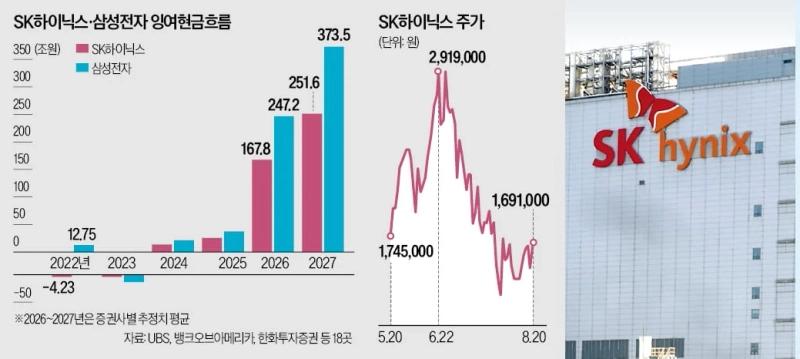
At Least $131.3 Billion to $152.9 Billion More Could Be Returned
Brokerages say the measure could mark the start of a rerating for the memory industry. As cash generated by AI investment begins flowing back to shareholders in earnest, investor focus may broaden from the sector’s cyclicality and peak-out concerns to shareholder value.
SK Securities wrote that the key point is that the company has secured ample room for shareholder returns even while stepping up investment for growth, and management has now begun turning that capacity into actual payouts. The spread of broader shareholder returns across the sector is a matter of time, it added.
Wall Street is focusing on SK Hynix’s decision to raise its payout policy for cumulative free cash flow in 2025 through 2027 from “up to 50%” to “50% or more.” That increases the upper limit of funds available for shareholder returns.
Based on that, JPMorgan estimates SK Hynix could provide at least $131.3 billion in additional shareholder returns by 2027. The figure is based on 50% of the bank’s projected cumulative free cash flow of 475 trillion won over three years, or 237.5 trillion won, minus already announced buybacks, cancellations and dividends of about 56 trillion won.
The return capacity could rise further if the memory cycle lasts longer and boosts cash generation, or if the payout ratio climbs above 50%. The average forecast from 18 domestic and overseas securities firms that updated SK Hynix free cash flow estimates in the past month points to 167.8 trillion won in 2026 and 251.6 trillion won in 2027. UBS, the most bullish among them, expects 188 trillion won this year and 320 trillion won next year. On that basis, additional return capacity would reach $152.9 billion.
A buyback of that size could also support the Korean won. If SK Hynix repatriates some of its dollar cash held overseas to fund domestic share repurchases, that would create demand to sell dollars and buy won.
Bin Nan-sae, Hankyung reporter binthere@hankyung.com

Korea Economic Daily
hankyung@bloomingbit.ioThe Korea Economic Daily Global is a digital media where latest news on Korean companies, industries, and financial markets.