Meta Weighs South Korea Bond Sale of at Least $720 Million as AI Funding Race Spreads
Summary
- Meta has approached a South Korean credit-rating agency for a nonpublic preliminary review for a planned won-denominated corporate bond sale and is considering raising at least $720 million.
- US Big Tech has raised $194 billion through corporate bonds this year as AI investment expands, while adopting a strategy of borrowing in multiple currencies.
- The article says investors should be cautious because products that are difficult to absorb in the US could move overseas as long-term Treasury yields rise and issuance of AI-company corporate bonds surges.
Forecast Trend Report by Period


Regional Diversification as US Treasury Yields Rise
Funding Costs and Exchange Rates Are Key Variables
Meta Platforms Inc. is considering a won-denominated corporate bond sale in South Korea as it broadens its funding channels for artificial intelligence investment.
According to investment-banking industry officials on Aug. 27, Meta recently sounded out a South Korean credit-rating agency about a nonpublic preliminary rating ahead of a potential bond offering. Companies typically seek such assessments before issuance to gauge likely credit ratings and borrowing costs. The rating is not disclosed publicly.
Meta is also reviewing the regulations, disclosure obligations and investor demand tied to a South Korean bond sale through local and overseas securities firms, people familiar with the matter said. In the market, expectations are that Meta could raise at least 1 trillion won ($720 million) through bonds in South Korea.
Bond-market participants say it is still too early to determine whether the won bond sale will proceed. Foreign companies that sell public corporate bonds in South Korea must file regular disclosures, including quarterly, semiannual and annual reports. Even issuers entering the market for a one-off fundraising deal must continue meeting those obligations afterward, adding to the burden.
Funding costs could also prove a hurdle. Meta would need to factor in not only the won-dollar exchange rate but also swap costs incurred when converting won proceeds into dollars. It would also have to test whether South Korea's bond market can absorb more than $720 million of supply at a competitive rate.
US artificial-intelligence companies including Meta have recently stepped up overseas fundraising. Alphabet Inc. and Amazon.com Inc. have issued about $64.8 billion of local-currency bonds this year in the UK, Europe, Switzerland, Canada and Japan. Earlier this month, Alphabet sold A$5.5 billion of Australian dollar-denominated kangaroo bonds.
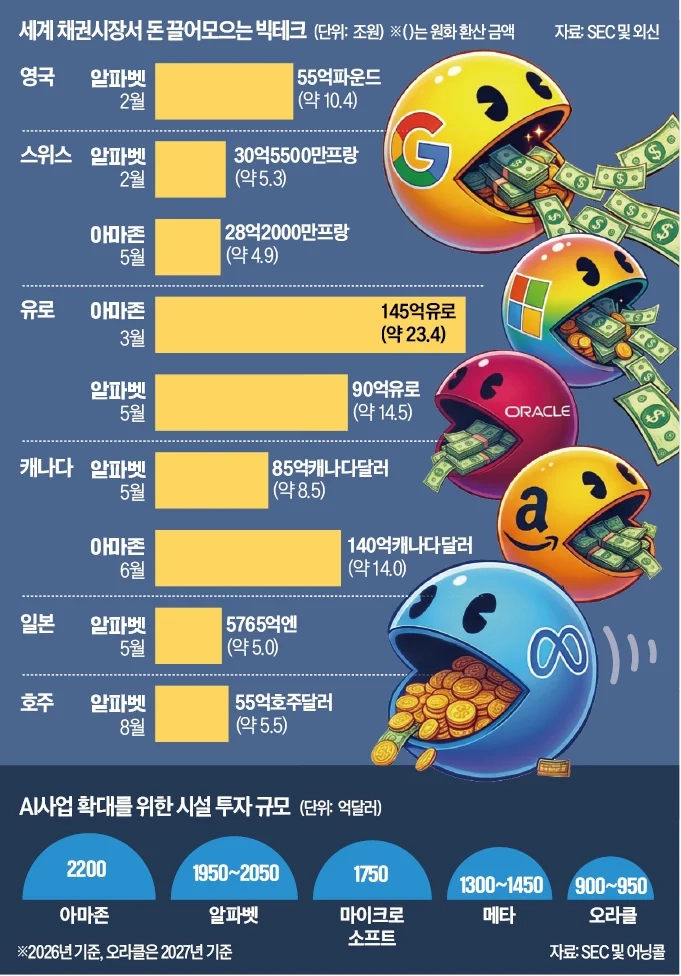
From Japan to Australia, Big Tech Scours the Globe for Funding
AI Financing Race Spreads Beyond the US
The fundraising drive by US Big Tech has expanded from the US, Europe and Japan to South Korea. Meta, Amazon, Alphabet, Oracle Corp. and Microsoft Corp. are issuing corporate bonds across global markets as conditions in the US debt market worsen. Long-term Treasury yields, which help determine corporate borrowing costs, have been climbing.
Big Tech Raises $194 Billion Through Bonds This Year
Goldman Sachs said on Aug. 27 that Amazon, Alphabet, Meta and Oracle sold $194 billion of corporate bonds from the start of the year through July. That is nearly double last year's full-year total of $108 billion. Goldman projects new bond issuance by the four companies will rise to $250 billion this year and $400 billion in 2027.
Issuing bonds in multiple countries is another notable shift. After tapping the UK, Switzerland and Japan, Alphabet sold A$5.5 billion of bonds in Australia this month. The strategy is to raise funds in several currencies and tap markets with relatively lower borrowing costs, since relying solely on US dollar debt can drive funding costs higher as issuance grows.
Big Tech companies are also ratcheting up spending on AI-related facilities. Meta initially projected 2026 capital expenditure of $115 billion to $135 billion early this year, then raised that to $125 billion to $145 billion in its first-quarter earnings report. In the second quarter, it lifted the low end again to $130 billion while keeping the top end at $145 billion. Alphabet also increased its capital expenditure plan from $175 billion to $185 billion early this year, to $180 billion to $190 billion in the first quarter and then to $195 billion to $205 billion in the second quarter.
Structured finance using special-purpose vehicles is also playing a bigger role. Rather than invest directly in data centers, Meta is setting up joint ventures with Blue Owl Capital and BlackRock to bring in outside capital.
In the US bond market, supply is rising rapidly and investor fatigue is building. Subscription ratios for AI companies' bond offerings fell from nearly 5-to-1 in February to below 2-to-1 in July. Amazon's March dollar-bond sale drew orders equal to 3.4 times the amount offered, while its $25 billion July issue drew only 1.6 times demand. An asset-management industry official said the pattern resembled South Korea's state utility bond market in 2022, when investors initially welcomed higher issuance from a top-rated borrower but later tired of the steady flood of supply. AI-company bonds could follow a similar path.
Big Tech Bond Sales Are Also Affecting Rates
Heavy bond issuance by US AI companies is also one factor pushing up long-term Treasury yields. The 30-year Treasury yield jumped to 5.27% the previous day before easing to close at 5.162%.
Industry participants say long-term Treasury yields have continued to trend upward as the US debt load keeps growing and AI companies raise funds on a massive scale. Some also caution that, as financing needs expand, US AI companies are increasingly seeking new investors overseas. A credit-rating industry official said US investors began cutting subprime exposure around 2006, after which related products were sold to overseas buyers including in South Korea. Investors should be cautious when products that are difficult to place at home begin to be marketed abroad.
Bae Jeong-cheol, Hankyung.com reporter bjc@hankyung.com

Korea Economic Daily
hankyung@bloomingbit.ioThe Korea Economic Daily Global is a digital media where latest news on Korean companies, industries, and financial markets.