PiCK
From BTS Songs to Samsung, SK Hynix Shares, South Korea’s Tokenized Securities Market Set to Broaden
Summary
- Authorities said tokenized securities will be formally introduced with full legal effect in February next year, opening the door to small-scale diversified investment in illiquid assets such as unlisted shares.
- Financial authorities said they will allow pooling and the issuance of tokenized securities backed by future receivables, while also proposing measures to promote fractional investment and protect investors through limits including an annual net purchase cap of 100 million won.
- Brokerages will gain new revenue opportunities through public offerings and underwriting of tokenized securities backed by unlisted shares, but the industry said stablecoin legislation remains critical to enabling 24-hour trading.
Forecast Trend Report by Period


Token Investment Path to Open From February Next Year
On-Chain Finance to Begin in Earnest
Small-Ticket Investment in Illiquid Assets to Become Possible
Liquidity for Fractional Investment Products to Improve
New Business Opportunities for Brokerages
Stablecoin Legislation Remains Key
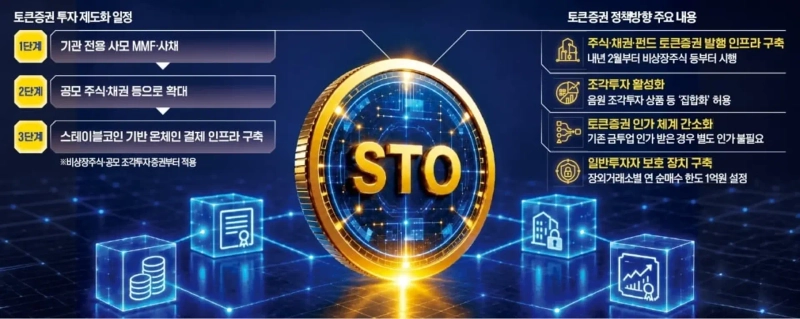
Tokenized securities, which use blockchain technology to split up and trade rights to a range of real and financial assets including real estate, music copyrights and artworks, will gain full legal force from February next year and be formally introduced into South Korea’s regulated financial markets. The securities industry is paying close attention to the trading convenience they offer. Because transactions are based on blockchain and other distributed ledgers, issuers and investors can trade directly without intermediaries. Another advantage is that trading can take place 24 hours a day. Tokenized securities are also defined by the ease of fractional trading and their ability to encompass products ranging from stocks to tangible assets.
That is why expectations have risen across the financial investment industry after the government on September 4 unveiled its policy direction for tokenized securities. In the industry’s view, the move signals the start of an era of on-chain finance in which everything from stocks to BTS songs can be issued as tokenized securities.
Unlisted Stock Trading Likely to Bloom First
The market expects tokenized securities to be adopted first in trading of unlisted shares. Financial authorities said they would pursue a plan to tokenize unlisted shares through trust structures when the related system takes effect in February next year. A financial investment industry official said securities firms that issue tokenized securities backed by unlisted shares would be able to trade one-on-one directly with investors.
Industry participants also say tokenized securities will become easier for brokerages and over-the-counter exchanges to handle because regulators decided not to create a separate licensing system exclusively for tokenized securities. Firms that already hold financial investment business licenses will be able to handle tokenized securities within the scope of those existing approvals. In practice, that means a brokerage licensed for investment intermediation in ordinary shares will be able to immediately underwrite and arrange public offerings of tokenized securities based on unlisted shares.
Fractional Investment Also Seen Gaining Momentum
Financial authorities also presented a series of steps to support fractional investment products. A key measure is allowing the pooling of the same type of fractional investment products. For example, music copyrights from multiple singers including IU, BTS and Tae Jin-ah could be bundled together and issued as a single tokenized security.
A venture investment industry official noted that Musicow had already sold multiple copyrights in bundled form in many cases. Allowing formal pooling would lower transaction costs, the person added. Financial authorities also decided to conditionally allow tokenized securities backed by future receivables.
Authorities also strengthened investor protections. Retail investors buying tokenized securities through over-the-counter exchanges will face an annual net purchase cap of 100 million won. Retail investors subscribing to publicly offered fractional investment products will be allowed to participate only up to the smaller of 30 million won or 5% of the issuance amount. Over-the-counter exchanges will also be required to consult in advance with the Financial Supervisory Service when supporting tokenized securities trading.
Brokerages Seen Gaining New Business Openings
The new framework is set to significantly change the investment environment for retail investors. Above all, it will widen access to small-ticket, diversified investment in a range of illiquid assets that had largely been the domain of institutions and wealthy investors, including high-value commercial real estate, infrastructure, high-quality unlisted shares, music rights and art. Secondary trading, which had faced heavy constraints under the regulatory sandbox, is also poised to become more active through licensed multilateral over-the-counter exchanges. That would make it far easier to cash out fractional investment products, which were often locked up until maturity after purchase.
The ripple effects for the financial investment industry could also be substantial. Brokerages stand to secure new revenue sources beyond fee-based business models by discovering new unconventional assets, dividing ownership interests and arranging public offerings through investment banking. That is likely to intensify competition among major securities firms seeking an early lead in the tokenized securities market through digital infrastructure investment.
Market participants widely agree that stablecoin legislation is the final key. A second-stage virtual asset bill containing a framework for stablecoins remains under discussion by financial authorities and the National Assembly. A financial investment industry official said stablecoin legislation would be needed for features such as 24-hour trading to become reality. Those hoping for fully fledged on-chain finance may have to wait longer.
Tokenized securities
These are securities issued and distributed through entries on blockchain ledgers. In addition to fractional investment products, conventional securities such as stocks and bonds can also be issued in tokenized form. In South Korea, they were formally institutionalized through revisions to the Electronic Securities Act in February.
Shim Woo-il, Hankyung.com reporter, goodwill@hankyung.com

Korea Economic Daily
hankyung@bloomingbit.ioThe Korea Economic Daily Global is a digital media where latest news on Korean companies, industries, and financial markets.