Rushing to Deploy Foreign AI Could Leave Korean Manufacturers Dependent on Big Tech
Summary
- The report said that amid global technology companies’ full-stack vertical integration, South Korea’s manufacturing sector could become dependent on foreign platforms unless it expands its domestic supply ecosystem.
- It said support for AI adoption in South Korea’s manufacturing industry could instead lead to market expansion for foreign platforms unless the country builds a shared data foundation and strengthens the capabilities of IT and OT suppliers together.
- The report said South Korea should move to take the lead in factory-based AI supply chains and operating standards through vertical AI tailored to manufacturing sites, edge technology, and autonomous operation standards.
Forecast Trend Report by Period


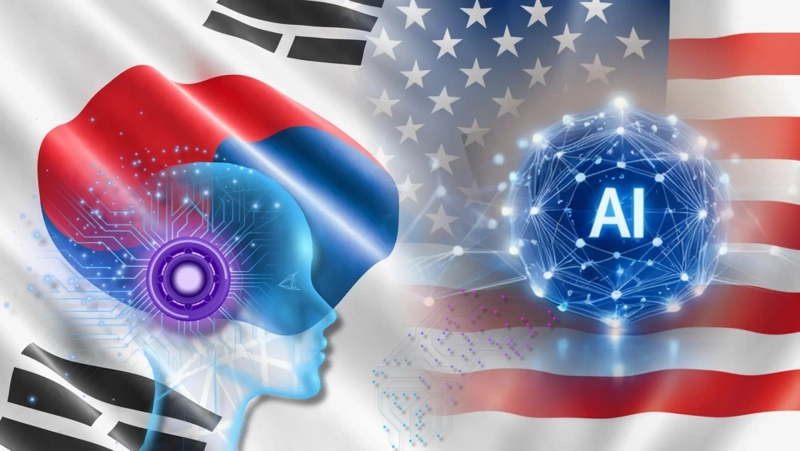
Relying solely on imported artificial intelligence for factories will not be enough to preserve the competitiveness of South Korea’s manufacturing sector, according to a new assessment. With global technology companies bundling semiconductors, cloud infrastructure and AI models into a single ecosystem, the country risks deeper dependence on overseas platforms unless it strengthens its domestic supply base.
The Korea Institute for Industrial Economics and Trade said in a report released Sept. 6 that the focus of AI policy should expand from helping companies adopt the technology to fostering a broader supply ecosystem. If South Korea limits itself to buying and using foreign technology, the AI sector could face problems similar to the supply-chain crisis in materials, parts and equipment that surfaced during Japan’s export restrictions, the report said.
The report said AI competition is shifting from standalone technologies to the full value chain. What it called full-stack vertical integration — linking power, data centers, semiconductors, software and services — is becoming a key driver of corporate competitiveness. Nvidia is combining chips, software and cloud services, while Google, Amazon and Microsoft are integrating their own semiconductors and AI models into cloud platforms.
In that structure, competitiveness in key components such as high-bandwidth memory alone is not enough to secure leadership. Suppliers’ positions can shift depending on the strategies of companies that control the broader ecosystem. Manufacturers that build AI systems around a single platform may also be exposed to lock-in, facing high costs if they try to switch to another service.
The institute said the contrast between South Korea and Europe is evident in the sequence of their manufacturing AI transitions. Since 2021, Europe has laid the groundwork for data sharing and connectivity among companies through projects such as Catena-X and Gaia-X. On top of that base, it has been applying industrial AI to shorten production-line changeover times and advance worker-free automation in some processes.
South Korea, by contrast, has put more emphasis on company-by-company AI adoption projects than on building a shared data foundation. The report said some domestic manufacturing sites spend 70% to 80% of total development time on cleaning and processing data. Unless South Korea also strengthens domestic suppliers of information technology and operational technology, support for AI adoption could end up helping foreign platforms expand their market.
The report identified vertical AI tailored to manufacturing sites as the area where South Korea should focus. Rather than entering the capital-intensive race for general-purpose AI, it said, the more realistic course would be to use the country’s accumulated equipment and process data, along with its production experience.
Manufacturing sites are difficult environments for generic cloud AI to be applied without modification. Some equipment operates on a millisecond basis and must respond immediately to abnormal signals. Delays in sending data to external servers and receiving analysis results can be a constraint. Semiconductor and defense factories that are isolated from external networks for security reasons also face limits in using services that assume outside connectivity.
In such settings, edge technology that processes data near equipment and on-site training capabilities become more important. The institute said South Korea should draw on its manufacturing base to build an AI supply chain capable of making decisions and controlling operations inside factories.
The report also said South Korea needs to move early to define autonomous operation standards, including rules for detecting process abnormalities and enabling equipment to cooperate on its own. The goal, it said, is to move beyond simply buying AI and rise to a position where the country sets the rules for how it operates on factory floors.
Lee Sang-hyun, a senior research fellow at the institute, said operating standards such as criteria for identifying process abnormalities and rules for autonomous cooperation among equipment can only be established by countries that have accumulated extensive manufacturing experience and on-site data. Securing those standards would allow South Korea to move beyond being a consumer of foreign AI and become a country that writes the rules for autonomous manufacturing, he added.
