Tiger Research: Maroo Embeds Financial Regulation in Blockchain, Tailored to South Korea
Summary
- Tiger Research said a network called Maroo, which directly incorporates South Korean financial regulations into a blockchain protocol, has been unveiled.
- It said Maroo was designed to manage regulatory changes and fee-volatility risk through a structure built around a Legal Oracle Committee, a Programmable Compliance Layer (PCL) and won stablecoin OKRW.
- Tiger Research said Maroo could see broader use as the Electronic Securities Act takes effect in February 2027 and discussions on formalizing won stablecoins advance.
Forecast Trend Report by Period


A blockchain network called Maroo, designed to embed South Korean financial regulations directly into its protocol, has been unveiled. The project is led by Hashed Open Finance, an affiliate of Hashed, and is built so that when rules change, every service connected to the network applies the new standards at the same time.
Tiger Research, a Web3 market research firm, said on September 17 that it had published a report analyzing Maroo's structure and potential applications. The report said compliance systems at South Korean financial services providers are currently dispersed across individual companies' code, requiring each firm to separately update its systems whenever standards such as the travel rule change.
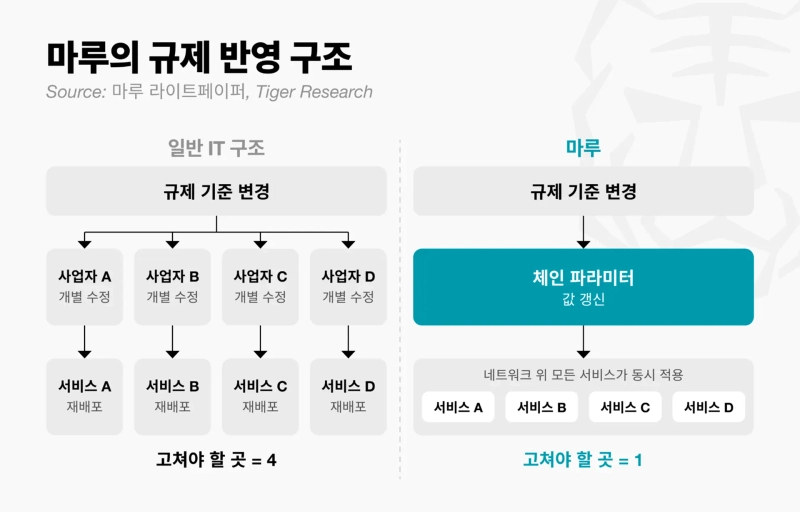
Maroo is designed to solve that by applying regulatory standards at the blockchain level rather than at the service level. A Legal Oracle Committee, premised on participation by supervisory authorities, financial companies and legal institutions, sets the regulatory data. A Programmable Compliance Layer, or PCL, checks every transaction against those standards before execution. Transactions that violate the rules are blocked before being recorded onchain.
When regulations change, only the relevant parameters need to be updated for the new standards to be applied across all services on the network at once. Tiger Research said the structure could be particularly useful in South Korea, where virtual-asset transactions must transmit sender and recipient information regardless of the amount.
Another feature is the adoption of won stablecoin OKRW as the network's base payment unit. On blockchains where fees are paid in volatile crypto assets, user costs can jump when network congestion coincides with rising token prices. Maroo is designed to use a won-based asset so that fee volatility is limited to network congestion. Authority to issue OKRW is managed by the protocol's governance system.
Maroo also built a separate mainnet to secure control over the network. In emergencies such as hacks or illicit fund transfers, the protocol can freeze or recover assets, or reissue them for victim relief. Transaction details are disclosed only to the parties involved through zero-knowledge proofs, while supervisory authorities can review the information with an audit key if legal requirements are met.
The project includes ShardLab, which has built stablecoin payment infrastructure in Southeast Asia, and Delight Labs, which has experience operating multiple mainnets, as partners. All three organizations, including Hashed Open Finance, have development teams in Seoul.
Tiger Research said Maroo's potential use cases could expand as South Korea's Electronic Securities Act takes effect in February 2027 and discussions on formalizing a won stablecoin framework advance. It said the two regimes could intersect as the market develops settlement methods for tokenized securities, increasing the need for infrastructure that can accommodate a range of regulatory scenarios.
"Once the system is finalized, it is difficult to secure enough time to gain an early market lead by choosing infrastructure afterward," Yoon Seung-sik, head of research at Tiger Research, said. "A practical task for institutions is to verify in advance infrastructure that can reflect whatever direction the regulations ultimately take."
