Global Rate Outlook Starts to Resemble Covid Tightening Cycle; Can South Korea Go to 3.5% a Year?
Summary
- Market pricing has begun to reflect expectations that South Korea’s benchmark rate could rise to 3.75% as investors increasingly see the US terminal rate climbing to 4.5%.
- Among domestic and foreign securities firms and banks, JPMorgan is the only one to put South Korea’s terminal rate at 3.75%, though some say rates could move into the 4% range by the second half of next year or the first half of 2028.
- The terminal rate will depend more on domestic economic growth and the inflation trend than on US tightening, and caution still dominates views on any move above 3.75% as production, investment and consumption all declined.
Forecast Trend Report by Period


Debate grows over terminal-rate levels as countries join the tightening march
Australia’s benchmark rate rises above its Covid-tightening peak
Some in the market see South Korea’s terminal rate at 3.75%
Outcome hinges on growth and the inflation trend
Output, investment and consumption all fell in August
Australia’s central bank has raised its benchmark interest rate above the peak reached during the Covid-era tightening cycle, the first such case among major economies. As expectations grow that the US terminal rate will rise, attention is turning to whether South Korea’s benchmark rate could climb above the 3.50% annual peak reached during the pandemic tightening phase.
Norway’s rate also reaches its Covid-era level
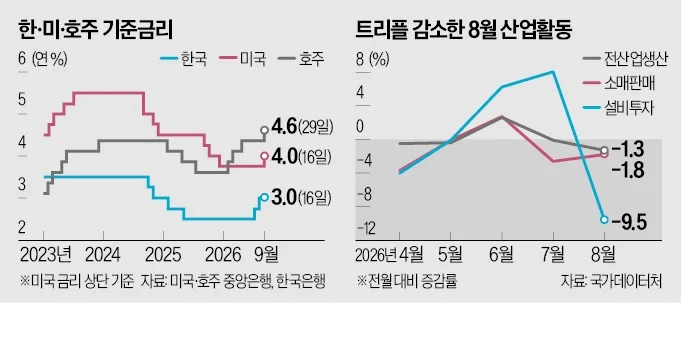
The Reserve Bank of Australia raised its benchmark rate by 25 basis points to 4.60% from 4.35% on Sept. 29. That puts it above the 4.35% peak reached during the withdrawal of pandemic-era stimulus. Persistent inflation pressure, driven by higher oil prices stemming from the Middle East war and rising housing costs, was behind the move. Norway’s central bank also raised its policy rate to 4.50% from 4.25% on Sept. 24. That matches the peak reached during the Covid-era tightening cycle, and the bank left open the possibility of further increases.
Debate is also intensifying in South Korea’s bond market over the terminal policy rate. Many in the market had expected the Bank of Korea to keep its benchmark rate from exceeding the 3.50% peak reached during the Covid tightening cycle. The reasoning was that, even with the Middle East war and a semiconductor boom, inflation would be unlikely to surpass the 6.3% peak seen during the pandemic.
That view has shifted as investors increasingly expect the Federal Reserve’s terminal rate to rise to 4.5%. Some market rates now reflect the possibility that South Korea’s benchmark rate could also rise to 3.75%.
So far, JPMorgan is the only domestic or foreign securities firm or bank to put South Korea’s terminal policy rate at 3.75%. Still, Yoon Yeo-sam, head of equity strategy at Meritz Securities, said risks were becoming more apparent that South Korean rates could be pulled up to 3.75% if concerns deepen that the Fed will raise rates above 4.5% next year. Lee Nam-kang, a senior researcher at Korea Investment Holdings, said the benchmark rate could rise into the 4% range by the second half of next year or the first half of 2028.
Domestic growth and inflation are key
Many analysts say the terminal rate will depend less on how far the US tightens than on South Korea’s domestic growth trend and the underlying path of inflation. Even if the rate gap with the US widens, that does not mean the won is likely to spike immediately.
In the short term, the key data point is the September consumer price index, due on Oct. 2. The market consensus is 2.9%. While still high, that reading is heavily affected by the timing of the Chuseok holiday, which fell in September this year versus October last year. Consumer-side inflation pressure from the semiconductor boom, which the Bank of Korea is watching closely, has yet to show up clearly. Statistics Korea said on the same day that the all-industry production index fell 1.3% from the previous month to 118.7 in August, following a 0.1% decline in July. It was the second straight monthly drop. Fewer working days during the vacation season and production disruptions caused by a strike at Hyundai Motor weighed on output.
The retail sales index, a measure of goods consumption, fell 1.8%, also posting a second straight monthly decline. Sales of durable goods such as passenger cars dropped 4.5%, while sales of nondurable goods including food and beverages fell 1.6%. Facility investment also plunged 9.5%.
Choi Ji-wook, a managing director at State Street Markets, said the possibility remains open that the terminal rate could rise to 3.50%, but it is too early to expect 3.75% or higher. He added that the Bank of Korea is likely to raise rates once more in November, then assess oil prices, the housing market and demand-side inflation pressure before deciding whether further tightening is needed.
Seong-mi Shim, Hankyung.com reporter smshim@hankyung.com

Korea Economic Daily
hankyung@bloomingbit.ioThe Korea Economic Daily Global is a digital media where latest news on Korean companies, industries, and financial markets.