South Korean Retail Investors Buy $3.9 Billion of U.S. Treasuries in Third Quarter
Summary
- South Korean retail investors were net buyers of about $3.9 billion of U.S. Treasuries from July through September, the largest quarterly total since 2011.
- As yields on 10-year and 30-year U.S. Treasuries climbed to peak levels, money shifted from bank deposits and U.S. stocks into bonds.
- A decline in the won-dollar exchange rate reduced the burden of investing in U.S. Treasuries, but investors in long-term bond ETFs could face losses if market interest rates rise further.
Forecast Trend Report by Period


Demand Surges as 10-Year Yield Tops 5%
Biggest Quarterly Buying Since 2011
Lower Won-Dollar Rate Eases Buying Costs
South Korean retail investors are piling into U.S. Treasuries. The move comes as the 10-year Treasury yield climbed above 5%, drawing more investors to U.S. bonds instead of bank deposits and other savings products.
According to the Korea Securities Depository, domestic investors bought a net 5.3861 trillion won of U.S. Treasuries in the July-to-September period, or about $3.9 billion. It was the largest quarterly total since the agency began compiling the data in 2011. Demand turned positive in July, after investors were net sellers of 226.2 billion won in June, before switching to net purchases of 1.207 trillion won in July. Net buying reached 2.4733 trillion won in August and 1.7058 trillion won in September.
Investors have shifted into bonds to lock in higher interest income after Treasury yields climbed to their highest levels in two decades. The 10-year Treasury yield rose to 5.24% on Sept. 28 from 4.48% on July 1, the highest level since 2007. Over the same period, the 30-year Treasury yield climbed to 5.56% from 4.97%.
By contrast, demand for U.S. stocks cooled. South Korean investors' net purchases of U.S. shares fell 57.7% to 2.6676 trillion won in August from 6.3109 trillion won in July. The jump in Treasury yields appears to have redirected some overseas investment funds from stocks into bonds.
A decline in the won-dollar exchange rate also reduced the burden of investing in U.S. Treasuries. The rate fell about 5.7% to 1,359.4 won per dollar on the morning of Sept. 29 from 1,441.8 won on Jan. 2, the first trading day of the year. That means investors needed less won to buy the same amount of U.S. government debt.
Retail investors can buy U.S. Treasuries directly through domestic brokerages or invest in bond exchange-traded funds listed in the U.S. or South Korea. In both cases, they must convert won into dollars, so a lower won-dollar exchange rate reduces the entry burden for new investors.
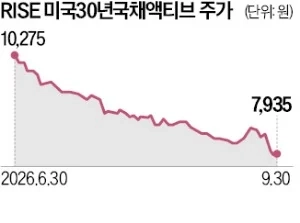
Still, investors need to account for the possibility that market rates could rise further. Those who bought long-duration bond ETFs over the past one to two months while betting on lower long-term U.S. yields have posted losses. RISE US Treasury 30Y Active closed at 7,955 won on Sept. 29, down about 7.2% from the end of August.
Bae Jeong-cheol, Hankyung reporter, bjc@hankyung.com

Korea Economic Daily
hankyung@bloomingbit.ioThe Korea Economic Daily Global is a digital media where latest news on Korean companies, industries, and financial markets.