PiCK
FOMO Adds Social Layer to Crypto Trading, Draws 2.7 Million Users in 17 Months
Summary
- FOMO said it is a social trading app that supports multiple blockchains, and that it has reached 2.7 million users and $250 million to $300 million in daily spot trading within 17 months.
- FOMO said it plans to expand beyond memecoins into tokenized stocks, RWA and stablecoin-based yield products, and that it will work with technology providers that have compliant frameworks and deep liquidity.
- FOMO said it has no plans to issue a native token and is targeting an IPO, with the aim of letting users participate in the company’s growth through the stock market.
Forecast Trend Report by Period


Interview with FOMO CEO Park Se-yong
Sharing Not Just Trades, but the Reasons Behind Them
Expanding Beyond Memecoins to Tokenized Stocks
Targeting an IPO Instead of Issuing a Native Token
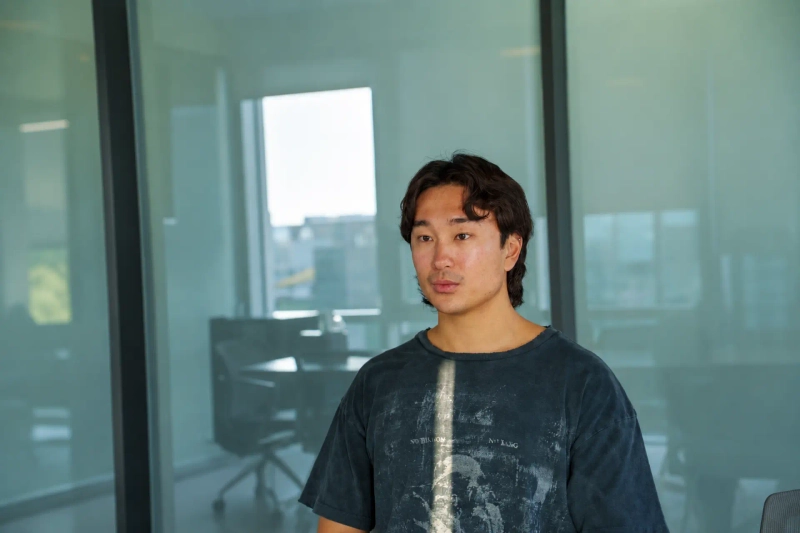
Investors often arrive to buy a specific coin, complete the trade and leave. Park Se-yong, chief executive officer of FOMO, sees that as a problem the crypto industry still needs to solve. Even users who enter the market with genuine interest have limited opportunities to explore other assets or learn how investment decisions are made. That is why he combined trading with social networking features.
“You need to be able to see not just what someone bought or sold, but why they made that decision,” Park told Bloomingbit in an interview on Oct. 1. “I thought the market needed a transparent space where users could communicate with one another and better understand it.”
FOMO is a social trading app that lets users trade digital assets across multiple blockchains, track other investors’ buy and sell activity in real time and share investment views. It supports seven networks, including Solana, Base, BNB Chain and Robinhood Chain. The app also handles the complexity of bridging assets between chains, reducing the hassle of moving funds manually.
Since its public launch in May 2025, FOMO has attracted 2.7 million users in about 17 months. In September, daily spot trading volume ran at about $250 million to $300 million, while perpetual futures volume was about $10 million. Fee revenue over the past 30 days totaled about $31.87 million, or roughly 60% of Pump.fun’s level. The company has raised $93 million in cumulative funding, including early-stage investment.
Beyond ‘Who Bought’ to ‘Why They Bought’
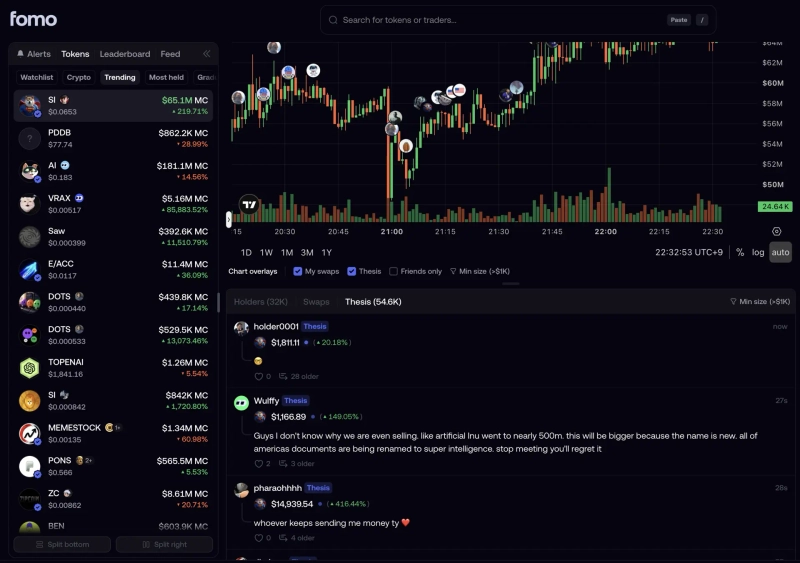
Park described FOMO not as an exchange, but as a social platform where users can trade. Instead of building its own trading venue, the app routes orders by linking multiple decentralized trading pools and service providers. That structure helps users access assets already tradable on-chain without waiting for a listing on a centralized exchange.
Its distinguishing feature is that trading and information discovery happen in one place. Users can monitor other investors’ trades in real time and receive alerts. After buying an asset, they can write out their investment rationale or link related articles and posts on X to explain their thinking. The app also provides a daily roundup of crypto markets, stocks and major economic developments.
Some users come in to buy a single token and then do not know what to do next, Park said. In those cases, they either keep trading only familiar coins or withdraw all their money. Being able to see what others are doing and discussing gives them a chance to learn how the market works.
The next step is user-to-user discussion. FOMO plans to add features that let users comment on investment views, ask questions and offer different perspectives. The aim is to move beyond simply copying high-return traders and instead examine the reasoning behind investment decisions.
Asked whether making other investors’ trades and returns public could encourage excessive speculation, Park emphasized education. The priority is to help users understand what assets exist and why people are buying them. Users should be able to judge what matters to them and make their own decisions.
To support that, the company plans to strengthen its investor-education tools. In addition to the daily market summary and the feature that lets users share the reasoning behind trades, FOMO plans to introduce discussion functions that support comments and questions. Users should be able to challenge someone else’s investment view or disagree with the assumptions behind it. Park said he wants those conversations to help users learn about the market.
FOMO is also trying to reduce friction in the trading process. The company currently covers network fees, or gas fees, on chains such as Solana. Trading fees offset part of that cost, though Park said generating profit from small investors is not the main objective. He added that the company cannot fully control costs on other blockchains because it relies on outside service providers.
“When people trade on a traditional finance app, they usually do not think about separate charges that are hard to identify,” he said. “Blockchain services need to offer a user experience closer to what existing financial apps provide.” He added that the goal remains to keep covering gas fees over time.
From Memecoins to Stocks and RWA
FOMO’s next task is broadening the assets available for trading. Park said memecoins currently account for about 50% of activity on the platform. The company plans to expand into tokenized stocks, real-world assets, or RWA, major cryptocurrencies and yield products built on stablecoins.
Rather than issuing all of those products itself, FOMO plans to work with specialist providers. Companies that put assets on-chain would supply the products, while FOMO would act as the distribution channel connecting them to users.
“We want to work with technology providers that have compliant frameworks and deep liquidity,” Park said. “We want to serve as a distribution gateway where users can discover and trade assets from partners that tokenize stocks and RWAs.”
Park said FOMO’s long-term competitiveness will come less from the number of products it offers than from the relationships between users. The company wants to build a network where investors can find others by area of interest, such as stocks or RWAs, and review their trades and decision-making transparently. “FOMO’s strength will be its network of people connected through finance,” he said. “Users should be able to find people who perform well in the areas they care about.”
No Native Token, IPO Is the Goal
Park ruled out issuing a native token. Running a service and a token at the same time would force an early-stage company to split its focus between two businesses, he said. “For a startup, building a single product already provides more than enough work,” Park said. “Operating two products at once can be a heavy burden.”
Instead, the company’s long-term goal is an initial public offering. The idea is to let users participate in FOMO’s growth through equity rather than through a token. “We have always aimed to become a public company,” Park said. “We want to give users who want to participate in the company’s growth that opportunity through the stock market.”
On South Korea, Park said he was struck by investors’ high level of engagement and the strength of local communities. He said the company does not yet have concrete plans such as setting up a local entity or forming domestic partnerships. This visit to Korea was focused less on announcing expansion plans than on understanding the market by meeting investors, companies and media organizations.
“In Korea, it is interesting to see communities form around deep conviction in a specific token or project,” Park said. “I want to better understand what kind of experience they are having and where they feel friction.”
He also did not argue that on-chain trading is necessary for every Korean investor. If users want to trade assets that have been hard to access through existing channels, FOMO can help with that process, he said. The first step is understanding what users find inconvenient, and in some cases there may be no problem to solve.
“What is shaping our direction right now is understanding users and their experience,” Park said. “If anyone wants to talk about the market or crypto, I’d like to hear their views.”
