PiCK
South Korea’s Super-Rich Sold $1.16 Billion of Samsung, SK Hynix Stock. Here’s What They Bought
Summary
- Ultra-wealthy investors moved to take profits and raise cash allocations by net selling 1.6 trillion won ($1.16 billion) of first-half market leaders including Samsung Electronics and SK Hynix.
- They concentrated purchases in preferred shares with strong dividend appeal and covered-call ETFs that pay monthly distributions, adopting an income-focused defensive strategy in a volatile market.
- Investors with more than 3 billion won in assets responded to fourth-quarter market uncertainty and the potential for a rebound with a barbell strategy combining leveraged ETFs and turnaround stocks.
Forecast Trend Report by Period


Took Profits on $1.16 Billion of Samsung, SK Hynix Shares
Also Bought Covered-Call ETFs With Monthly Payouts
South Korea’s ultra-wealthy investors sold about 1.6 trillion won ($1.16 billion) worth of Samsung Electronics Co. and SK Hynix Inc. shares in the third quarter. They reworked portfolios with an extreme barbell strategy, selling market leaders that had surged over a short period and buying both dividend-rich preferred shares and leveraged products that could deliver double returns in a rebound.
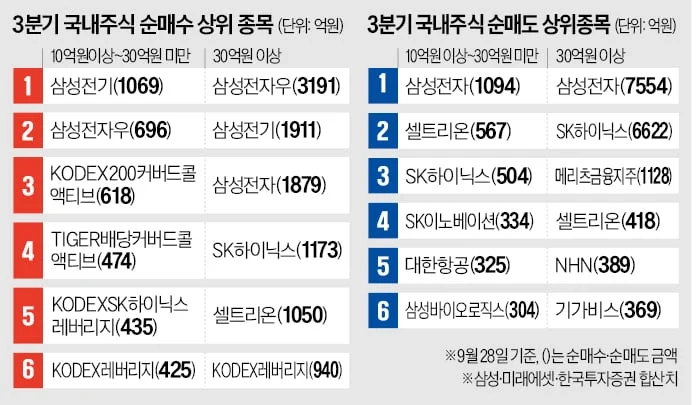
An analysis by the Korea Economic Daily on Oct. 4 of third-quarter portfolios at Samsung Securities Co., Mirae Asset Securities Co. and Korea Investment & Securities Co. showed Samsung Electronics and SK Hynix were the two most heavily sold domestic stocks among clients with at least 1 billion won in financial assets. They were net sellers of 864.8 billion won ($626 million) of Samsung Electronics and 718.9 billion won ($520 million) of SK Hynix. The shift points to tighter risk management as stock volatility intensified amid debate over peak valuations and concerns about an artificial-intelligence bubble.
Those investors bought heavily into preferred shares offering stable dividends and covered-call exchange-traded funds that pay monthly distributions. Clients with more than 3 billion won in financial assets did not stop at defensive positions. They also raised exposure to higher-risk products, concentrating on leveraged ETFs tied to the Kospi 200 or the semiconductor sector that aim to deliver twice the underlying return.
In overseas stocks, they bought heavily into names linked to the AI power-infrastructure theme, including SpaceX and Vertiv Holdings Co., to position for the fourth quarter.
Wealthy Investors Sold Samsung and SK Hynix, Bought Covered Calls
Portfolio Analysis Shows Profit-Taking in First-Half Leaders Such as Defense and Food
South Korea’s stock market swung sharply in the third quarter, from July through September, and has since struggled to break out of a narrow range. How did investors managing tens of billions of won respond? Domestic equity portfolios among ultra-wealthy investors showed a clear split by asset bracket in the third quarter. The focus shifted from capital gains to income assets. Investors with 1 billion won to less than 3 billion won in financial assets favored covered-call ETFs, while those with 3 billion won or more opted for preferred shares.
Semiconductor Top Two Saw the Heaviest Selling
The Korea Economic Daily’s analysis of portfolios at the country’s three largest brokerages — Samsung Securities, Mirae Asset Securities and Korea Investment & Securities — showed that high-net-worth clients with more than 1 billion won in financial assets sold down Samsung Electronics and SK Hynix, the two stocks that led the domestic market in the third quarter. On a combined basis across the three firms, they were net sellers of 864.8 billion won ($626 million) of Samsung Electronics and 716.2 billion won ($519 million) of SK Hynix. Net selling in those two names alone topped 1.5 trillion won ($1.09 billion).
Another stock that saw notable profit-taking was Meritz Financial Group Inc., which hit a record high on expectations it would benefit from the government’s corporate value-up program. Investors with more than 3 billion won in assets were net sellers of 112.8 billion won ($81.7 million). Leading South Korean defense names that had rallied sharply also became targets for profit-taking. Investors with 1 billion won to less than 3 billion won in assets sold 21.1 billion won ($15.3 million) of Hanwha Aerospace Co., while the group with more than 3 billion won in assets was a net seller of 34.8 billion won ($25.2 million) of LIG Nex1 Co. They also pared holdings in Alteogen Inc. by 27.9 billion won ($20.2 million) and Samyang Foods Co. by 26.9 billion won ($19.5 million).
A private banker at a securities firm said wealthy investors focus on the long-term growth potential of specific sectors. But once a stock has delivered tenfold returns or market interest becomes so intense that valuation concerns mount, they move quickly to lock in gains. That helps explain why they sold first-half leaders in semiconductors, value-up plays, defense and food, while raising cash ahead of fourth-quarter uncertainty.
Preferred Shares, Covered-Call ETFs Used to Defend Returns
What filled the gap were preferred shares with stronger dividend appeal and covered-call ETFs. Investors with 1 billion won to less than 3 billion won in assets mainly bought covered-call ETFs. KODEX 200 Covered Call Active, with net buying of 61.8 billion won ($44.8 million), ranked third, while TIGER Dividend Covered Call Active, at 47.4 billion won ($34.3 million), ranked fourth. The products are designed to cushion part of any decline through option premium income when the underlying assets fall, while paying monthly distributions. The approach points to a search for steady cash flow in a directionless market.
Investors with more than 3 billion won in assets bought 319.1 billion won ($231 million) of Samsung Electronics preferred shares, making them the top net purchase. They sold more than 750 billion won ($543 million) of Samsung Electronics common stock while concentrating buying in the preferred shares. The attraction was the lower price relative to the common shares and the higher dividend yield. Recent share-price declines also lifted the indicated cash dividend yield to about 3% annually.
Even with the Kospi stuck in a range, net buying of leveraged ETFs stood out. Investors with more than 3 billion won in assets, after heavily cutting Samsung Electronics and SK Hynix, bought more than 250 billion won ($181 million) combined of KODEX Leverage, at 94 billion won ($68.1 million), TIGER SK Hynix Single Stock Leverage, at 88.4 billion won ($64.1 million), and KODEX SK Hynix Single Stock Leverage, at 70.3 billion won ($50.9 million). The positioning suggests they treated the short-term pullback as an opportunity to add leverage.
Park Jin-young, a private banker at Samsung Securities, said ultra-wealthy clients responded with a barbell strategy that paired preferred shares and covered-call products with leveraged ETFs, unlike retail investors who stayed on the sidelines as fourth-quarter uncertainty persisted over high oil prices, higher interest rates and the U.S. midterm elections.
Wealthy investors also bought aggressively into turnaround names that had lagged the first-half artificial-intelligence rally, including Samsung Electro-Mechanics Co., with 191.1 billion won ($138 million) of net buying, and Celltrion Inc., with 105 billion won ($76.1 million).
Ahn Sang-mi, Korea Economic Daily reporter, saramin@hankyung.com

Korea Economic Daily
hankyung@bloomingbit.ioThe Korea Economic Daily Global is a digital media where latest news on Korean companies, industries, and financial markets.