XRP Seoul 2026 Draws 5,000, Marks Official Launch of XRP Asia
Summary
- More than 5,000 people attended XRP Seoul 2026, where XRPL-based NFT tickets were used.
- Ripple said it introduced a pilot to fund payment liquidity using XRP as collateral and new XRPL features at the event.
- The event also marked the launch of Singapore-based XRP Asia, while South Korean financial institutions discussed applications for tokenized deposits, stablecoins, RWAs and blockchain-based cross-border remittances.
Forecast Trend Report by Period


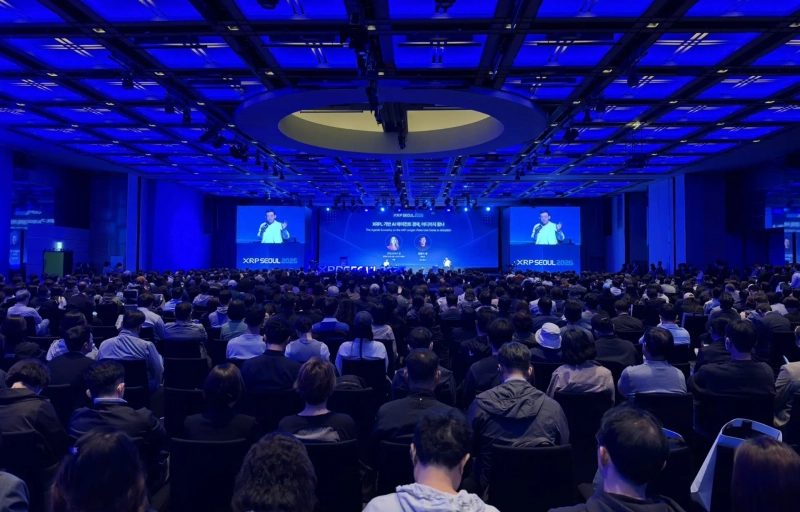
Asia’s largest XRP conference, XRP Seoul 2026, drew more than 5,000 attendees and concluded on Oct. 3 at the Grand Hyatt Seoul in Yongsan, XRPL Korea said on Oct. 6.
Held during Korea Blockchain Week 2026, or KBW2026 with Upbit, the event was hosted by XRPL Korea with Ripple as title sponsor. Attendance rose from about 3,000 last year to more than 5,000 this year. Entry tickets were issued as non-fungible tokens on the XRP Ledger, or XRPL.
Ripple President Monica Long attended the event, along with Christina Chan, senior director of ecosystem growth at Ripple, and Ayo Akinyele, senior director of engineering at Ripple. Other speakers included Johann Kerbrat, senior vice president at Robinhood; Ashish Birla, chief executive officer of Evernode; and Alex Manson, managing director at SC Ventures. More than 40 speakers took part, including global industry executives and South Korean financial-sector officials.
In a session with Chan, Long said Ripple is conducting a credit-related pilot aimed at activation next year. The company plans to use XRP as collateral to fund part of customers’ payment liquidity. Akinyele also introduced new features planned for XRPL, including zero-knowledge-proof-based confidential transfers and infrastructure for artificial intelligence agents.
The event also included the official launch announcement of XRP Asia, an independent organization supported by Ripple and the XRP Ledger Foundation. Headquartered in Singapore, the group plans to support developer education, hackathons and startup grants across Asia-Pacific to expand the XRPL ecosystem.
Sabrina Tachjian, president of XRP Asia, said the organization would support established communities such as XRPL Korea and XRPL Japan while also building new communities across Asia-Pacific.
South Korean financial institutions including Woori Bank, KakaoBank, K Bank, Kyobo Securities, Meritz Securities and Jeonbuk Bank joined discussions on practical applications for tokenized deposits, stablecoins, real-world asset tokenization and blockchain-based cross-border remittances. KakaoBank outlined a plan to integrate basic digital-asset services into its core banking system starting in 2027. Meritz Securities emphasized the need for regulatory clarity to help the won-denominated stablecoin market grow.
Robinhood focused on tokenized stocks and the potential for 24-hour trading. Kerbrat said 70% of the company’s trading volume occurs on weekends and at night. “24-hour tokenized stock trading would be a remarkable shift,” he said. Blockchain can reduce delays in clearing and settlement in traditional financial markets and improve trading infrastructure, he added.
Eighteen companies from South Korea and overseas, including Doppler Finance and Kweather, also participated as sponsors. On the night of the event, a beam projection commemorating XRP Seoul was displayed at N Seoul Tower.
An XRPL Korea official said turnout of more than 5,000 this year, up from about 3,000 last year, underscored strong interest in the XRP ecosystem. The group plans to keep using XRP Seoul to connect the global XRPL ecosystem with South Korean financial institutions, companies and developers, and to turn those discussions into real collaborations and services.
