Chainalysis Says South Korea’s $449.1 Billion Crypto Economy Is East Asia’s Largest, With AI Tokens Prominent
Summary
- South Korea’s cryptocurrency economy reached $449.1 billion, the largest in East Asia, and rose 12.3% from a year earlier.
- Domestic trading in AI-linked cryptocurrencies accounted for about 18% of all won-denominated trading, surpassing payment tokens as retail-led activity drove market growth.
- The report said broader corporate participation in the cryptocurrency market and regulatory changes including a tax on cryptocurrency income set for 2027 could affect participation patterns in the domestic market.
Forecast Trend Report by Period


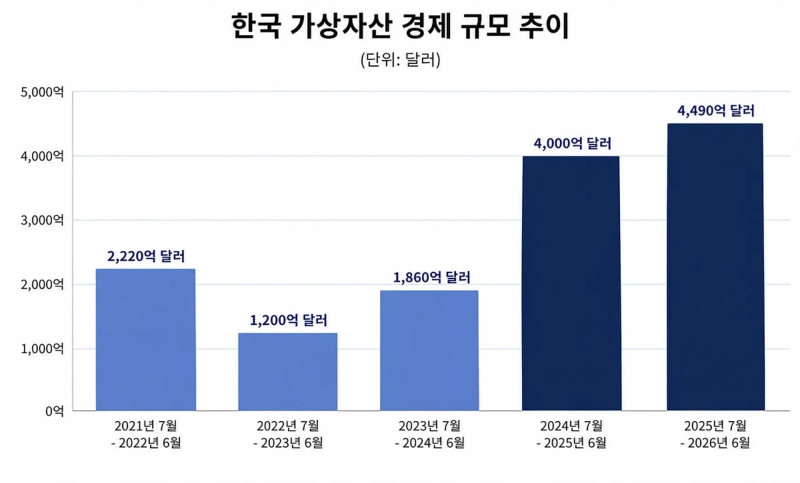
South Korea’s cryptocurrency economy reached $449.1 billion, the largest in East Asia, according to Chainalysis. Trading in artificial intelligence-linked tokens was especially prominent in the domestic market, which remains driven largely by retail investors.
In its East Asia Crypto Adoption Report released on Oct. 6, the blockchain data platform said South Korea’s crypto economy totaled $449.1 billion in the 12 months from July 2025 through June 2026. That was up 12.3% from a year earlier. The figure exceeded Japan’s $228.3 billion, Hong Kong’s $192.2 billion, China’s $176.3 billion and Taiwan’s $140.4 billion.
Crypto activity through domestic exchanges also rose 16.3% from a year earlier. Exchange-related fund flows increased by $51.1 billion. The report said retail-led trading drove growth in South Korea even though major financial institutions have yet to enter the market in a meaningful way.
Strong interest in AI-linked cryptocurrencies was another defining feature of the South Korean market. As of June, those tokens accounted for about 18% of all won-denominated crypto trading, the highest share among major thematic asset groups. That exceeded the share of payment tokens such as XRP.
The share of AI-linked crypto in won trading was 19.5 times that seen in yen-denominated trading. It was also well above the shares recorded in Brazilian real-, British pound- and euro-denominated trading.
Among AI-linked cryptocurrencies, Worldcoin had the largest trading volume at $7.41 billion. It was followed by Sahara AI at $3.2 billion, Virtual Protocol at $2.7 billion, Bio Protocol at $2 billion and Near Protocol at $1.7 billion.
Preferred tokens also shifted quickly. Last year, trading was led by Virtual Protocol and KAITO. This year, Worldcoin and Sahara AI emerged as the leading names. Chainalysis said South Korean retail investors tended to rotate among favored AI-linked tokens more quickly than participants in other markets covered by the analysis while continuing to trade actively.
The report also raised the possibility that broader corporate participation in the crypto market could alter the structure of the domestic market. Major South Korean banks and securities firms have set up dedicated digital-asset teams and are running pilot projects tied to stablecoins, tokenization and custody. Corporate participation for investment purposes, however, has yet to begin in earnest.
As the government pursues a phased plan to allow corporate participation in the crypto market, the report said regulatory changes could shape how retail and institutional investors participate in South Korea going forward. Those changes include broader corporate access and a tax on crypto investment income scheduled to take effect in 2027.
The report also examined market characteristics across major East Asian jurisdictions. In Hong Kong, inflows through institution-focused platforms accounted for 16% of total inflows into crypto services. In Japan, decentralized exchanges accounted for 34.5% of the crypto services market. In China, 59.1% of the total crypto economy was estimated to come from person-to-person fund flows.
Kwon Jun-hyuk, head of Chainalysis Korea, said South Korea remains a market with active retail participation, with particularly strong interest in AI-linked cryptocurrencies and rapid shifts in investor preferences. As participation by corporations and institutions expands, the domestic crypto market is expected to become more diverse. Chainalysis will continue contributing to a safer and more transparent market environment through reliable blockchain data and analysis, he added.
