PiCK
How Long Will the Slide Last? Strategists Say Kospi Rebound Hinges on Big Tech Earnings After Breaking Below 6,000
Summary
- Strategists said the Kospi’s break below 6,000, combined with foreign selling, rising interest rates and a vacuum in market demand, could leave stocks in a difficult stretch for at least two to three weeks.
- They said AI remains a foundational technology revolution and semiconductor conditions could stay firm for two to three years, while SK Hynix earnings and shareholder returns and Big Tech earnings will be key variables for a market rebound.
- Strategists said a return to the previous peak this year will be difficult and advised holding cash, diversifying across global core companies, avoiding leverage and buying in stages.
Forecast Trend Report by Period


Kospi breaks below 6,000
Emergency assessment from market strategists
“The AI cycle isn’t over yet...
Big Tech earnings are the key variable for a market rebound”
Kospi heavily exposed to memory stocks
No clear buyers to absorb foreign selling
Tough stretch may last at least two to three weeks
Focus on SK Hynix shareholder returns
Quick recovery to the previous peak looks difficult
Hold cash and diversify across core companies
On Oct. 15, the Kospi fell below the 6,000 level and slid into the 5,500 range. The Kospi and Kosdaq both tumbled more than 7%, triggering back-to-back circuit breakers. Doubts about the profitability of artificial intelligence intensified after Anthropic’s third-quarter results, while concerns over U.S. inflation added to worries that interest rates could rise further. South Korea’s stock market, heavily weighted toward memory-chip names, fell more sharply because there were few buyers willing to absorb foreign selling.
The Korea Economic Daily conducted an emergency survey of six market strategists on Oct. 15 to gauge the outlook. Their view was that earnings forecasts have not changed materially, but higher funding costs from rising rates and skepticism over 2028 earnings are weighing on share prices.
◇“Rates and flows are weighing more heavily on Korean stocks”
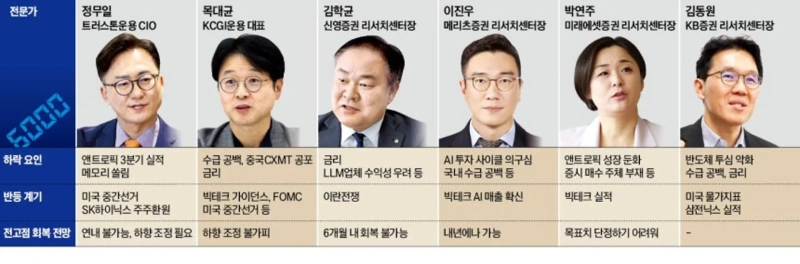
Jeong Moo-il, chief investment officer at Truston Asset Management, said Anthropic’s third-quarter results were the decisive trigger for the day’s selloff. Monthly annual recurring revenue stalled at its July peak, and quarterly revenue growth also slowed. Park Yeon-joo, head of research at Mirae Asset Securities, said slowing growth at Anthropic and a sharp drop in CoreWeave bond prices had heightened concerns over how quickly AI investment can pay off.
The strategists pointed to South Korea’s concentration in memory stocks and a gap in buying demand as reasons the market fell harder than others. Jeong said Taiwan has a broader non-memory value chain centered on TSMC, while South Korea is more concentrated in memory and therefore more exposed. Mok Dae-gyun, chief executive officer of KCGI Asset Management, said share buybacks that had supported the market were effectively over, leaving domestic demand in a vacuum.
Lee Jin-woo, head of research at Meritz Securities, said the problem was not market panic but the absence of foreign buying. Mok said long-only funds and global capital had shifted into risk-management mode, and that the difficult stretch could last at least two to three weeks. Kim Hak-kyun, head of research at Shin Young Securities, cited rising U.S. rates, while Kim Dong-won, head of research at KB Securities, pointed to macro uncertainty including rates and oil prices as drivers of the rout. Park said foreign selling was concentrated in profit-taking and that market flows would normalize in line with fundamentals.
◇“The semiconductor cycle can stay firm for two to three years”
Strategists remain upbeat on AI-related earnings. Park said AI is a foundational technology revolution and that semiconductor industry conditions could remain firm for the next two to three years. Kim Hak-kyun said the market reaction to the string of negative developments looked excessive, though high volatility would be unavoidable for the time being. He added that SK Hynix’s drop of more than 50% from its peak was also a reaction to a more than 17-fold rise.
Potential catalysts for a rebound include the U.S. midterm elections and SK Hynix earnings and shareholder returns. Lee said the market also began to stabilize in the last cycle after Microsoft and Amazon reported second-quarter earnings. Investors took comfort then as key AI companies gave a clearer picture of the investment cycle. He said a similar pattern could emerge this time. If Big Tech restores confidence that AI-related revenue is indeed materializing, foreign flows will likely move in tandem.
◇“A return to the previous peak this year will be difficult”
The strategists’ response is to endure the volatility and stay selective. Mok recommended holding cash. Park advised diversifying across global core companies and building positions gradually. Lee said the market is in a historically oversold zone, making a rebound more likely than further declines, but added that investors should avoid leverage because volatility could intensify further. Even if a technical rebound emerges, he said, investors should not assume it marks a trend reversal. Instead, they should buy in stages while monitoring turnover, foreign flows and the stability of large semiconductor stocks.
The strategists were united in saying a quick return to the previous peak of 9,114.55 would be difficult. Lee said the chances of reclaiming that high before year-end are low and that confidence in semiconductor earnings growth and an improvement in foreign flows must come first. He added that a more dramatic recovery scenario may only be possible next year. Sharp short-term rebounds remain possible because the market is oversold, but a return to the earlier optimistic index levels would require confirmation of a much stronger cycle.
Ahn Sang-mi, Korea Economic Daily reporter saramin@hankyung.com
Ko Song-hee, Korea Economic Daily reporter hgsong@hankyung.com

Korea Economic Daily
hankyung@bloomingbit.ioThe Korea Economic Daily Global is a digital media where latest news on Korean companies, industries, and financial markets.