U.S. 10-Year Yield Falls Despite PPI Shock
Summary
- U.S. September CPI and PPI both exceeded expectations, but the yield on the 10-year Treasury fell after the data was released.
- Markets see little chance of a rate hike in November, but are factoring in a rate hike in December and the possibility of additional increases after that.
- A sharp selloff in U.S. tech stocks and concern over slower AI growth are driving money into safe-haven U.S. Treasuries, putting downward pressure on Treasury yields.
Forecast Trend Report by Period


Tech Stocks Sold on Fears AI Boom May Be Peaking
Money Flows Into Safe-Haven U.S. Treasuries
This article appeared on Hankyung Premium 9, the paid investment platform of the Korea Economic Daily. Subscribers to Hankyung Premium 9 can access more global investment stories at www.hankyung.com/premium9.
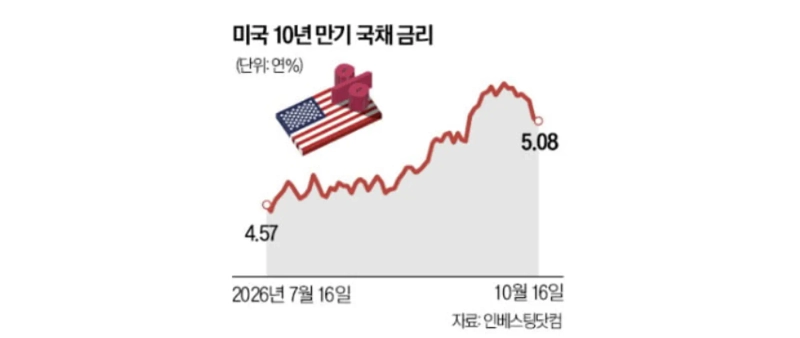
U.S. 10-year Treasury yields fell even after September consumer and producer price data came in well above market expectations.
As of 4 p.m. on Oct. 16, the yield on the 10-year Treasury was trading around 5.08%. As recently as Oct. 14, it was well above 5.3%. The yield fell sharply after the release of the September CPI and PPI data. Normally, short- and long-term yields rise together when inflation picks up and concern grows over higher policy rates, because investors sell Treasuries to reflect the prospect of further tightening.
U.S. September PPI, often seen as a leading indicator of consumer inflation, rose 6.3% from a year earlier. That was the highest level since December 2022. Core PPI, which excludes energy and food, rose 0.7%, well above the market forecast of 0.3%. Core CPI, released a day earlier, climbed 2.6% from a year earlier, fueling concern that inflation may take longer than expected to cool.
CNBC reported that Wall Street's average forecast for September core personal consumption expenditures inflation, based on the CPI and PPI figures, stands at 0.32%. That is up sharply from 0.25% in August. "The market's earlier expectation that U.S. inflation would stabilize from the second quarter of next year is starting to waver," Lee Eun-taek, an analyst at KB Securities, said.
The Federal Reserve is unlikely to raise interest rates in October ahead of the November midterm elections. Even so, markets are looking for a rate increase in December. "This is a time when investors also need to keep in mind the possibility of additional hikes after December," Ahn Ye-ha, an analyst at Kiwoom Securities, said.
Even in that environment, experts cite demand for safe-haven assets and concern over slower growth in the technology industry as reasons Treasury yields are falling instead. U.S. tech stocks have dropped sharply in recent sessions, wiping more than $1 trillion from the market value of major technology companies in the span of a week. As investors seek refuge from stock-market volatility, Treasuries are drawing fresh demand as a haven.
At a deeper level, doubts over whether growth in the artificial intelligence industry can continue are also weighing on yields. Mohamed El-Erian, chief economic adviser at Allianz, said the move into safe assets is strengthening as nominal rates hit their highest levels in years and credit stress emerges in vulnerable sectors. He added that concern is especially high over whether the technology sector, one of the two main engines of U.S. economic growth, can maintain solid momentum.
Shim Seong-mi, Korea Economic Daily reporter smshim@hankyung.com

Korea Economic Daily
hankyung@bloomingbit.ioThe Korea Economic Daily Global is a digital media where latest news on Korean companies, industries, and financial markets.