PiCK
Kospi Selloff Drives Forced Liquidations to Nearly 300 Billion Won as Buying Pours Into Triple-Leveraged ETFs Overseas
Summary
- The Kospi's seven-session decline led to 298.1 billion won in forced liquidations tied to margin trading, while investor deposits also fell.
- Amid turmoil in South Korea's stock market, domestic investors' net purchases of U.S. stocks reached $3.5 billion, with buying concentrated in triple-leveraged ETFs such as SOXL and KORU.
- As retail investors continued net bond purchases at home and abroad, a brokerage executive said a review of market rules and measures to restore investor confidence are needed.
Forecast Trend Report by Period


Forced liquidations hit 169.8 billion won over two days of steep declines
Investor cash balances shrink as bond buying continues
"Restoring market confidence matters more than simply warning investors"
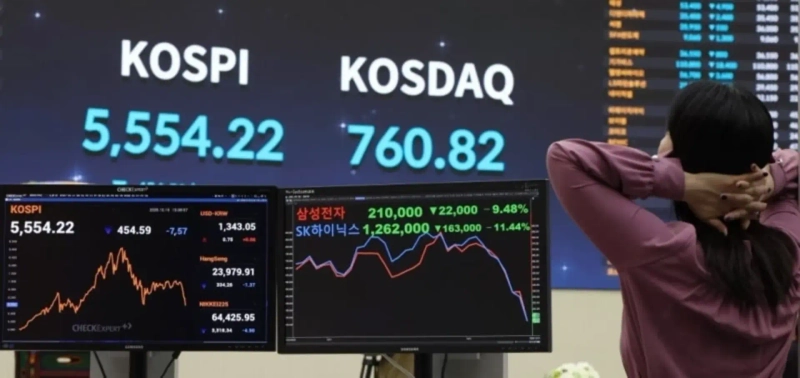
Forced sales tied to margin trading neared 300 billion won ($215 million) as the Kospi fell for seven straight trading sessions. Investor cash parked in the stock market also shrank. At the same time, South Korean investors' net purchases of U.S. stocks surpassed the total for all of last month, with buying concentrated in high-risk products betting on a rebound in semiconductor shares.
Forced liquidations tied to unpaid margin purchases totaled 298.1 billion won ($215 million) from Oct. 6 to Oct. 15, according to the Korea Financial Investment Association on Oct. 17. Of that, 169.8 billion won ($122 million) was concentrated in just two days, Oct. 14 and Oct. 15. The daily totals were 89.3 billion won ($64.4 million) on Oct. 14 and 80.5 billion won ($58.1 million) on Oct. 15.
A forced liquidation occurs when a brokerage sells an investor's shares because the investor failed to meet settlement obligations or no longer has sufficient collateral. When stock prices plunge, investors can be compelled to sell holdings even while locking in losses.
During that period, the Kospi fell for seven straight trading days to 5,554.22. It rebounded to 5,668.05 on Oct. 16, but money on the sidelines of the stock market remained weak. Investor deposits fell 4.1% to 96.9121 trillion won ($69.8 billion) on Oct. 15 from 101.0486 trillion won ($72.8 billion) on Oct. 6.
Unlike the unease in South Korea's domestic market, buying of U.S. stocks strengthened. South Korean investors posted net purchases of $3.5 billion in U.S. equities from Oct. 1 to Oct. 15, according to Seibro, the securities information portal operated by the Korea Securities Depository. That was 3.5 times the $1 billion net bought during all of last month.
The most-bought stock or fund on a net basis over the past week was SOXL, an exchange-traded fund designed to deliver three times the daily return of a U.S. semiconductor stock index. Net purchases reached $260.13 million. KORU, which tracks three times the daily return of an index linked to South Korean stocks, drew $235.36 million. Net purchases of quantum computing company IonQ totaled $103.44 million.
Leveraged ETFs can generate outsized returns when markets rebound, but losses also widen when prices fall. Even as forced selling increased in South Korea's stock market, demand persisted overseas for products that take on high volatility.
Bond buying also continued. Retail investors posted net purchases of 1.1617 trillion won ($837 million) of domestic bonds from Oct. 1 to Oct. 16. That was lower than the 2.0967 trillion won ($1.51 billion) recorded from Sept. 1 to Sept. 14, but net buying still topped 1 trillion won this month. Total net purchases for September were 4.0225 trillion won ($2.90 billion), the highest since April 2024.
Investment in U.S. bonds also remained in net-buying territory. South Korean investors posted net purchases of $1.21 billion in U.S. bonds from Oct. 1 to Oct. 15. After switching from net selling in June to net buying in July, they extended that buying streak to a fourth month. The pattern shows investors seeking safety through bonds while also taking aggressive positions through leveraged products.
Calls are also growing for stronger policy action to ease market anxiety. One brokerage executive said that simply urging caution is not enough when retail investors are exposed to forced liquidations and mounting losses. Authorities need to examine the causes of supply-demand instability and the market system, while preparing measures to restore investor confidence, the executive added.
