Asset-Backed Finance Expands to GPUs and Art as Market Nears $12 Trillion
Summary
- It explained that asset-backed finance (ABF) is a structure in which investors recover capital through the cash flow generated by pledged assets.
- The ABF market is estimated at about $12 trillion, with private investment opportunities expanding as banks pull back on lending.
- It stressed that as collateral assets broaden to include GPUs, art and aircraft, investors need to diversify risk by using a range of assets.
Forecast Trend Report by Period


ASK Global Alternative Investment Conference
ABF Emerges as a Hot Keyword
Investors Recover Capital Through Collateral Cash Flow
Market Estimated at Nearly $12 Trillion
"Homes, artworks and aircraft can serve as collateral — and so can graphics processing units, or GPUs."
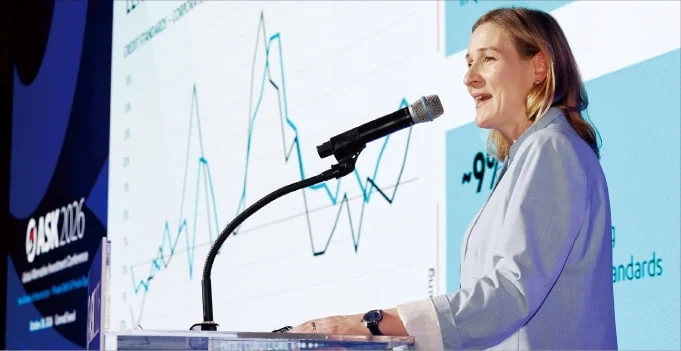
Asset-backed finance, or ABF, was a key topic at the ASK 2026 Global Alternative Investment Conference for the second half, held at Conrad Seoul in Yeouido on Oct. 28. ABF refers to lending based on the cash flow generated by pledged assets. In many cases, loans are structured so creditors regularly collect part of the income produced by the asset, such as exhibition fees from artwork or usage fees from GPUs.
Jay Kim, a partner at Canyon Partners, drew a distinction with conventional corporate lending. In a standard corporate loan, the focus is on whether a company generates enough profit to repay its debt. In ABF, the critical factor is how much income the pledged asset itself produces. Because lenders recoup part of the principal along the way, the risk declines over time.
The ABF market is estimated at $12 trillion. One reason for that growth is a pullback in bank lending. Tony McDermott, head of credit and lending solutions at Arrow Global, said European banks are reducing loans for areas such as real estate development, creating more room for private investors to provide financing. Because bank lending accounts for a larger share of Europe’s credit market than it does in the US, there is more scope for non-bank investors to enter.
Rising investment in artificial intelligence infrastructure is also fueling demand for ABF. Building data centers, GPUs and other AI infrastructure requires huge amounts of capital, and bank loans alone are often not enough. Uday Bishnoi, co-chief investment officer at Sculptor Capital, said investors can still recover their capital from income generated by collateral assets even if a company’s earnings weaken.
The range of assets used as collateral is also widening. Beyond traditional assets such as residential mortgages and auto installment loans, investment targets now include GPUs, aircraft, heavy construction equipment and art. Residential transition loans, or RTLs, which finance the purchase, renovation and resale of aging homes, are also a form of ABF. According to Pimco, about 60% of owner-occupied homes in the US are more than 35 years old. That means demand to repair and upgrade older homes could also present a financing opportunity.
Speakers also stressed the need for safeguards to protect investor capital when losses occur. Kyle McCarthy, a senior vice president at Pimco, said ABF is not a substitute for direct lending but a complement to it. He added that investors should diversify risk by using a range of assets.
Nam Jun-woo and Song Eun-kyung, Korea Economic Daily reporters
njw0825@hankyung.com

Korea Economic Daily
hankyung@bloomingbit.ioThe Korea Economic Daily Global is a digital media where latest news on Korean companies, industries, and financial markets.