Hashed Hosts 'OBA.RUN' Hackathon to Build AI Ecosystem
Summary
- The "OBA.RUN 2nd Hackathon," hosted by Hashed and MarketFit Lab with participation from OpenAI, SK Telecom and Shinhan Card, was held to develop AI services.
- Hashed said the rise of AI agents, open API access and closer developer collaboration have made it increasingly important to build new services and foster an ecosystem.
- Maroo said efforts to combine AI and blockchain are continuing, including through a proposed payments and settlement service built on blockchain infrastructure based on a Korean won stablecoin.
Forecast Trend Report by Period


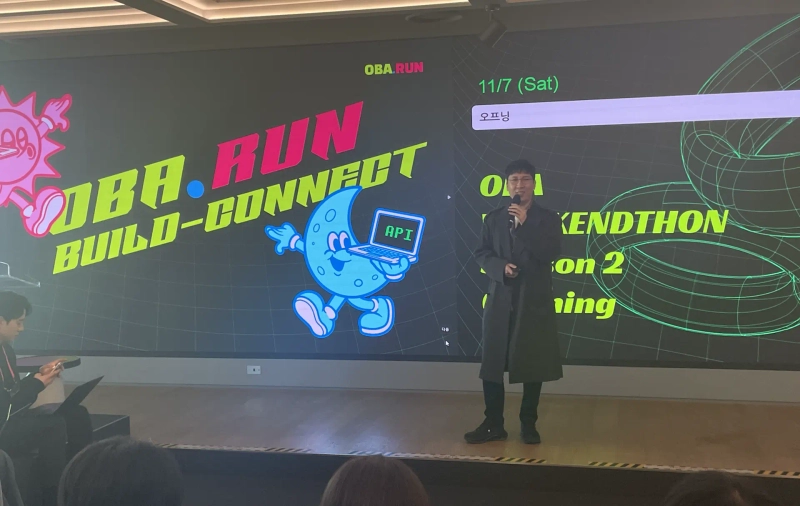
A hackathon bringing together companies and developers to turn ideas into working services was held as advances in artificial intelligence sharply cut the time and cost of building new products.
The "OBA.RUN 2nd Hackathon" was held on November 7 at Hashed Lounge in Seoul's Gangnam district. About 50 builders gathered to develop services using AI agents to handle tasks and even make payments on behalf of users. The event was hosted by Hashed, a global venture capital firm focused on digital assets and frontier technology, and MarketFit Lab, and organized by the Open Builders Alliance, or OBA. OpenAI, SK Telecom, F&F and Shinhan Card supported service development.
The hackathon was structured so participants could build new services over the course of a day using application programming interfaces, or APIs, open-source software and AI tools provided by companies. Participants were free to pitch their own ideas or take on company-backed challenges in areas including finance, payments and fashion.
At the event, Hashed CEO Kim Seo-jun said advances in AI have reduced the time and cost required for service development, opening an era in which anyone can quickly turn an idea into a product. He also said companies need to open their APIs and expand collaboration among developers as AI agents begin using a range of services on behalf of users.
In the US, multiple companies are opening their APIs and establishing related standards. Asia, by contrast, still lacks the open infrastructure and community that developers can use together, Kim said. He added that he hopes the companies and developers gathered at the event will help build that ecosystem and pave the way forward.
Participating companies presented development challenges tied to their businesses and technologies. SK Telecom introduced "Agentic Pay" as a core task, describing a service in which an AI agent understands a user's request and completes the payment. Fashion company F&F proposed an AI service to optimize product displays by store. Generative UI platform GGUI suggested developing AI agents tailored to specific industries. Maroo, which is building blockchain infrastructure based on a Korean won stablecoin, presented a payments and settlement service combining AI agents and blockchain.
The event was designed to let developers build new services using corporate technology while also sharing experience and development know-how with one another. At the first hackathon, some participants went on to start new projects together or launch companies after connecting through the event.
Hashed, a blockchain-focused investment firm, has continued broader efforts to support the AI ecosystem through this event and by operating Nitro, an AI founder and developer community. It is seeking to expand exchanges between developers and founders, widen the overlap between AI and various industries, and support new service development and startup opportunities.
