PiCK
South Korean Chipmakers Brace for ‘Blue Wave’ as US Subsidy Shifts Loom
Summary
- The U.S. midterm election “blue wave” could tighten or delay payment procedures for subsidies and tax credits tied to Samsung Electronics and SK Hynix, the report said.
- Even so, the prevailing view is that AI chip demand and long-term supply agreements (LTAs) will remain intact over the medium to long term without taking a major hit.
- Expectations are rising that the Democrats’ stance in favor of clean-energy investment will create a supportive environment for related industries including batteries and solar power and ESS.
Forecast Trend Report by Period


How a Democratic Sweep in the U.S. Midterms Could Affect South Korean Industry
Subsidies for Samsung and SK Hynix’s U.S. Plants
Payment Procedures Could Expand or Be Delayed
‘No Immediate Hit to Chip Demand’
Battery, Solar Sectors Hope for Green-Energy Revival
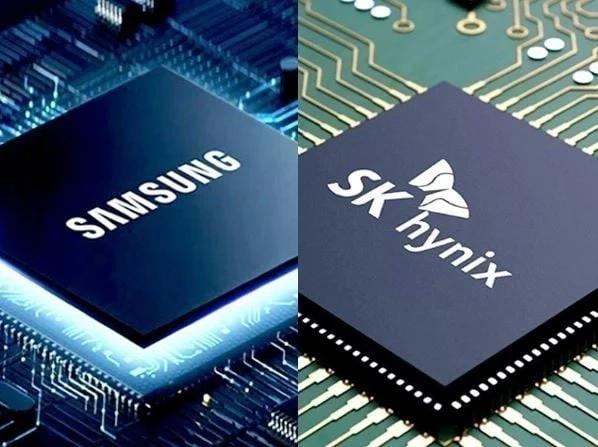
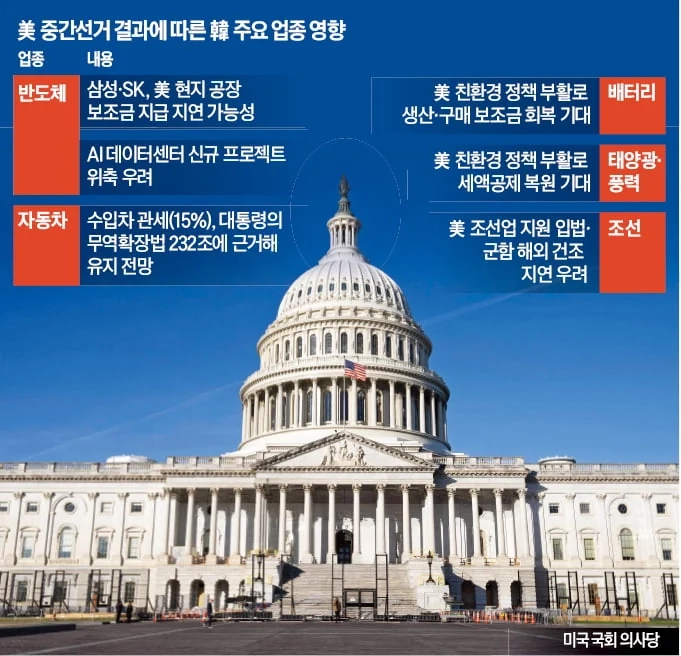
South Korean semiconductor companies are on alert over the fallout from a Democratic “blue wave” that gave the party control of both chambers in the U.S. midterm elections. Samsung Electronics Co. and SK Hynix Inc., which operate factories in the U.S. or are expanding capacity there, could be directly affected by changes to subsidy and tax-credit policies. Even so, some in and around the chip industry say worries about a pullback in artificial intelligence investment are overdone. Containing China’s AI push remains a bipartisan priority in the U.S., fueling the view that AI investment is unlikely to slow sharply. In electric vehicles, batteries and solar power, there is also growing hope that clean-energy investment will regain momentum.
Subsidy Procedures a Variable as Long-Term AI Demand Persists
According to industry officials on Nov. 8, subsidies are the first issue likely to affect Samsung Electronics and SK Hynix after the U.S. midterms. Samsung’s foundry plant in Taylor, Texas, is due to receive phased subsidies of up to $4.745 billion from the federal government and as much as $250 million from the state of Texas under the CHIPS Act. SK Hynix’s fab in Indiana, where construction began in August, is eligible for up to $458 million in subsidies.
Still, procedures tied to subsidy payments, including certification of compliance with environmental regulations, could grow more cumbersome or face delays. KOTRA, the Korea Trade-Investment Promotion Agency, said in a recent report titled “The 2026 U.S. Midterm Election Results and Implications” that a Democratic-controlled Congress would likely strengthen oversight of existing agreements, subsidy execution and the management of funding for research-and-development programs.
Despite concerns about tighter regulation in the U.S., many in the industry do not expect demand for AI chips to weaken sharply anytime soon. Lee Jong-hwan, a professor in the Department of System Semiconductor Engineering at Sangmyung University, said construction of AI data centers may slow temporarily, but U.S. investment in AI cannot retreat if the threat from China becomes more acute. Some long-term supply agreements signed by Samsung Electronics and SK Hynix may be affected, he added, but a major hit remains unlikely.
New investment in data centers is expected to become more selective. Democrats have signaled that companies should bear the cost of AI infrastructure, including electricity and water. Industry participants also say data centers, which create fewer jobs than other large-scale facilities such as factories, could face demands for employment measures. If the cost burden rises, less profitable data-center projects could lose momentum.
Big Tech is already moving to respond. Meta Platforms Inc. is considering expanding existing data centers to avoid complex permitting procedures. Building data-center hubs outside the U.S., including in Asia, is also under discussion. The Wall Street Journal reported that OpenAI Chief Executive Officer Sam Altman told employees after the midterm elections that the company could even consider building data centers in the desert.
‘MASGA’ Policy Seen Staying in Place
The blue wave’s impact on South Korea’s auto industry is likely to be limited. The 15% tariff imposed on South Korean-made vehicles is based on Section 232 of the Trade Expansion Act, placing it under the executive branch rather than Congress. Instead, there is growing expectation of a more favorable environment for electric-vehicle adoption. Democrats are pushing to restore a tax credit for EV purchases that expired in September 2025. The key variable is whether President Donald Trump exercises his veto power.
With Democrats viewed as supportive of green business, battery and solar companies have also gained some relief. Republican efforts to quickly scale back tax credits for battery production in the U.S. and support for investment in energy storage systems, or ESS, are likely to face resistance. Delays in data-center permits may be a burden, but industry participants expect Big Tech to increase ESS capacity and backup batteries for servers to store electricity against shortages and blackouts.
The basic direction of MASGA, a South Korea-U.S. shipbuilding cooperation project, is also likely to remain unchanged. Rebuilding the U.S. shipbuilding industry and strengthening defense capabilities are bipartisan priorities.
Roh Yoo-jung and Yang Gil-sung, Hankyung.com reporters yjroh@hankyung.com

Korea Economic Daily
hankyung@bloomingbit.ioThe Korea Economic Daily Global is a digital media where latest news on Korean companies, industries, and financial markets.