PiCK
Nvidia Soothes AI Investment Fears Without Jensen Huang as Earnings Beat, Outlook Rises
Summary
- Nvidia said third-quarter revenue came in at $115.8 billion and EPS of $2.68, beating market expectations on both counts.
- Nvidia said it raised its fiscal 2028 revenue growth forecast to 75% and that China data-center revenue was not included.
- Nvidia said it will evaluate support and guarantees for investee companies including neocloud operators more strictly and closely review new transactions.
Forecast Trend Report by Period


Third-Quarter Results Top Estimates
2028 Outlook Raised Even Excluding China
Kospi Rises 2% to Reclaim 5,000
A blond woman in a tweed suit stood where the leather-jacketed rock star once did. Nvidia Corp., appearing before investors for the first time in its 33-year history without co-founder Jensen Huang, reported better-than-expected results and stronger growth guidance on Nov. 17 under Interim Chief Executive Officer Colette Kress. South Korea’s Kospi reclaimed the 5,000 level a day later in a relief rally led by heavyweight chip stocks.
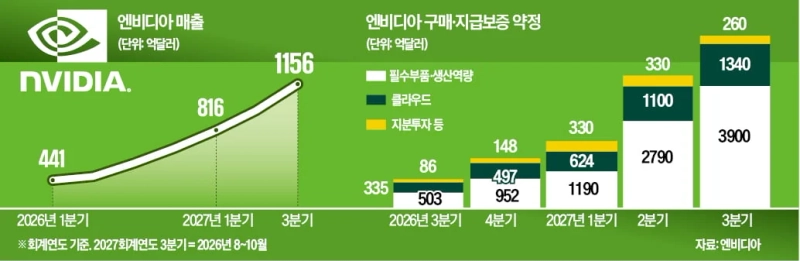
Nvidia said fiscal third-quarter 2027 revenue for August through October 2026 rose 103% from a year earlier to $115.8 billion. That exceeded the market forecast of $109.1 billion by more than $5 billion. Earnings per share came in at $2.68, above Wall Street’s $2.47 estimate.
The key point in the results was the higher growth outlook. Nvidia projected fourth-quarter revenue of $130 billion for November 2026 through January 2027, topping the market expectation of $125.1 billion. It also raised its fiscal 2028 revenue growth forecast to 75% from 70%. The company said the figure does not reflect any China data-center computing revenue, which totaled $2.4 billion in the third quarter.
Kress said results should remain solid even after the US Commerce Department announced new export controls because demand still far exceeds supply.
Nvidia said it will keep existing financing commitments tied to customer funding, including for neocloud operators, while closely reviewing new transactions. The approach reflects concern over both circular-finance risks and tighter funding conditions. JPMorgan described it as a delicate balance. Hanwha Investment & Securities said the likelihood of fresh support may be lower than when Huang was CEO.
Samsung Electronics Co. and SK Hynix Inc. rose 2.3% and 4.2%, respectively. The Kospi closed up 1.99% at 5,067.44, while the Kosdaq gained 1.96% to 662.81.
Nvidia Says It Will Scrutinize Investee Companies More Strictly as ‘AI Central Bank’ Role Shrinks
Record Quarterly Revenue of $115.8 Billion Signals a More Independent Nvidia
“Demand for artificial intelligence hasn’t gone away.”
That was tech investor Dan Ives’s assessment of Nvidia’s quarterly earnings release on Nov. 17, the company’s first without Huang. Interim CEO Kress signaled a pullback in the vendor financing Huang had pushed for AI infrastructure companies even as she raised the projected pace of revenue growth. The result, investors say, is that Nvidia’s post-Huang stand-alone era has begun in earnest.
Still Running Smoothly Without Jensen Huang
Nvidia beat market expectations in fiscal third-quarter 2027 results for August through October 2026 and raised its fiscal 2028 revenue growth forecast for January 2027 through January 2028 to 75% from 70% in the previous quarter. Kress said the earlier 70% outlook had been constrained by supply-chain limits and that the new forecast reflects additional volume the company can now deliver to customers. The figure excludes China data-center revenue.
The rollout of next-generation GPU Vera Rubin also gathered pace. Vera Rubin, the AI chip succeeding Blackwell, began shipping in earnest this quarter. Kress said it is off to an explosive start and that the company’s ambitions are bigger than ever.
Nvidia also increased purchases of parts needed for products including Vera Rubin. Commitments to buy key components and manufacturing capacity rose 40% from the previous quarter to $390 billion, from $279 billion. The increase reflected multiyear long-term memory supply agreements. That has fueled expectations that Samsung Electronics and SK Hynix have secured a substantial amount of HBM business for years. Vera Rubin uses HBM4, the sixth-generation high-bandwidth memory supplied by the two companies, as well as the low-power memory module SOCAMM 2.
An industry official said concerns about slowing AI investment had recently emerged because of the Jensen Huang scandal and other factors, but demand remains strong for memory from Samsung Electronics and SK Hynix. The person added that growth in AI investment could moderate somewhat because of external policy uncertainty, though a sharp reversal in industry conditions appears unlikely for now. Other Nvidia suppliers also got some breathing room. Samsung Electro-Mechanics said on Nov. 17 it had signed an additional semiconductor substrate contract with Nvidia and that Nvidia is reviewing further funding support.
‘Future Investments and Guarantees to Face Stricter Review’
Nvidia’s role as a central bank for the AI ecosystem, backed by its huge cash flow, appears set to shrink. Kress said that as the market matures and new sources of capital become available, Nvidia will apply stricter standards to future investments, commitments and guarantees. The comments suggest the company plans to reduce that role now that Huang has used circular transactions reinvesting Nvidia’s cash flow into customers to help build much of the AI ecosystem.
Support for neocloud infrastructure providers that buy Nvidia GPUs and lease them out is therefore set to become more selective. Kress said funding will be prioritized for neocloud operators that have secured power, land and buildings. In effect, companies without that infrastructure would be excluded from support. She also said Nvidia will check whether neocloud firms with speculative-grade credit ratings of BB or lower have actual contracts in place to sell or lease computing resources to customers.
The shift comes as some neocloud operators face management crises after running into fundraising difficulties. Tesla Chief Executive Officer Elon Musk likened neocloud companies to guppies last month and said more than 200 of them would die.
Some in the market see Kress as beginning an “accounting diet” that would scale back the AI ecosystem investment Huang had expanded. Kress, a finance executive by background, is known to have opposed internally the growing size of circular financing.
Bin Nan-sae and Noh Yoo-jung, reporters; Kim In-yeop, Silicon Valley correspondent, Hankyung.com binthere@hankyung.com

Korea Economic Daily
hankyung@bloomingbit.ioThe Korea Economic Daily Global is a digital media where latest news on Korean companies, industries, and financial markets.