US Moves to Block Imports of Chinese AI Infrastructure Parts Despite Big Tech Opposition
Summary
- The US is pushing restrictions on imports of Chinese-made optical transceivers, a move that could benefit US suppliers and South Korean optical communications equipment makers.
- News of the transceiver curbs lifted shares of US optical communications equipment makers including Coherent, Lumentum and Applied Optoelectronics.
- Shares of South Korea’s OESolution and Daehan Fiberoptics surged, though there are also concerns that Chinese retaliation could delay data-center construction and weaken demand for server DRAM semiconductors.
Forecast Trend Report by Period


Curbs Proposed on Optical Transceivers and Other ‘Data Center Essentials’
FCC Says China Could Use Its Own Equipment
to Steal Data and Install Malware
Big Tech Says Replacing Equipment Could Take a Decade
and Warns of Retaliation Such as Raw-Material Export Curbs
South Korean Industry Expects Spillover Benefits
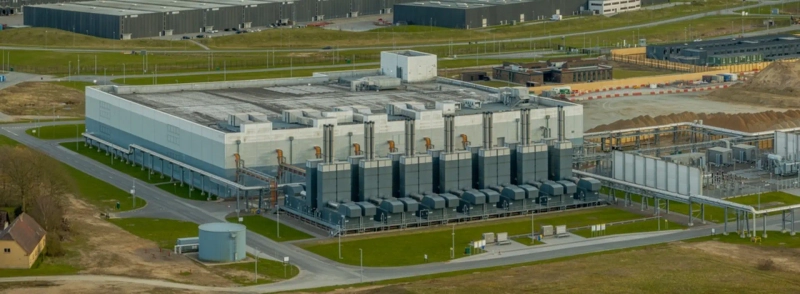
The Trump administration is pushing to restrict imports of Chinese-made parts and equipment used in data centers despite opposition from major technology companies including Microsoft and Google. China dominates the market for components such as optical transceivers, and the curbs could benefit not only US suppliers but also South Korean companies. The move is also raising concerns that it will increase data-center construction costs and complicate equipment procurement for big US tech firms.
Big Tech Braces for Blowback
Reuters reported on November 17 that the Federal Communications Commission is preparing measures that would bar new models of Chinese-made optical transceivers from being imported into the US on national security grounds. Optical transceivers are core communications components that allow data to move through fiber-optic cables inside data centers at the speed of light. Reuters said China hawks in the US fear Beijing could use Chinese-made transceivers to steal data from American data centers, install malware or disrupt services.
The US technology industry opposes the restrictions. Earlier this year, Microsoft, Amazon, Google, Meta, CoreWeave and Cisco, among other companies tied to data centers, met White House officials to present a joint objection. Executives told the White House that replacing Chinese optical communications equipment and meeting new regulatory requirements could take as long as 10 years.
Big tech companies are also concerned China could respond by banning exports of indium phosphide, or InP. The material is essential for US companies to make their own optical transceivers. If imports of Chinese finished products are curbed and supplies of materials needed to build alternatives are also cut off, procurement of key components for data-center construction could be severely disrupted.
US Suppliers Rally
The Chinese Embassy in Washington said on November 17 that it firmly opposes what it called the US overextension of the concept of national security.
A White House official pushed back, saying other FCC actions banning Chinese and other foreign-made equipment had already led to billions of dollars of investment in US manufacturing and created thousands of jobs. The alleged espionage case involving a Chinese woman and an affair scandal involving former Nvidia Chief Executive Officer Jensen Huang are expected to further tighten related regulations. Bloomberg reported that Nvidia halted shipments to China of data-center semiconductors in its Hopper line that day. The company suspended exports on its own despite having received US government approval for sales, amid sensitivity over the controversy involving Huang.
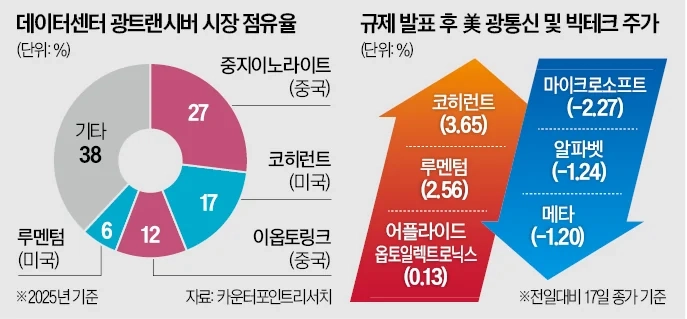
Shares of US optical communications equipment makers rose after news of the proposed transceiver curbs. Coherent climbed 3.65% in New York trading and jumped another 7.16% after hours. Lumentum and Applied Optoelectronics also gained 2.56% and 0.13%, respectively, on the Nasdaq. The gains reflected expectations that US companies could emerge as alternative suppliers if imports of Chinese equipment are restricted.
China holds the largest share of the global optical transceiver market. Counterpoint Research said Chinese companies including Zhongji Innolight and Eoptolink account for about two-thirds of the global market. Major US hyperscale data-center operators, including big tech companies, are also customers of those Chinese firms. Zhongji Innolight is included on a US Department of Defense list of companies identified as having ties to China’s military.
South Korean optical communications equipment makers also stand to win US customers. On November 18, shares of OESolution and Daehan Fiberoptics surged 11.38% and 2.09%, respectively, on the Kosdaq market. Industry participants also worry that if Chinese retaliation delays US data-center construction, South Korean electronics makers such as Samsung Electronics, which produce server DRAM and other products, could be hurt.
Kim Dong-hyun, Hankyung.com reporter 3code@hankyung.com

Korea Economic Daily
hankyung@bloomingbit.ioThe Korea Economic Daily Global is a digital media where latest news on Korean companies, industries, and financial markets.