BOK Raises Rate to 3.25%, Sees 4.1% Growth Next Year on Chip Boom, but Doubts Linger Inside Board
Summary
- The Bank of Korea said it raised its benchmark interest rate to 3.25% and sharply lifted its forecast for next year's growth to 4.1%.
- It said a semiconductor supercycle driven by expanding AI investment would boost exports and investment and lead to a recovery in private consumption.
- It also said differences remain among Monetary Policy Board members over the spillover effects of the semiconductor boom and the likelihood of additional rate hikes, along with concern that the benefits may not spread broadly through domestic demand.
Forecast Trend Report by Period


BOK, after raising rates, sees 4.1% growth next year
Benchmark rate raised 0.25 percentage point to 3.25%
Chip boom to continue, lifting next year's growth forecast sharply from 2.9%
More focus on inflation, signaling one or two additional hikes
Global stock markets have been roiled by mounting doubts about the artificial intelligence industry, but the Bank of Korea took a different view. It said a semiconductor supercycle driven by expanding AI investment will continue next year, helping South Korea post growth of about 4% for a second straight year. Citing the risk that strong growth could stoke inflation, the central bank raised its benchmark interest rate by 0.25 percentage point at its final monetary policy meeting of the year. It also sent a hawkish signal that one or two additional increases could be possible next year.
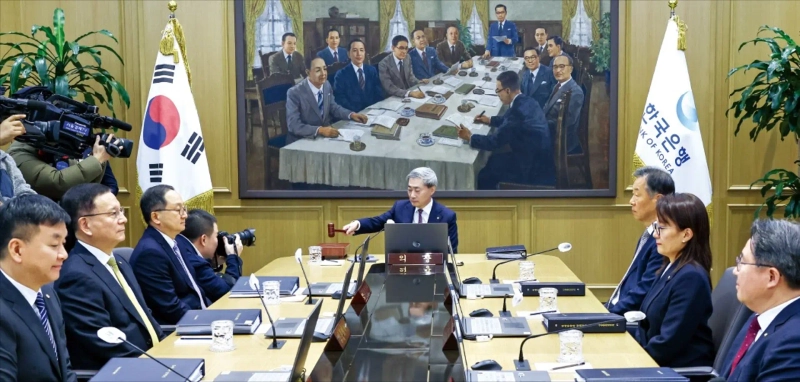
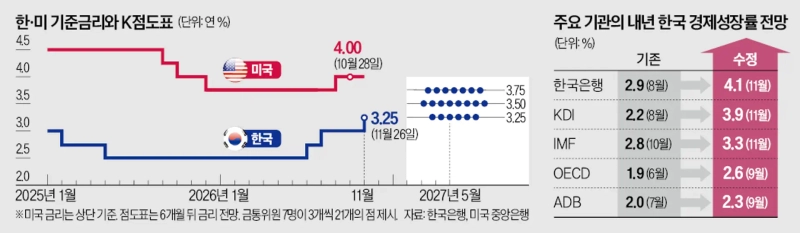
The Bank of Korea held a monetary policy meeting on Nov. 26 and raised its benchmark rate by 0.25 percentage point to 3.25% from 3.0%. It was the third increase this year, following moves in July and August. The policy rate has not stood at 3.25% since November 2024.
The BOK raised rates despite a sharp stock-market correction and weak private consumption because it expects next year's growth to outpace earlier forecasts. In revised economic projections released the same day, it lifted its 2027 growth forecast to 4.1% from 2.9%, a jump of 1.2 percentage points. If realized, that would mark the first time in 20 years, excluding rebounds after the global financial crisis and the Covid-19 shock, that growth topped 4% since 2007, when the economy expanded 5.8%. It also raised this year's growth forecast by 0.6 percentage point to 3.9%.
BOK Governor Shin Hyun-song said worries about the AI industry have been growing, but investment in AI infrastructure will continue, driving strong gains in semiconductor exports and capital spending. That increase in exports and investment, he said, will feed into household income and broaden the recovery in consumption. Prolonged high oil prices also mean the bank needs to put greater weight on inflation stability.
In the BOK's dot plot released on Nov. 26, the median policy-rate view for six months ahead rose to 3.50% from 3.25% in August. Seven dots were also placed at 3.75%, a level absent from the August plot. Even so, divisions emerged among Monetary Policy Board members over how durable the semiconductor boom will be and how far its spillover effects will reach. Board members Hwang Geon-il and Lee Soo-hyung dissented, arguing for no change in rates.
'Chip profits worth $506.5 billion won't disappear; investment and dividends will continue next year and the year after'
Two members dissented in favor of holding rates, reflecting concern that the spread of gains will be limited
Central banks typically lean toward caution rather than optimism when setting economic forecasts. Even when new variables emerge, they usually adjust projections gradually after checking a range of indicators. Against that backdrop, the Bank of Korea raised its growth forecast for next year by 1.2 percentage points in a single move. The bank is betting that a semiconductor supercycle fueled by AI investment will lift not only exports, but also corporate investment, household income and private consumption. Even so, clear differences remain within the Monetary Policy Board over whether the chip boom will spread to domestic demand.
Semiconductor boom lifts growth outlook
The main reason the BOK sharply raised its 2027 growth forecast to 4.1% from 2.9% is its view that the semiconductor upcycle will last through 2028. Shin said the forecast was derived from a broad set of information, including chipmakers' orders and sales proceeds, and should be given meaningful weight. The BOK also sees growth reaching 3.0% in 2028.
The chain-weighted method used to calculate growth also contributed to the higher forecast. Under that approach, the previous year's nominal value-added share by industry is reflected in calculating this year's growth rate. As semiconductor prices climbed, the share of information-technology manufacturing in nominal gross domestic product more than doubled to 24.5% in the second quarter from 10.4% at the end of last year. The BOK estimates that if the IT manufacturing share were fixed at past levels, next year's growth would be around 3.0%. Lee Dong-ryeol, director general of the BOK's Research Department, said applying historical weights could instead understate economic growth.
The BOK said that even if the AI market suffers the worst combination of shocks, the economy would still post growth in the mid-3% range in 2027 and the low-2% range in 2028.
The key question is whether the semiconductor boom will lead to a recovery in domestic demand. Shin spent considerable time on Nov. 26 stressing that the trickle-down effect will begin in earnest next year. Of the 700 trillion won in profits earned by semiconductor companies, or about $506.5 billion, a substantial amount remains in short-term funding markets after corporate taxes, performance bonuses and dividends are paid, he said. But that money will eventually be channeled into investment and dividends next year or the year after. It is not disappearing into a black hole, he said; it is only a matter of time before it returns to the broader economy.
Shin also said that while supply-side inflation pressure remains strong, demand-side pressure is already building as well. All indicators for next year point to stronger private consumption, he added, with private consumption expected to rise 2.4% next year from this year.
The BOK left its consumer inflation forecast for this year unchanged at 2.7%. For next year, it raised the projection by 0.1 percentage point to 2.4%. It expects inflation to converge near its 2% target only in 2028, when it sees consumer-price growth at 2.1%.
A clearer hawk-dove divide inside the Monetary Policy Board
That outlook fed expectations of additional rate increases. In the dot plot, six dots were placed at 3.25%, eight at 3.5% and seven at 3.75% for the benchmark rate six months from now. The median stood at 3.5%, signaling that at least one more increase may be possible. The dot plot reflects three rate projections from each of the seven Monetary Policy Board members, including the governor.
The yield on South Korea's three-year government bond ended trading up 0.039 percentage point at 3.622% on Nov. 26. Yoon Yeo-sam, head of equity strategy at Meritz Securities, said the BOK could raise rates once more in February 2027. For the rate to reach 3.75%, however, the semiconductor trickle-down effect would need to materialize in earnest.
Differences within the board over the durability of the semiconductor boom and the speed and scale of its spillover effects also came into clearer view. Hwang and Lee issued dissenting opinions calling for the benchmark rate to remain unchanged. Questions have persisted over whether the chip boom can spread broadly to jobs and incomes. Because growth is being driven more by higher semiconductor prices than by shipment volumes, the benefits may not easily flow through suppliers and the rest of the economy. There are also concerns that workers outside the semiconductor industry may bear the burden of higher rates without sharing in the gains from the recovery.
Shin said board members spent a great deal of time discussing uncertainty surrounding semiconductors in particular. The wider dispersion in the dot plot could also be seen as reflecting greater uncertainty at home and abroad.
Shim Sung-mi, Korea Economic Daily reporter smshim@hankyung.com

Korea Economic Daily
hankyung@bloomingbit.ioThe Korea Economic Daily Global is a digital media where latest news on Korean companies, industries, and financial markets.