Stocks, Gold and Crypto Are All Falling. Wall Street Sees the Real Rebound After Mid-December
Summary
- Wall Street and Seoul brokerages said the real rebound may come after mid-December, once the Fed signals a slower pace of tightening at the December FOMC.
- Global investment banks said they expect the Fed to eventually stop tightening and begin cutting rates, and presented 2027 S&P 500 targets of 8,200 to 9,000 and Kospi targets of 7,000 to 9,000.
- Institutions advised investors to focus on quality stocks, diversification, and avoiding an all-in semiconductor bet as excess liquidity dries up and higher rates last longer, while refraining from aggressive directional bets until early December.
Forecast Trend Report by Period


Fed vs. the Market: Who Blinks First
Global financial markets are locked in a tense standoff with hawkish central banks, including the Federal Reserve and the Bank of Korea. Stocks, gold, cryptocurrencies and commodities are all falling, while warnings are growing that liquidity is drying up fast. On Wall Street and in Seoul, strategists say markets may only begin to form a floor if the Fed signals a slower pace of tightening at the December Federal Open Market Committee meeting. In their view, the real rebound would come after mid-December, when flow distortions start to ease.
Stocks Catch Their Breath on Holiday Effects and Burry’s Call, but Bottoming Signals Still Fall Short
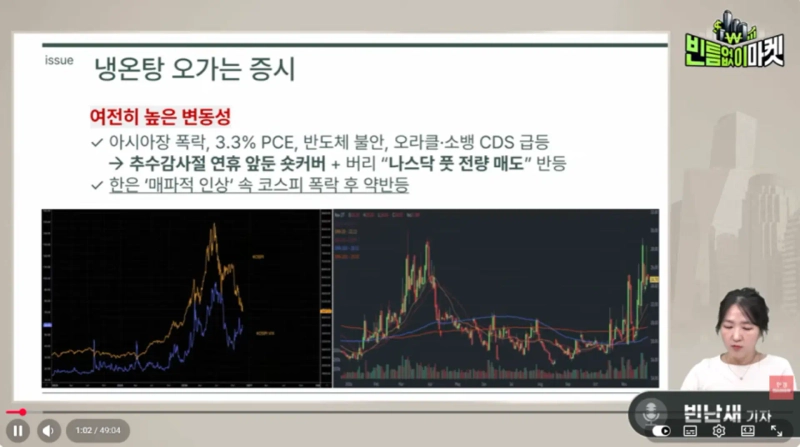
Equity markets in South Korea and abroad have remained highly volatile. The Kospi gave back in a single session all the gains from the so-called Jensen rally. In New York, stocks slumped sharply intraday before recovering much of the loss into the close. The Dow Jones Industrial Average fell nearly 1,100 points during the session before turning positive, while the S&P 500 and Nasdaq finished down less than 1% after sliding 3% to 4% at one point.
The late rebound on Wall Street was driven in part by lighter trading ahead of the U.S. Thanksgiving holiday, with markets closed on Nov. 26 and shutting early on Nov. 27, as well as short covering. Since 1960, the S&P 500 has risen eight times out of 10 on the day before Thanksgiving. Investor sentiment also steadied after Michael Burry, whose bets inspired the film “The Big Short,” said he had closed out all put options tied to a Nasdaq 100 decline and was temporarily “all long.” He still holds put options on Palantir and MetLife, however, and added that Nvidia may look cheap at current levels but he would consider shorting it again near $200.
In South Korea, by contrast, stocks surrendered most of an intraday rebound of nearly 3% and ended just 0.3% higher as foreign investors turned net sellers. The Bank of Korea’s rate increase, along with its signal that further hikes next year remain possible, hurt appetite for risk assets.
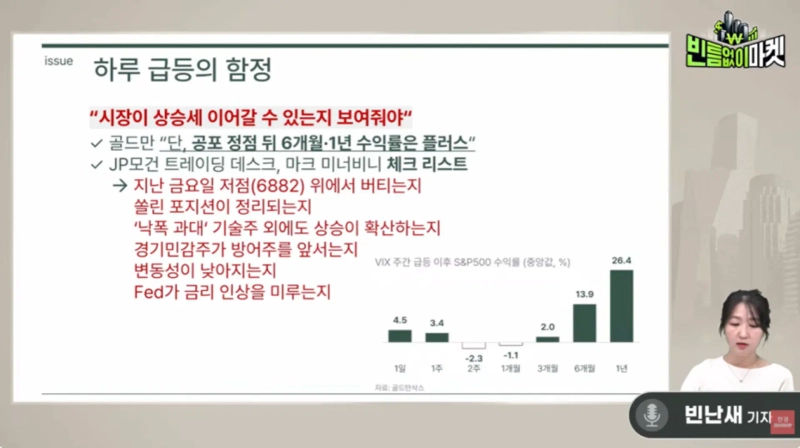
Strategists broadly agree it is too early to call this rebound the real bottom. Technical and sentiment indicators used to confirm a floor remain unstable.
·Volatility remains elevated: The VIX, often called Wall Street’s fear gauge, has retreated to 24.7 from around 30. Even so, it remains above 20, a level often viewed as a threshold for market stability. Kospi volatility is also high.
·Support levels are broken and market breadth is thin: The Nasdaq 100, the S&P 500 and the Kospi have all fallen below their 200-day moving averages. Investors now need to see whether the previous lows in the S&P 500 at 6,882 and the Kospi in the low-4,600 range hold. Fundstrat’s Mark Newton wrote that a healthy rebound would require at least two sessions in which advancing stocks or trading volume top 90%. That has failed to happen over the past two days, and order books remain thin.
·Forced selling may not be over, while inflation and credit fears linger: Hedge funds have shed a substantial amount of exposure, but long-term investors remain concentrated in artificial-intelligence technology stocks. Continued inquiries from institutional investors about when to buy the dip suggest true panic selling has not fully run its course. Newton still sees room for a retest of the lows through the first week of December and said the S&P 500 would need to reclaim 7,350 for investors to feel more comfortable. Goldman Sachs also urged caution on bottom-fishing after October core personal consumption expenditures inflation came in above forecasts, cementing expectations for a December rate increase at the Dec. 9-10 FOMC and lifting the odds of another move in January next year to 60%. It also cited a widening of nearly 70 basis points in high-yield bond spreads since early October, driven by names such as CoreWeave and Oracle.
“The Effect of Four Rate Hikes Is Already Here” — the Market’s Warning to Central Banks
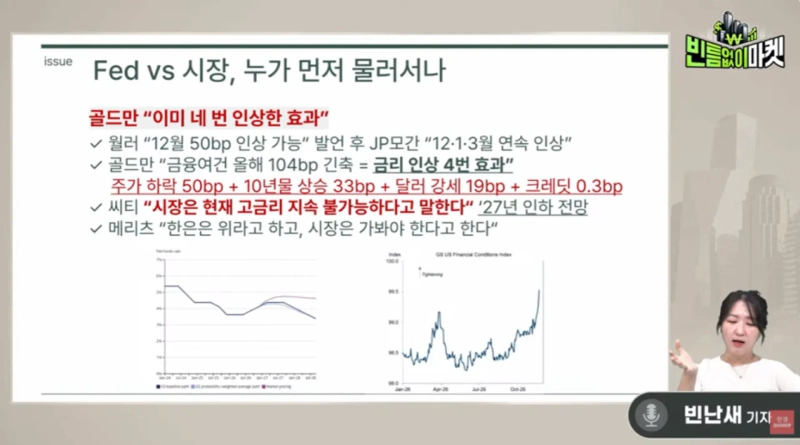
Monetary policy remains the biggest force weighing on markets. After Fed Governor Christopher Waller raised the possibility of a 50-basis-point move in December, major Wall Street banks including JPMorgan, Bank of America and Deutsche Bank revised their outlooks to three consecutive rate increases in December, January and March. JPMorgan had previously expected only one increase in December.
The problem is that financial conditions are already extremely tight. Goldman Sachs estimates that this year’s stock-market slump, the rise in the U.S. 10-year Treasury yield and the stronger dollar have together produced a tightening effect equal to 104 basis points. That is roughly equivalent to four 25-basis-point rate hikes. Conditions have deteriorated sharply since late October, and the stock decline alone has generated a tightening effect of about 50 basis points.
Investors are increasingly pushing back on the idea that rates can keep rising under those conditions. Citigroup said in a recent report that the equity selloff itself signals current rates are already unsustainably high, and that while the Fed may still raise rates in December, it will eventually have no choice but to cut them next year. Bank of America said the S&P 500 would need to erase all of this year’s gains before the Fed abandons further tightening, underscoring the tug-of-war between policymakers and markets.
A similar struggle is unfolding in South Korea. The Bank of Korea raised its benchmark rate to 3.25%, the highest in about two years, and its dot plot signaled room for additional hikes next year to 3.5% to 3.75%, along with an upward revision to its growth outlook. Yoon Yeo-sam, an analyst at Meritz Securities, said a sharp deterioration in financial conditions caused by falling stock prices and persistent uncertainty over the semiconductor cycle, a key growth driver, may make further hikes next year difficult despite the BOK’s intentions.
2018 Déjà Vu and Kevin Warsh’s Dilemma: Two Conditions for a Pivot
Wall Street is increasingly drawing parallels between the current market and 2018, the second year of Donald Trump’s first term. Back then, stocks tumbled after the midterm elections as the Fed kept raising rates, before rebounding the following year when then-Chair Jerome Powell signaled a pause, or pivot.
By coincidence, current Fed Chair Kevin Warsh co-wrote a Wall Street Journal opinion piece in 2018 with Stanley Druckenmiller under the headline that the Fed should not be tightening at that point. Warsh argued then that relying only on lagging indicators such as employment and growth to justify rate hikes risked damaging the economy, and that policymakers should pay attention to warnings from stocks and credit spreads. After the Fed went ahead with a rate increase, the S&P 500 fell 6% over four to five sessions into Christmas Eve.
Warsh is hawkish on inflation and critical of quantitative easing, but he also believes in the productivity gains from AI. At the October FOMC, he said it is not the Fed’s job to “throw sand into the economic engine.” Unlike in 2018, when inflation was in the 2% range, price growth is now in the 3% range, leaving him in a dilemma that makes a pause harder to deliver.
The market’s preferred scenario is a dovish hike at the December FOMC — a 25-basis-point increase paired with a signal that the pace of tightening will slow. Druckenmiller, a mentor to both Warsh and Treasury Secretary Scott Bessent, has also shifted from a fully long position in January this year to neutral net equity exposure and a short copper position, effectively pressuring the Fed by signaling concern over a slowdown in the second half of next year.
So what would force the Fed to retreat from its tightening stance? Wall Street Journal reporter Nick Timiraos and former Boston Fed President Eric Rosengren have argued that a stock-market correction alone will not move the Fed. The key variables are credit markets and inflation.
·Credit spreads: Spreads on speculative-grade, or junk, corporate bonds are now well above their median levels of the past three years. But spreads on BBB-rated bonds, the lowest rung of investment grade, are still around their three-year median and remain below levels seen during last year’s tariff shock. That gives the Fed room to conclude the economy is not yet at a breaking point. If yields on BBB corporate debt also surge and concerns about a chain of defaults intensify, policymakers would have little choice but to change course.
·Slowing inflation: The prevailing view is that the sharp drop in oil prices after the October midterm elections will begin feeding into November inflation data, easing price pressures. Goldman Sachs, which sees PCE inflation at 2.3% by the end of next year, and UBS, which forecasts 2.4% to 2.5%, both expect inflation has passed its peak. John Williams, president of the New York Fed, has also indicated that arguing for a 50-basis-point increase based only on backward-looking data would be excessive.
If Treasury yields and credit spreads both fall from here, stocks could rebound on expectations of a soft landing. If yields fall but spreads keep widening, the move would more likely be read as a recession signal and offer little support for equities.
Why Stocks, Gold and Crypto Are Falling Together: Excess Liquidity Is Drying Up
One striking feature of the recent correction is that even gold, a traditional haven, has dropped alongside stocks, cryptocurrencies and copper. That points less to a straightforward flight to safety than to a liquidity squeeze in which investors are selling whatever they can because cash itself is becoming scarce.
Bloomberg columnist Simon White has focused on an “excess liquidity” gauge that subtracts economic growth from real money-supply growth across the 10 largest economies. Excess liquidity, or spare cash left over after the economy has absorbed what it needs, tends to lead stocks by three to six months. White argues the measure began falling sharply in May, helping trigger deleveraging and equity-market corrections after late June. Unlike in past cycles, big technology companies are now pouring money into heavy real-world capital expenditures, including AI semiconductors, land and data-center construction, rapidly absorbing liquidity that might otherwise have flowed into risk assets. By that logic, a less hawkish Fed is also essential to reversing the trend.
2027 Outlook and Sector Strategy: Avoid an All-In Semiconductor Bet, Diversify Into Quality
With the exception of JPMorgan, which still expects three straight rate increases, Wall Street and South Korean brokerages broadly believe the Fed will ultimately be unable to tolerate a recession and a sharp market slide and will have to stop tightening. Citigroup expects rate cuts in June next year. Goldman Sachs sees hikes in December this year and March next year, followed by cuts in December next year. Meritz Securities expects cuts could come by the end of next year, while Mirae Asset Securities sees the Fed on hold next year. Both anticipate U.S. 10-year Treasury yields will stabilize at lower levels.
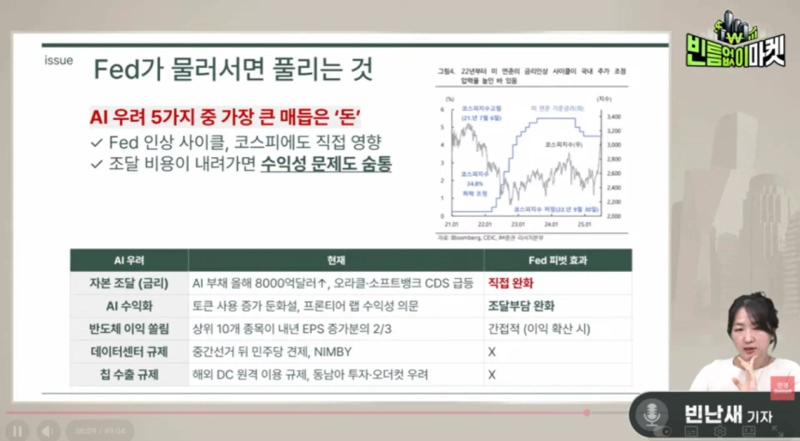
Against that backdrop, global investment banks are projecting the S&P 500 at 8,200 to 9,000 in 2027, with Deutsche Bank at 9,000, Goldman Sachs and Morgan Stanley at 8,700, and JPMorgan and UBS at 8,200. For the Kospi, South Korean securities firms are mostly targeting 8,000 to 9,000, while Goldman Sachs and JPMorgan expect levels in the 7,000s. If the Fed changes direction, funding pressures on AI companies would ease, buying them time until clearer monetization metrics emerge amid concerns about slowing token usage and debate over profitability after Anthropic’s listing.
Even so, caution is growing around an all-in bet on semiconductors. JPMorgan listed as one of next year’s risks a market structure in which memory-chip makers capture margins as high as 80%. A surge in memory prices could hit smartphone and PC demand and also undermine profitability at AI model and service companies with less financial firepower. No order cuts have emerged yet, but stock gains on the scale seen in past cycles may be difficult to repeat.
The common advice from institutions is to concentrate portfolios in quality names that can withstand higher rates for longer — companies with strong free cash flow, solid balance sheets, low leverage and robust shareholder returns.
“The Real Rebound Starts After Dec. 15” — Final Pain in a Bull-Market Correction
From a flow and seasonality perspective, the worst phase may be nearing an end. Goldman Sachs said mechanical trend-following funds, or CTAs, sold $70 billion of global equities over the past week. It expects additional selling next week to mark the peak, with flow distortions starting to unwind in early December. Data going back to 1928 show that 80% of year-end Santa-rally gains have come after Dec. 14. Combined with the December FOMC schedule, that suggests the period around Dec. 15 could mark the real point for confirming a bottom and starting a rebound.
Moon Nam-joong, an analyst at Daishin Securities, said in a recent report that the current market is not a recession-driven or financial-crisis-style bear market, but rather a correction within a bull market caused by valuation pressures and Fed tightening. Such corrections typically take one to three months to recover from. Until investors see the outcome of the early-December FOMC, he said, they should avoid aggressive directional bets and ride out this final bout of turbulence with a cautious, fundamentals-based approach.
Bin Nan-sae, Hankyung.com reporter binthere@hankyung.com

Korea Economic Daily
hankyung@bloomingbit.ioThe Korea Economic Daily Global is a digital media where latest news on Korean companies, industries, and financial markets.