Biotech, Robotics and Battery Shares Soar as Kosdaq Jumps 8.13%
Summary
- Reports that the government is reviewing an increase in the stock-market stabilization fund sent the Kosdaq index up 8.13% and the Kospi index up 4.34%.
- Gains spread across biotech, robotics, secondary batteries and semiconductors, with shares such as Rainbow Robotics, Alteogen and EcoPro BM posting sharp advances.
- Still, caution persisted as investors pointed to the Taiwan market example, weakness in bank stocks and concerns that the stabilization fund’s effect may be short-lived, making it too early to call a sustained rebound.
Forecast Trend Report by Period


Kosdaq surges on hopes for bigger market-stabilization fund
Index reclaims 700 after 8% jump; Kospi rises more than 4%
This article was published on Hankyung Premium 9, the Korea Economic Daily’s paid investment platform. More stock-market coverage is available to subscribers at Hankyung Premium 9 (www.hankyung.com/premium9).
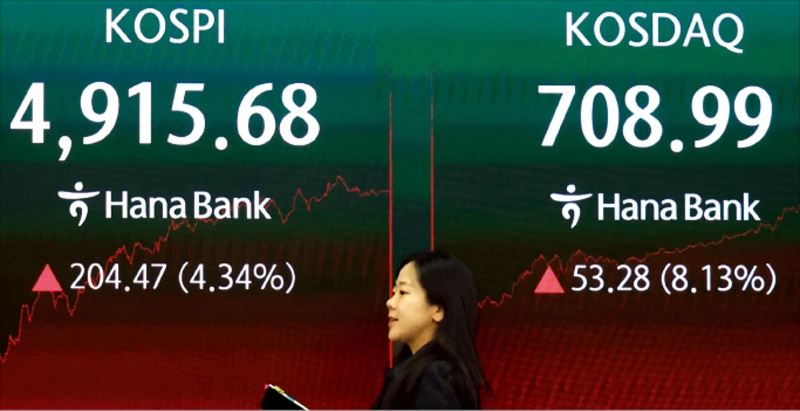
South Korea’s Kosdaq index surged more than 8% on Nov. 27 on expectations that the stock-market stabilization fund will be expanded. The Kospi also rose more than 4% to reclaim 4,900. With U.S. markets closed for Thanksgiving, foreign and institutional investors were net buyers of more than 2 trillion won ($1.44 billion) of stocks across the country’s two main equity markets.
The Kosdaq closed up 8.13% at 708.99 on Nov. 27. It was the biggest gain since July 31, when it climbed 11.63%, and the strongest daily advance in about four months. A buy-side sidecar was triggered briefly during the morning session. The Kospi finished 4.34% higher at 4,915.68.
Investor sentiment revived quickly after the government began preparations on Nov. 24 to activate the market-stabilization fund and then reviewed whether to increase its size. The market expects the government to raise the fund from the current 10 trillion won ($7.23 billion) to 20 trillion won to 40 trillion won ($14.5 billion to $28.9 billion).
Kosdaq Jumps 8% on Tailwind From Review of Bigger Stabilization Fund
Foreign, Institutional Buying Lifts Index by Most in Four Months
South Korean stocks rebounded sharply on expectations that the market-stabilization fund will be deployed. The Kosdaq, helped by bargain hunting and hopes for policy support, vaulted back above 700 after an 8% rally. Still, some investors remain cautious about calling a sustained recovery after Taiwan’s market delivered only a brief rebound following state support, with several major external risks looming next month.
Broad-Based Surge Across Sectors
The Kosdaq ended trading on Nov. 27 up 53.28 points, or 8.13%, at 708.99. Based on the closing level, it marked the biggest jump since July 31, about four months ago. A buy-side sidecar was triggered at about 10:26 a.m. The Kospi also rose 204.47 points, or 4.34%, to close at 4,915.68.
Foreign and institutional investors turned net buyers in both markets for the first time in three sessions. On the Kosdaq, institutions bought a net 586.7 billion won ($424 million), the most since Sept. 10, while foreigners bought 383.7 billion won ($277 million), the most since July 7. On the main Kospi board, foreigners bought a net 1.4233 trillion won ($1.03 billion) and institutions bought 199.5 billion won ($144 million), helping lift Samsung Electronics, which rose 4.55%, and SK Hynix, which gained 5.41%. Expectations that part of Samsung Electronics’ total 30 trillion won ($21.7 billion) dividend payout would be reinvested also supported demand.
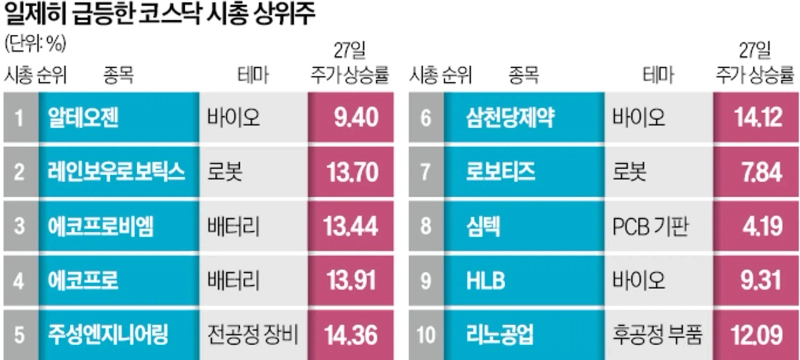
Unlike the August-September rally, which was largely confined to semiconductor materials, parts and equipment makers, Thursday’s rebound spread across biotech, robotics, secondary batteries and the broader chip sector. All but one of the top 70 stocks by market capitalization on the Kosdaq rose. Rainbow Robotics jumped 13.70% to close at 531,000 won, cementing its position as the market’s No. 2 stock by value at 10.3013 trillion won ($7.45 billion). Other large robot stocks including Robotis, up 7.84%, and Hyundai Movex, up 17.33%, have rallied about 30% this week as investors priced in expectations for CES 2027 in January next year.
In biotech, Alteogen rose 9.40% to 186,300 won after receiving 53.8 billion won ($38.9 million) in technology-license fees from MSD for its subcutaneous formulation technology for Keytruda. Peptron also surged 15.66% after signing a technology evaluation agreement with Ferring. Secondary-battery names such as EcoPro BM, which climbed 13.44%, and semiconductor materials and equipment shares including Jusung Engineering also advanced.
First Purchases in 18 Years May Be Near, but Watch for a Short-Lived Bounce
The market-stabilization fund was the main catalyst behind the rebound in sentiment. South Korea’s financial authorities will hold an emergency meeting of the investment management committee on Nov. 29, followed by an emergency market-stability review meeting on Nov. 30 chaired by Financial Services Commission Chairman Lee Eok-won, with the heads of the country’s five largest financial holding companies and Korea Development Bank set to attend. Officials are discussing a plan to increase the fund, which has maintained commitments worth 10.76 trillion won ($7.78 billion) since 2020, to around 20 trillion won to 40 trillion won ($14.5 billion to $28.9 billion) and put it into operation. If the fund begins buying stocks, it would mark the first such intervention since the 2008 global financial crisis.
As purchases of exchange-traded funds tracking the Kospi 200 and Kosdaq 150 emerged as the most likely approach, buying concentrated in large-cap Kosdaq stocks that had fallen sharply and seen margin balances decline. Lee Kyung-min, an analyst at Daishin Securities, said gains in U.S. equity index futures, a turn in foreign buying and hopes for the stabilization fund combined to drive the rally. By contrast, bank stocks including KB Financial Group and Shinhan Financial Group weakened on concern that unpaid capital commitments would be partly reflected in risk-weighted assets, increasing pressure on common equity tier 1 capital ratios.
Skepticism also remains over whether policy support alone can produce a sustained rebound. According to the Korea Capital Market Institute, Taiwan’s stock market rose 10.01% in the first week after authorities approved the activation of the National Financial Stabilization Fund on Nov. 6, but had given up all of those gains by Nov. 25 as foreign selling continued. Lee Hyo-seop, a senior research fellow at the institute, said the execution standard should be based on market trading functions rather than the size of the index decline. Focusing too heavily on defending a specific index level could quickly drain available resources, he added.
Han Ji-young, an analyst at Kiwoom Securities, said the effect of the stabilization fund may be limited to reducing short-term volatility unless concerns ease over delays in monetizing artificial intelligence and cuts in capital spending.
Jeon Beom-jin, Korea Economic Daily reporter forward@hankyung.com

Korea Economic Daily
hankyung@bloomingbit.ioThe Korea Economic Daily Global is a digital media where latest news on Korean companies, industries, and financial markets.