

News 8
Summary
- Dollar stablecoin issuer Circle's stock price has fallen 74.1% compared to its all-time high.
- Global macro headwinds and rate cuts are said to worsen Circle's profitability.
- Concerns over USDC market share decline and new businesses such as Arc will determine Circle's stock rebound.
Circle, plunges 74% from peak
Investor sentiment plunges amid global macro headwinds
Rate cuts and intensified competition are also burdening factors
New businesses such as Arc likely to determine rebound

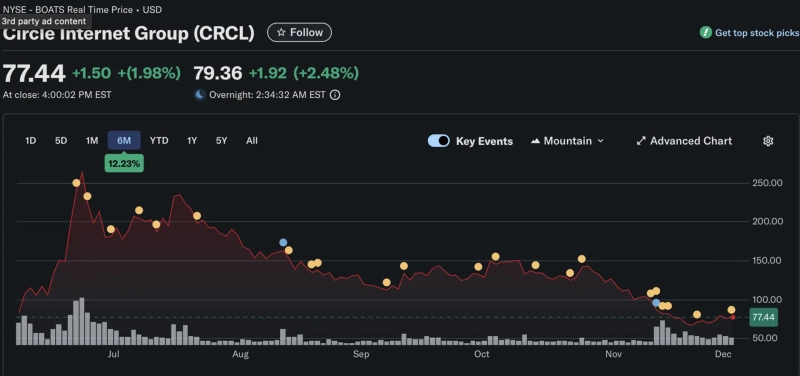
The share price of dollar stablecoin issuer Circle continued to decline, falling back to its initial listing price. Riding on positive developments such as expectations of passage of the U.S. stablecoin law 'Genius Act', it drew attention as this year's major IPO, but it has been pointed out that it failed to meet investors' expectations.
On the 2nd (local time), Circle closed on the New York Stock Exchange at $77.44, up 1.98% from the previous day. Although it closed higher that day, this is a 74.1% decline compared to its record high ($298.99) recorded on June 23.
Earlier, Circle listed on the New York market on June 5 at $69.00. At the time of listing, U.S. President Donald Trump's pro-crypto policies and expectations of the Genius Act's passage combined to make it a standout in this year's U.S. IPO market.
However, after struggling for several months post-listing, it recorded an intraday low of $64.20 on the 20th of last month — a figure close to the initial low of $64 recorded on the first day of listing. Hong Seong-wook, a researcher at NH Investment & Securities, explained, '(Circle's stock price) experienced an exaggerated early pricing-in of expectations, and as the market entered an overall correction phase, the decline widened.'
Strong results for the third quarter did not prevent the stock's weakness. In the third quarter, Circle posted revenue of $740 million and net income of $214 million. Revenue and net income increased by approximately 65.9% and 300% year-on-year, respectively. Earnings per share (EPS) were $0.64, well above Wall Street's estimate of $0.19.
Despite the strong results, analysts say multiple factors contributed to Circle's stock underperformance. First, global macroeconomic uncertainty triggered by recent developments over the past one to two months — such as the U.S.-China tariff war, yen-carry trade liquidation concerns, and a potential U.S. federal government shutdown — acted as negative factors.
U.S. rate cuts are also a negative
Risk-asset aversion that spread across asset markets added fuel to the decline. In particular, the crypto market suffered a steeper decline than global equities, as the liquidity drain from large-scale liquidations on October 10 continued to have an effect.
Specifically, the price of Bitcoin (BTC), often considered the leading crypto asset, is down about 20% from its peak. Major altcoins such as Ethereum (ETH) experienced larger declines than Bitcoin. Worsening crypto sentiment raised concerns about reduced demand for stablecoins — which function as cash within the market — negatively affecting Circle as well, analysts say.
A Federal Reserve interest rate cut — which could be positive for the crypto market — is negative for Circle. Circle holds a large amount of U.S. Treasuries as reserves for USDC. If rates fall, the yields on those Treasuries decline, worsening Circle's profitability. Researcher Hong said, 'Most of a stablecoin company's revenue comes from bonds accumulated to back stablecoin issuance,' adding, 'Rate cuts can directly lead to reduced earnings.'
Concerns over "USDC market share decline"
Intensifying market competition is also cited as a factor weakening investor sentiment. Reports that global fintech firms and major exchanges are entering or preparing to enter the dollar stablecoin business have raised concerns that USDC's market share could be shaken.
In fact, U.S. investment bank Compass Point downgraded Circle to 'sell' in July, citing intensified stablecoin competition and the possibility of overvaluation. Researcher Hong said, 'If the Genius Act is enacted, many financial firms and fintech companies could issue stablecoins,' adding, '(However) at present, concerns that USDC will lose market share are an overinterpretation.'
Market participants say Circle's new businesses will determine whether its stock rebounds. Circle is pursuing diversification of revenue models through new businesses such as the USDC-optimized blockchain network 'Arc (Acr)' and the distribution infrastructure 'CPN (Circle Payments Network)'. In particular, Arc has already released a test version and is scheduled for official launch next year.
Researcher Hong said, 'Considering the case where Tron (TRX) grew into a Tether (USDT)-centric blockchain and formed a market cap of $26 billion, Arc could also contribute to Circle's corporate value,' predicting, 'The performance of an Arc token could act as a positive for Circle's stock.'

nineteen
nineteen@bloomingbit.ioHello, I'm a reporter at bloomingbit